DLR Logo
Sonntag, 14.03.2010
 
Fontsize: [-] Text [+]
Neuigkeiten und Bekanntmachungen
des Instituts für Aerodynamik und Strömungstechnik

"AIAA - INTERNATIONAL COOPERATION AWARD 2009" für Prof. Dr.-Ing. Dietrich Hummel und Dr. John E. Lamar


5. Mai 2009 – Reston, Va.
Prof. Dr.-Ing. Dietrich Hummel ist dem Institut für Aerodynamik und Strömungstechnik seit Jahrzehnten wissenschaftlich verbunden. Bis zu seiner Pensionierung war er seit mehr als 40 Jahren am Institut für Strömungsmechanik an der TU Braunschweig tätig, über einige Jahre auch als kommissarischer Leiter des Instituts. Der wissenschaftliche Schwerpunkt seiner Forschungen liegt in der Aerodynamik von Flügel-Konfigurationen mit wirbeldominiertem Strömungsfeld. Seine Verdienste für das DLR spiegeln sich in zahlreichen Promotionen wider, die unter seiner wissenschaftlichen Leitung erfolgreich abgeschlossen wurden. Darüber hinaus unterstützt Prof. Hummel mit seinem Fachwissen das Institut für Aerodynamik und Strömungstechnik in der Ausrichtung und Durchführung von wissenschaftlichen Projekten auf nationaler und internationaler Ebene.
Vollständiger Artikel

C²A²S²E - Newsletter Ausgabe 01 (März 2009) veröffentlicht


22. April 2009
Die aktuelle Ausgabe des Newsletters finden Sie unter "Abteilungen > C²A²S²E > C²A²S²E Newsletter" oder klicken Sie einfach hier...
Vollständiger Artikel

C²A²S²E - Hochleistungsrechner für die Luftfahrtforschung beim DLR in Betrieb genommen


13. Mai 2008 - C²A²S²E - Flugzeuge aus dem Computer
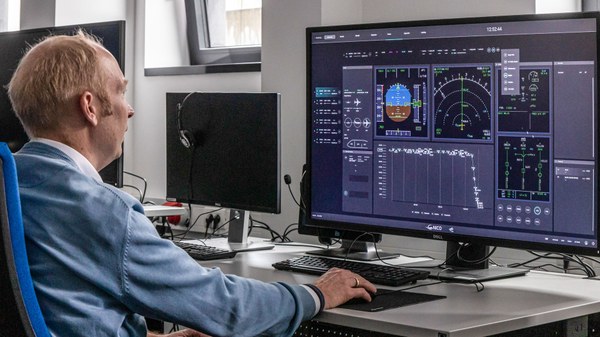
Einen Hochleistungsrechner für die Luftfahrtforschung hat das Deutsche Zentrum für Luft- und Raumfahrt (DLR) heute im Simulationszentrum C²A²S²E (Center für Computer Applications in AeroSpace Science and Engineering) in Braunschweig in Betrieb genommen. Der Rechner ist das Kernstück des Simulationszentrums und Europas schnellster Hochleistungsrechner für die Luftfahrtforschung. Damit beginnt, nach nur sieben Monaten Vorlaufzeit, die Forschung in einem der anspruchsvollsten Projekte der Luftfahrtforschung.
Vollständiger Artikel

C²A²S²E - Flugzeuge aus dem Computer


29. Mai 2007
Mit der heute erfolgten Vorstellung des Projektes C²A²S²E (Center for Computer Applications in AeroSpace Science and Engineering) wurde am Standort Braunschweig des Deutschen Zentrums für Luft- und Raumfahrt (DLR) die Grundlage für eines der anspruchsvollsten Projekte in der aktuellen Luftfahrtforschung gelegt. Aufgabe des Projektes ist es, Prozesse, Methoden und numerische Verfahren so weit zu entwickeln, dass sie eine hochgenaue Simulation des fliegenden Flugzeugs im gesamten Flugbereich ermöglichen.
Vollständiger Artikel

HPC-Cluster im Institut für Aerodynamik und Strömungstechnik


seit dem 04.10.2005 betreibt das Institut AS einen HPC-Cluster
Seit dem 04.10.2005 betreibt das Institut für Aerodynamik und Strömungstechnik ein Cluster-System zur numerischen Strömungssimulation. Das Cluster besteht mittlerweile aus 210 Rechenknoten mit insgesamt 516 Prozessorkerne und 1 TB Hauptspeicher. Das Clustersystem erreicht die beachtliche Leistung von 2,5 TFlops und ist damit eines der größten PC-Clustersysteme im Forschungsumfeld der Region Braunschweig.
Vollständiger Artikel

Webseite des DLR-Instituts AS im neuen Design online


3. März 2006
Die Internetpräsentation des DLR-Instituts für Aerodynamik und Strömungstechnik wurde in den letzten Monaten neu gestaltet. Auf den ersten Blick ist das neue, moderne und optisch gefällige Deisgn zu erkennen. Aber auch an der Strukturierung der Inhalte und an den Inhalten selber wurde gearbeitet.
Vollständiger Artikel
Aktuelle Veranstaltungen und Kolloquien

INSTITUTS-KOLLOQUIUM AS-GÖ


Freitag, 19. März 2010; 11.30 Uhr
Vortragender: Martin Grabe, AS-RF Thema: Zur Charakterisierung der Patterson-Sonde mit gaskinetischen Simulationsverfahren Zeit: Freitag, 19. März 2010; 11.30 Uhr Ort: Ludwig-Prandtl-Saal, Haus 7
Vollständiger Artikel

Joint Symposium of DFG FOR 1066 and DLR-Airbus C²A²S²E: “Simulation of Wing and Nacelle Stall”


22-23 June 2010 in Braunschweig, Germany : Symposium Co-Chairmen: Prof. R. Radespiel and Prof. N. Kroll
Reliable simulations of flow separation on airfoils, wings and powered engine nacelles at high Reynolds numbers represent great challenges in defining suitable mathematical models, computing numerically accurate solutions and providing comprehensive experimental data for the validation of numerical simulations. Additional scientific problems arise from the need to consider airframe-engine interactions and inhomogeneous onset flow conditions as real aircraft operate in atmospheric environments with sometimes ...
Vollständiger Artikel

Symposium : CFD on Future Architectures - Many-Cores, GPUs, FPGAs, ...


14th and 15th of October 2009, C²A²S²E - Center of Computer Applications in Aerospace Science and Engineering DLR Braunschweig, Hermann-Blenk-Saal
Vollständiger Artikel

25 Years of Particle Image Velocimetry in Aerodynamics


September 23 - 25, 2009, DLR-Göttingen
The twenty fifth return of the day when the first PIV measurements in a wind tunnel have been performed in Göttingen is considered to be a good opportunity to commemorate the early developments of the PIV technique and to contrast the technical possibilities of those days to the state-of-the-art of PIV today.
Vollständiger Artikel

20th Liepmann-Ludwieg-Seminar


May 04, 2009, DLR-Göttingen
The annual "Liepmann-Ludwieg Seminar" was established in 1987 by the Graduate Aeronautical Laboratories, GALCIT, and the German Aerospace Center, DLR. It was ideated by the former director of GALCIT, Prof. Hornung, with the aim of fostering international cooperation among young scientists working in the field of fluid mechanics. (Further information: http://www.as.dlr.de/LLS/)
Vollständiger Artikel

3rd PSP Course - Application of Pressure Sensitive Paint - Theory and Practice


September 7 - 11, 2009, Göttingen
For investigations of pressure distributions on wind tunnel model surfaces with high spatial resolution new experimental techniques, such as Pressure Sensitive Paint (PSP) are required. Using this non- intrusive optical pressure measurement technique, spatial structures and/or rapid temporal or spatial changes of aerodynamic phenomena (transition from laminar to turbulent flow, coherent structures, pitching airfoils in transonic flows with shocks, rotors, test facilities with short run time and different flow temperature etc.) can be investigated. The PSP technique has also expanded from the measurement of steady state pressures to include both periodic and unsteady phenomena to study the instantaneous structure of pressure fields in various areas of fluid mechanics.
Vollständiger Artikel

18th PivCourse - Application of Particle Image Velocimetry - Theory and Practice


March 22 - 26, 2010, Göttingen
The main interest of todays research in fluid mechanics is more and more directed to problems where unsteady and separated flows are predominant. For investigations of flow fields with pronounced spatial structures and/or rapid temporal or spatial changes (transition from laminar to turbulent flow, coherent structures, pitching airfoils in transonic flows with shocks, rotors, test facilities with short run time, etc.) new experimental techniques, such as Particle Image Velocimetry (PIV) are required which allow to capture the flow velocity of large flow fields instantaneously.
Vollständiger Artikel

STAB-Forschungspreis für Strömungsmechanik, Bewerbungsfrist: 30.04.2010
17. DGLR-Fach-Symposium der STAB, 9.-10.11.2010, Berlin


30. August 2005
Die Deutsche Strömungsmechanische Arbeitsgemeinschaft, STAB wurde auf Initiative der Deutschen Gesellschaft für Luft- und Raumfahrt (DGLR) - Lilienthal-Oberth, e.V. - 1979 von Strömungsforschern, Aerodynamikern und Luftfahrtingenieuren aus DLR, Hochschule und Industrie ins Leben gerufen. Sie entstand aus "dem gemeinschaftlichen Bestreben, die Strömungsforschung in Deutschland generell zu fördern und durch Konzentration auf ein wirtschaftlich und forschungspolitisch zukunftsträchtiges Teilgebiet zu vertiefen".
Vollständiger Artikel
Copyright © 2010 Deutsches Zentrum für Luft- und Raumfahrt e.V. (DLR). Alle Rechte vorbehalten.