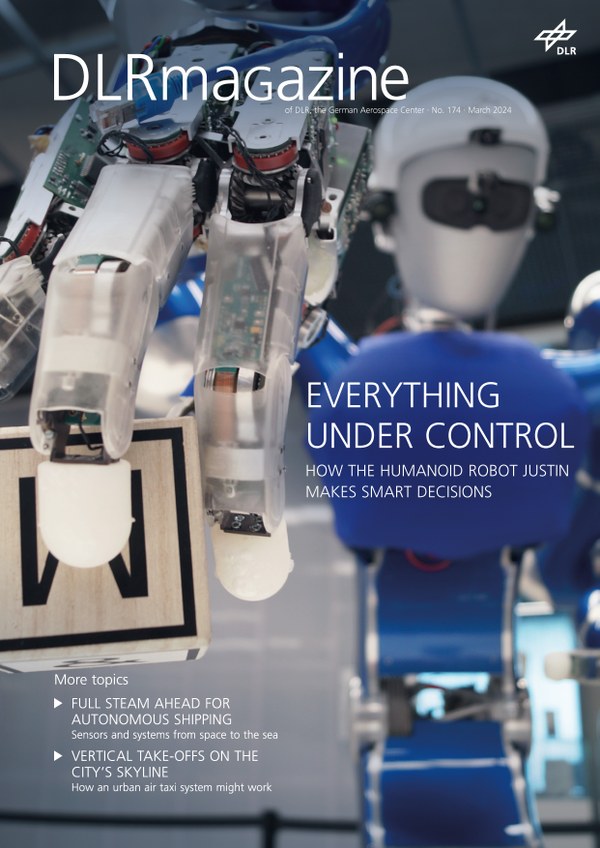
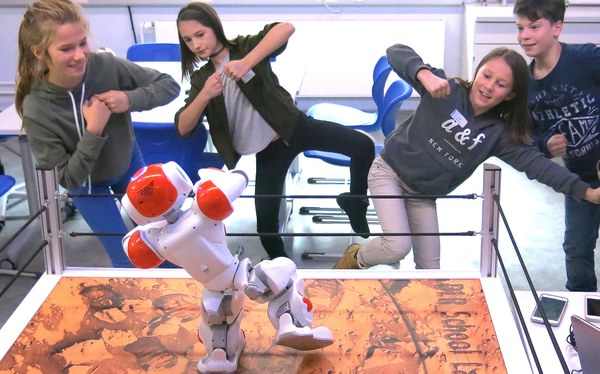
The Robotics and Mechatronics Center (RMC) at the German Aerospace Center (Deutsches Zentrum für Luft- und Raumfahrt; DLR) is exhibiting at AUTOMATICA, the leading international exhibition for automation and mechatronics, which is being held in Munich from 22 to 25 May.
Almost 15 years after being paralysed by a stroke, a 58-year-old US-American woman was once again able to serve herself a drink of coffee. This was possible thanks to a state-of-the-art DLR robot arm and hand that she controlled with neural signals sent directly from her brain.
Valles Marineris, the largest canyon system in the Solar System and a potential refuge for extraterrestrial life, is 7000 metres deep and stretches for some 4000 kilometres along the Martian equator.
Even though it doesn’t quite qualify as a 'proper' planet, the second most massive asteroid in the Solar System, Vesta – which has a diameter of approximately 530 kilometres – exhibits numerous planetary characteristics. This is just one of the many significant results of NASA's Dawn mission, published in the journal Science on 11 May 2012. The Dawn spacecraft has been orbiting Vesta since 16 July 2011. The German Aerospace Center (DLR) is involved in the mission.
GREAT results of the early science flights with SOFIA, the airborne observatory, puiblished in the European scientific journal 'Astronomy & Astrophysics'.
New images from the HRSC camera on board the Mars Express spacecraft show numerous dried up river valleys and various former crater lakes in the Acidalia Planitia region. They are further evidence of the existence of water on the surface of Mars for an extended period of time. Such areas are of particular interest to the search for microbial life, which may have developed here under these circumstances.
Insects are capable of masterful feats of flying; whenever they witness locusts flying long distances or moths hovering over flowers, aerodynamicists can only marvel.
Alpine and polar lichens could also survive on Mars. Planetary researchers at the German Aerospace Center (Deutsches Zentrum für Luft- und Raumfahrt; DLR) simulated the conditions on Mars for 34 days and exposed various microorganisms to this environment.
As Janine Schneider walks through the materials testing facility, her eyes light up; it is clear that she is comfortable between the long rows of test equipment. She knew she wanted to work here the moment she entered the premises of the DLR Institute of Materials Research in Cologne for the first time, during a trip there as a student. In our DLR Portraits series, we present the materials researcher.
The Moon continues to be a fascinating research objective for scientists from around the world. The DLR Institute of Planetary Research collaborated with NASA's Lunar Science Institute to hold a two-day Lunar Symposium, which took place on 19 and 20 April 2012 at the Adlershof Forum in Berlin.
The SHEFEX II (SHarp Edge Flight EXperiment) spacecraft successfully withstood vibration on a shaker and spinning at two rotations per second. These tests represented the final simulation of the conditions that the space vehicle will be subjected to during its launch in the summer of 2012.
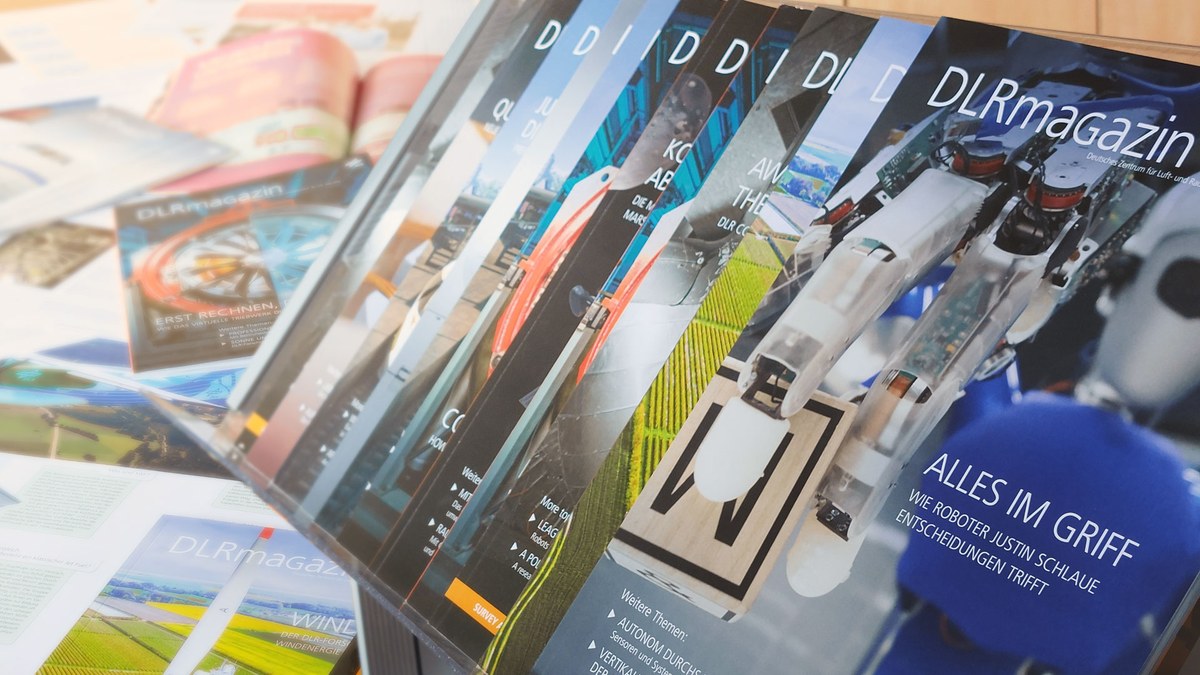
The cover of DLR Magazine issue 133 shows the Soyuz launch facility and a launcher being prepared for lift-off at Europe's Spaceport in French Guiana.
In the Tharsis volcanic region, almost the size of Europe, the Martian highlands have arched up into a shield several thousand metres in height as a consequence of volcanic processes. Quite a few unusual topographic features can be observed there.
Rendezvousing at 28,000 kilometres per hour at an altitude of about 380 kilometres is hardly routine – even for experienced spaceflight engineers and astronauts, which is why applause broke out in the European Space Agency (ESA) Automated Transfer Vehicle (ATV) Control Centre in Toulouse when the third European space transporter, 'Edoardo Amaldi', docked with the International Space Station (ISS) at 00:31 CEST (22:31 UTC) on 29 March 2012.
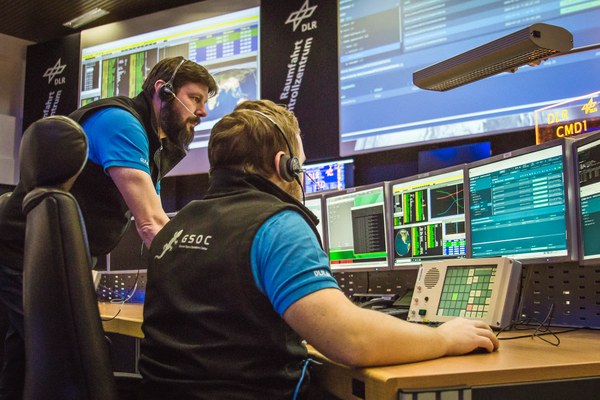
Erica Barkasz is an early riser; her working day starts at six in the morning in the control room of the German Aerospace Center (Deutsches Zentrum für Luft- und Raumfahrt; DLR) ground station at Weilheim in Upper Bavaria.
It is a freighter, storage facility and propulsion system all in one - and an important link between the astronauts on board the International Space Station (ISS) and their base on Earth. The third European Automated Transfer Vehicle (ATV) space transporter was launched on 23 March 2012 at 05:34 CET (01:34 local time) on board an Ariane 5ES rocket, from Europe's Spaceport in French Guiana.
Lufthansa AG has conducted a long-term test of biokerosene on 1187 scheduled flights. This involved one of the engines of an Airbus A321 being powered by a fuel mixture containing 50 percent biosynthetic kerosene.
"How clean is my air?" People, businesses and public authorities across Europe can now find this out online – the new 'obsAIRve' service portal provides rolling three-day forecasts and current observations of air quality for places and regions across Europe.
Until now, energy storage has mainly been used in devices such as mobile phones or notebook computers. Energy experts say this is going to change. As the use of renewable energy sources expands, the electricity grid will change and energy storage facilities will be required to take on an important role in this process.
Ice and snow can be colourful – at least when seen through the 'eyes' of the German Aerospace Center's (DLR) TerraSAR-X radar satellite. The radar signals are able to penetrate the snow cover to a depth of one metre – and the subsurface reflects the pulse in different ways.