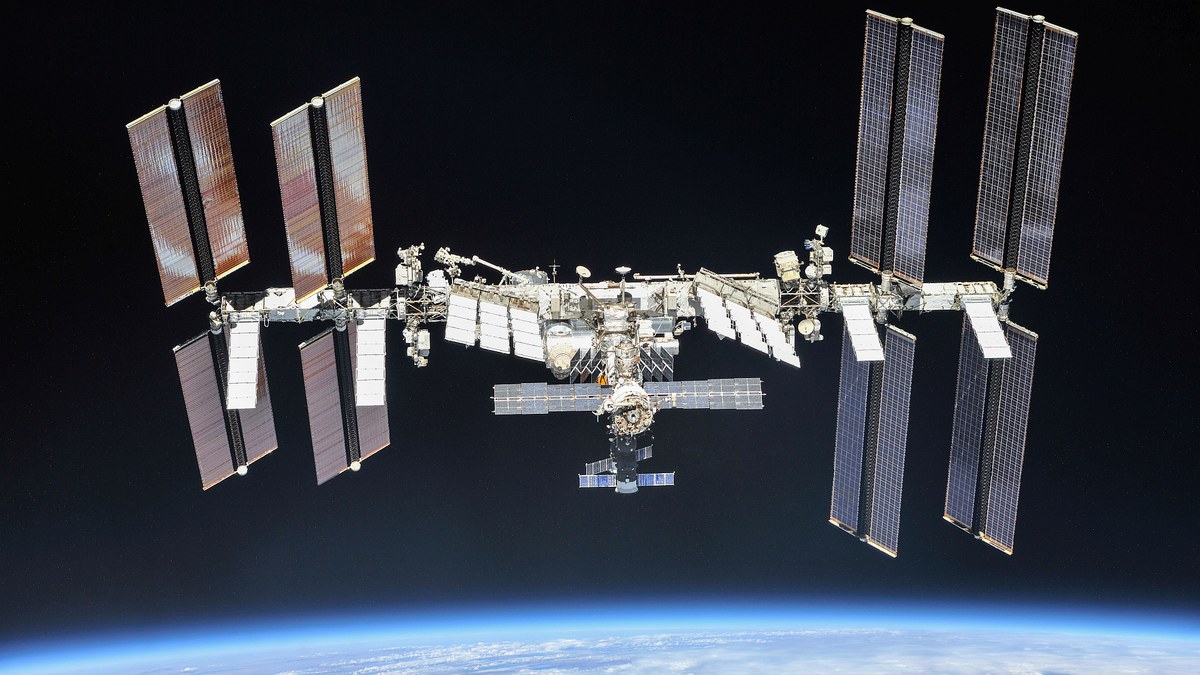
On 18 September 2011, German ESA astronaut Alexander Gerst was nominated for his first mission to the International Space Station (ISS). Gerst will visit humankind's largest outpost in space for a long–term mission lasting from May to November.
"It was only when I removed my helmet that I noticed that something was different – it floated as soon as I let go of it. We had arrived in orbit," wrote astronaut Gerhard Thiele in his logbook when he flew on the Shuttle Radar Topography Mission in February 2000.
On 30 October 1985, Space Shuttle Challenger launched with the European Spacelab research module on board. Ernst Messerschmid was on board this mission, also called D1 - the first mission under German responsibility. In this interview, the former astronaut tells us about insomnia, floating in space, 12-hour shifts, and strange expense reports.
In 1992, Klaus-Dietrich Flade became the fifth German to fly to space. His mission, Mir '92, lasted for seven days. Alongside scientific experiments, it also involved taking the mouse that starred in the German television programme 'Sendung mit der Maus' (Mouse TV) into space. Klaus-Dietrich Flade is now a test pilot for Airbus in Toulouse. In this interview he talks about his trip to space, his present job and his reasons for returning to flying.
Sigmund Jähn was selected as the first German astronaut in 1976; Alexander Gerst was also born that same year. Today Gerst is just a small step away from outer space: he was appointed to the European Space Agency's (ESA) Astronaut Corps in May 2009. In this interview, the volcanologist speaks about the expectations for his first mission, the fascination with the Moon and his day-to-day life at ESA.
Alexander Gerst is the 14th German to be selected for the European Space Agency (ESA) Astronaut Corps. He and five other candidates were selected from a pool of 8413 applicants. He has been based at the European Astronaut Center (EAC) in Cologne since September 2009, where he has been receiving basic astronaut training.
Hans Schlegel became Germany's sixth astronaut in orbit when he lifted off on 26 April 1993 as part of the second German Spacelab mission (D2). With him were German Ulrich Walter and five American astronauts. The multidisciplinary mission hosted 88 experiments.
Thomas Reiter has totalled 350 days in orbit, making him the European astronaut with the most experience. It was during the Euromir 95 mission that he had the change to travel to space for the first time. At 179 days it was ESA's longest manned spaceflight mission. And in 2006 he travelled to space for a second time: Thomas Reiter became the first long-stay European on the ISS.
In 1990, Gerhard Thiele was assigned to the D2 Spacelab mission. He served as backup payload specialist for the 1993 mission from the DLR Control Center at Oberpfaffenhofen. In 1995 he became Director of the DLR Crew Training Center (CTC).
His appointment to the astronaut team took place in 1990. Just like Sigmund Jähn 14 years before him, Ewald trained at the Yuri A. Gagarin Cosmonaut Training Center at Swjosdny Gorodok (Star City) outside Moscow. It was in 1997, during the Russo/German Mir '97 mission that he had the chance to travel to space: Ewald took off aboard the Russian Soyuz TM 25 on 10 February as a scientific cosmonaut and spent 18 days aboard Russia's Mir space station.
Klaus-Dietrich Flade was born on 23 August 1952 in Büdesheim, near the Belgian border. He served in the military from 1974 to 1976 where he completed both his officer and aircraft mechanics training. He then studied for a degree in Aerospace Engineering at the University of the Federal Armed Forces in Munich.
On 26 April 1993 the Germans Ulrich Walter and Hans Schlegel took off on the 'D2' mission. Many of the experiments augmented the D1 mission undertaken seven years previously. After concluding the mission, Walter returned to Germany where he headed the development of DLR's German satellite imaging database for four years.
"I'll be flying on that," is what Reinhard Furrer said in 1978, before applying to the German Test and Research Institute for Aviation and Spaceflight (Deutsche Forschungs- und Versuchsanstalt für Luft- und Raumfahrt; DFVLR – a precursor of present-day DLR) to become a scientific astronaut on the first German Spacelab mission, executed with NASA. He was proved correct: the Austrian left behind 699 rivals.
Ulf Merbold has logged 55 days in space over three missions. This makes him the German with the highest number of spaceflights, although that is not his only historic distinction. When he took off on 28 November 1983 from the Kennedy Space Centre aboard Space Shuttle Columbia, he was the first foreigner to fly into orbit on a US space vehicle.
As a citizen of the then German Democratic Republic, Sigmund Jähn became the first German in space on 26 August 1978. Accompanied by Soviet cosmonaut Valery Bykowski, Jähn flew on the Soyuz 29 mission to the Salyut 6 space station, where he performed a number of scientific experiments. During the eight-day flight he orbited Earth 125 times.