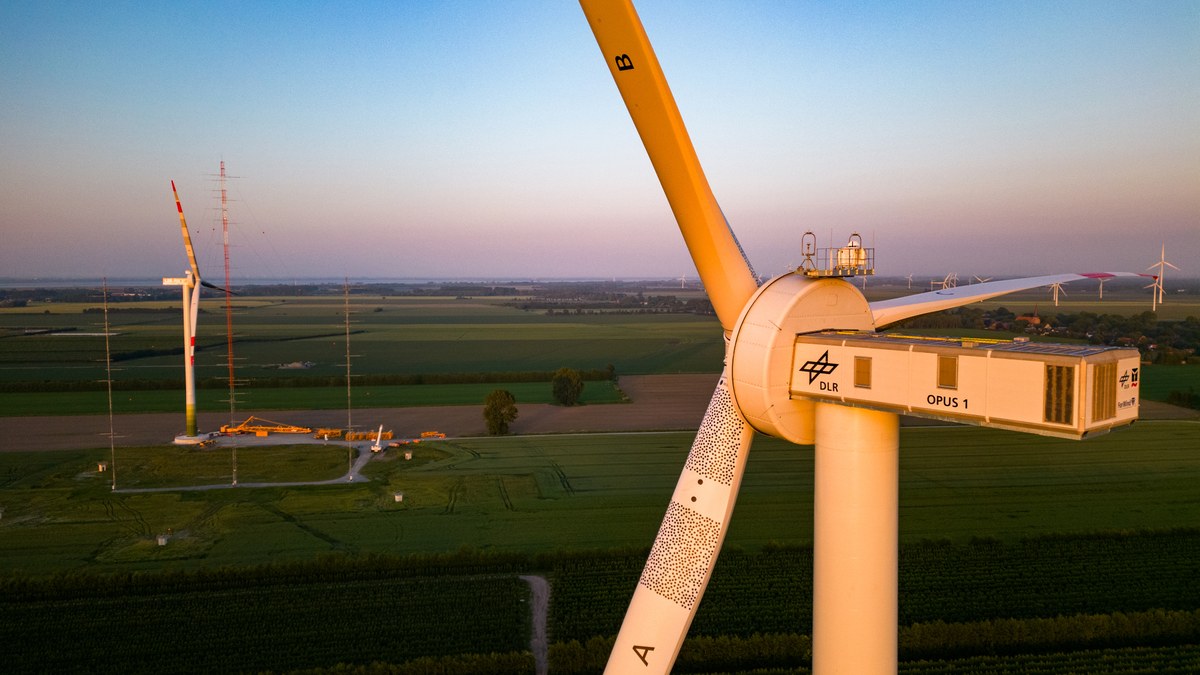
Rotor blade trailing edges that can change their shape and flaps that divert wind when required – very large rotor blades equipped with such mechanisms can systematically correct gusts and reduce performance fluctuations. Local flow will be influenced more accurately and quickly through movable slats, trailing edges and other systems.
Credit: DLR (CC-BY 3.0).
Share image:
Since the beginning of 2013 at the Plataforma Solar de Almería research site in Spain, DLR researchers have been testing a new system in which steam to drive a turbine is generated directly in the receiver tubes of parabolic troughs.
2153 mirrors twist and turn at the German Aerospace Center (Deutsches Zentrum für Luft- und Raumfahrt; DLR) Experimental Solar Thermal Power Plant in Jülich, directing sunlight onto a 22-square-metre receiver. TerraSAR-X, the German radar satellite operated by DLR, can also detect the mirrors as they follow the Sun – from more than 500 kilometres above Earth. The reflections of the radar signals make the tower and mirror array appear as bright spots of light.
At the DUKE (Durchlaufkonzept – Entwicklung und Erprobung; Once-through Concept – Development and Testing) test facility, steam for generating power is produced directly in receiver tubes in the parabolic troughs. This avoids the need for intermediate stages using thermal transfer media and also allows for higher operating temperatures.
In the DUKE (Durchlaufkonzept – Entwicklung und Erprobung; Once-through Concept – Development and Testing) test facility, at the Plataforma Solar in Almería (Spain), the steam that drives the turbine is generated directly in the receiver tube. In today's plants, synthetic thermal oil is used as the heat transfer medium.
The first solar tower power plant in North Africa will be built in Algeria. The People’s Democratic Republic of Algeria Ministry of Higher Education and Scientific Research and the German Federal Ministry for the Environment, Nature Conservation and Nuclear Safety (Bundesministeriums für Umwelt, Naturschutz und Reaktorsicherheit; BMU) have agreed to collaborate on this project. The aim is to build a solar-gas hybrid power plant with an output of up to seven megawatts. Important components of power station technology were, to a great extent, developed by the German Aerospace Center (Deutsches Zentrum für Luft- und Raumfahrt; DLR) with partners.
High-temperature storage could accelerate the deployment of renewable energy and also provide for more flexibility and greater efficiency in industrial processes as well as conventional power plant applications. The core of the 'HOTREG' experimental plant at the DLR Institute of Technical Thermodynamics is a five-metre-high storage unit. With the reconfigurable test unit for investigation of thermal storage, researchers can test various storage concepts, operating methods and materials.
By incorporating thermal energy storage, solar thermal power plants are able to provide electricity as required, even at night-time and during periods of low sunlight. DLR researchers use the 10-kilowatt test facility to examine heat storage at temperatures ranging up to 400 degrees Celsius. The storage container can be operated with different storage mediums based on salt to develop latent heat storage, and molten salt storage.
The solar thermal power plant fed its full output of five megawatts into the grid for the first time on 25 January 2012. This power plant went into operation at the end of last year, and is the first parabolic trough collector array in which steam is generated directly in the collectors.
Credit: DLR.
Electrolysis test stand with DLR-developed electrodes for alkaline water electrolysis. DLR researchers are working on more efficient methods of producing hydrogen by electrolysis.
As a dependable technology, solar thermal power stations can play an important role in transitioning the power grid to renewable energy sources. In contrast to other renewable sources, they supply electricity on demand and can stabilise the grid. This fact was emphasised in the study produced by EASAC (the European Academies Science Advisory Council), a body set up by leading European scientists and lead by the German Aerospace Center (Deutsches Zentrum für Luft- und Raumfahrt; DLR). On 7 November 2011, this study was handed over to the German Federal Minister for Education and Research, Annette Schavan, in Brussels. In solar power stations, mirrors are used to concentrate sunlight and convert it into thermal energy). This process enables temperatures of more than 1000 degrees Celsius to be achieved, which can be used to generate electricity, among other things.
In parabolic trough solar power plants, sunlight is concentrated onto a receiver tube located at the focus of the parabolic mirrors. The sunlight is then converted into heat. The heated oil heats water, producing steam that drives a turbine to generate electricity.
In Dish-Stirling systems, a parabolic mirror concentrates solar radiation into a focal point, where the Stirling motor is placed. Heat energy is transformed into mechanical energy by the Stirling motor. As a general rule, a generator then uses the mechanical energy to generate electricity.
DLR researchers at the Plataforma Solar de Almería in southern Spain calibrate measuring stations that will be used for a monitoring network in some North African countries.
With KONTAS (Konzentrator-Teststand Almeria Spanien), energy researchers from the DLR Institute for Solar Research will be able to test parabolic trough collectors up to 20 metres long at any angle to the Sun and measure their efficiency. The new test stand can be used to evaluate complete modules of parabolic trough collectors as well as individual components such as mirrors and absorber pipes. DLR operates the new test stand at the Plataforma Solar de Almería with CIEMAT.
With KONTAS, researchers have expanded the techniques and possibilities for testing solar-thermal power plant components even further.
A researcher from the DLR Institute for Solar Research tests a mirror for a solar-thermal power plant. DLR has developed its own test facilities and methods for verifying quality. In important areas, they have succeeded in developing internationally recognised quality standards.
Using artificial sunlight, researchers use this test stand to investigate the optical, geometrical and mechanical quality of the mirrors that capture and concentrate the sunlight in a solar power station, as well as the properties of the pipes that absorb the energy and transfer it in the form of heat.
The heliostat of DLR's solar furnace in Cologne collects the Sun's rays and reflects them onto the 'concentrator' – 157 separate, slightly curved and precisely aligned mirrors that focus the radiation. The radiation is concentrated by a factor of 5200 and falls on the approximately four-metre by four-metre test chamber of the solar furnace.
A 57 square metre mirror collects sunlight and directs it towards the facetted mirrors (left in the picture). These mirrors concentrate the incoming radiation up to around 5200 times and direct it to the research laboratory of the Cologne solar furnace (the beam of light can be seen on the right of the image).
‘alpha ventus’, situated 75 kilometres off the German North Sea coast, was the first offshore wind farm. The twelve wind turbines became operational in 2010. If companies and wind power equipment manufacturers find favourable conditions, the North Sea could become home to offshore wind farms with a combined generating capacity as high as 135 gigawatts by the year 2030. This is the result of a study conducted as part of an international project chaired by the Energy Research Centre of the Netherlands (ECN) and in which the German Aerospace Center (DLR) participated.
Credit: DOTI/J.Oelker/2010.
Scientists from the DLR Institute of Materials Research will use the 'TEG line' to further advance the development of thermoelectric materials and generators. They have around 400 square metres of laboratory space at their disposal.
At the Jülich site, set up on an area covering about eight hectares, are 2153 moving mirrors that concentrate the solar radiation onto a receiver atop the 60-metre tower.
Credit: DLR/Lannert.
At the Jülich site, set up on an area covering about eight hectares, are 2153 moving mirrors (heliostats). These mirrors track the path of the sun and concentrate the solar radiation on a receiver, about 22 square metres in size, installed at the top of a 60-metre-tall tower. The receiver is made of porous ceramic elements permeated by ambient air. This heats the air up to about 700 degrees Celsius and then, it releases this heat to the water-steam cycle. The steam generated here drives a turbine, which produces electrical power.
Studies have demonstrated the vast potential of solar power; for example, the deserts on Earth receive more solar energy in just six hours than the world's population consumes in an entire year. To enable the cost-efficient conversion of solar power into electricity, solar cells and solar thermal power stations need to operate more efficiently and become much less expensive to build.
The locations of the new institute are Cologne, Jülich, Stuttgart and Almería. In Almería, researchers have been conducting research into solar power plants for 30 years. The solar tower power plant is surrounded by a mirror field that reflects solar radiation onto a receiver. The heat energy collected drives a turbine, thus generating electricity.
At the DLR Institute of Solar Research, scientists develop new components for solar power plants, from first principles through to pilot plants. Here, researchers can test new components for the future under power plant conditions. The solar tower in Jülich will be expanded as a large-scale test facility.
DLR is conducting research into energy for the future in Stuttgart, Cologne and Almeria, southern Spain. With thermal storage, the electricity production of solar-thermal power plants can be decoupled from variations in solar radiation. Solar-thermal power plants could then provide a more uniform flow of power, operating even at night or during heavy cloud cover.
The German Aerospace Center (DLR) and Endesa test direct solar steam generation and energy storage in this pilot plant in Carboneras, located in southern Spain. In this type of solar power plant, steam is produced directly from concentrated solar radiation and used to drive a generator. The highlight of this facility is a new system that efficiently stores energy, both as sensible and latent heat. The stored energy can be used to generate electricity even at night.
A fuel cell system delivers electrical energy capable of powering the nose wheel of a 70-ton aircraft.
Last visual check: DLR employee Miriam Ebert checks to ensure that the ceramic fibres protecting the radiation receiver are well sealed. The test power station Solhyco has been constructed in a 60-metre-high solar tower at the Plataforma Solar de Almería in southern Spain. The sunlight that the mirrors direct on to the radiation receiver in the tower heat the absorber tubes to 800 degrees Celsius. The radially arranged black tubes conduct this heat to a 100-kilowatt micro gas turbine, which drives a generator that in turn produces electricity.
With the combustion chamber, the scientists at the DLR Institute of Combustion Technology can research synthetic gas with a high percentage of hydrogen under real conditions.
Share gallery: