The image depicts all four Galileo In Orbit Validation satellites in their orbits. The first two satellites were launched on 21 October 2011.
Credit: ESA / Carril.
Share image:
On 12 October 2012, at 20:15 CET, two Galileo satellites were launched from Europe's Spaceport in French Guiana on board a Soyuz ST-B. All stages of the Soyuz worked as planned. The Fregat-MT upper stage delivered the satellites to their orbits, at an altitude of 23,200 kilometres, 3 hours and 45 minutes after lift-off.
Credit: ESA - S. Corvaja, 2012 .
After the successful launch of the Soyuz ST-B on 12 October 2012 at 20:15 CET from Europe's Spaceport in French Guiana, two more Galileo satellites made their way to space.
After the successful launch of the Soyuz ST-B on 12 October 2012 at 20:15 CET from Europe’s Spaceport in French Guiana, two more Galileo satellites made their way to space.
Credit: ESA - S. Corvaja, 2012.
The lower three stages of the Soyuz launcher were rolled out to the launch complex (Ensemble de Lancement Soyouz; ELS) from the launcher assembly and test building (монтажно-испытательный корпус; montazhno-ispytatelniy korpus; MIK) at Europe’s Spaceport in French Guiana on 8 October 2012. After the launcher was erected, the ‘upper composite’, consisting of the launcher’s fourth stage (Fregat-MT) and the two satellites was connected to the lower stages.
Credit: ESA / S. Corvaja, 2012.
Two operational satellites for Europe's Galileo satellite navigation system (Galileo IOV FM3 and FM4) aboard a Soyuz ST-B launcher with a Fregat-MT upper stage.
Credit: ESA - P. Carril.
The lower three stages of the Soyuz launcher were rolled out to the launch complex (Ensemble de Lancement Soyouz; ELS) from the launcher assembly and test building (монтажно-испытательный корпус; montazhno-ispytatelniy korpus; MIK) at Europe's Spaceport in French Guiana on 8 October 2012. After the launcher was erected, the 'upper composite', consisting of the launcher’s fourth stage (Fregat-MT) and the two satellites was connected to the lower stages.
Credit: ESA–S. Corvaja, 2012.
Two more operational satellites (Galileo IOV FM4 and FM4) for the European navigation system will be carried into orbit by mission VS03.
The 'upper composite' of the launch system, made up of the launcher's fourth stage, Fregat-MT, the two Galileo satellites and the fairing.
Artist's impression of a Galileo In-Orbit Validation (IOV) satellite.
Credit: ESA.
Double success: On 21 October at 12.30 CEST the first two Galileo satellites were launched on board a Russian Soyuz rocket from Europe's Spaceport in French Guiana. This was the first launch of a Soyuz rocket from French Guiana.
Credit: DLR (CC-BY 3.0).
On 21 October 2011, Soyuz lifted off for the first time from Europe’s Spaceport in French Guiana carrying the first two Galileo In-Orbit Validation satellites.
Credit: ESA / Corvaja.
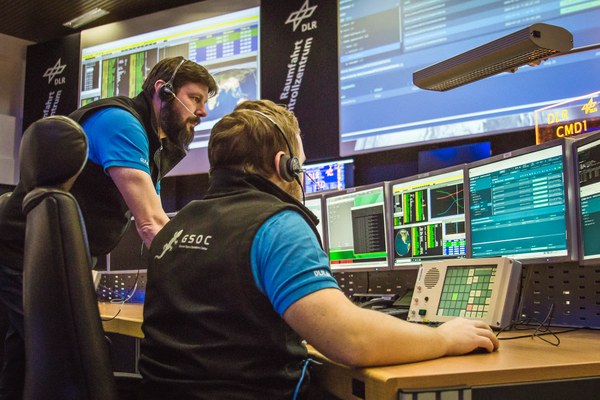
The Control Centre (Ground Control Segment, GCS) in Oberpfaffenhofen controls the Galileo satellites.
The Soyuz-Fregat launch vehicle carrying GIOVE-B, the second of ESA's two Galileo In-Orbit Validation Element demonstrators for Europe's global navigation satellite system, on the launch pad at Baikonour spaceport, Kazakhstan, on 22 April 2008. Based on the results obtained with GIOVE A and B, the first Galileo satellites were developed and launched in 2011.
Credit: ESA / Corvaja .
On October 14 2011 Soyuz VS01, the first Soyuz flight from Europe’s Spaceport in French Guiana, was transferred to the launch zone, from where it carried the first two Galileo IOV satellites into orbit. Shown in the image is the ‘Upper Composite,' comprising the Fregat upper stage, payload, and fairing.
On 22 April 2008, the Soyuz Fregat launch vehicle brought the GIOVE B test satellite to space. GIOVE B was the second of the two Galileo test satellites, needed for initial testing and demonstrations for the European Galileo navigation system. The rocket was launched from the Baikonur Cosmodrome in Kazakhstan.
The two Galileo satellites are mounted on the Fregat upper stage on 10 October 2011. The Fregat upper stage deployed its two-passenger payload to the final 23,222-kilometre orbit.
Credit: ESA / CNES / Arianespace / Optique Video du CSG.
The two Galileo satellites are attached to the ‘satellite dispenser’, which attaches them to the Fregat transport module during their journey into space. It is responsible for ensuring that the satellites can be injected into their respective positions on the orbital plane. The ‘firstborn’ of the twin satellites, known as ‘PFM’ was mounted on the dispenser on 04 October 2011; the second satellite, ‘FM2’, the day after.
Credit: ESA, CNES, Arianespace, Optique Video du CSG, P. Baudon.
The Galileo In-Orbit Validation (IOV) satellites, a Proto-Flight Model (PFM) and three flight models (FM-2, FM-3 and FM-4) being built and tested by Thales Alenia Space.
Galileo satellite in orbit. This artist impression shows the satellite with its solar arrays deployed.
The two Galileo navigation satellites are almost there. About four hours after the launch they reach their orbit at an altitude of 23,222 kilometres. The In-Orbit Validation satellites simultaneously separate from the Fregat.
Share gallery: