DLR Portal
Home|Textversion|Imprint|Sitemap|Contact |Deutsch
You are here: Home:
Advanced Search
News
Institute
Departments
Compact Test Range
Projects
TanDEM-X Science
Tandem-L Science
Publications
Awards
Jobs
Service & Links
Zukunftspreis 2012
Archive - Conferences
TanDEM-X Science Home
Send article to a friendPrint

Technical Concept


Sketch of InSAR measurement configuration
.
Sketch of InSAR measurement configuration
.
With TanDEM-X a novel interferometric instrument is introduced, consisting of two companion SAR satellites flying in close formation with the main goal to provide operational, bi-static single pass interferometry products of new quality with tuneable interferometric baselines.

To comply with the mission and system requirements the technical concept is based on TerraSAR-X (TSX) and the TDX satellite as a quasi-rebuild of TSX, with mission specific functions. The advantage of two "equal" satellites for TanDEM-X, is that it

  • is cost effective, because only one mainly recurring satellite has to be built and it provides the required capability to swap the satellites between the TanDEM-X and the TerraSAR-X mission, thus the TerraSAR-X mission goal will not be affected negatively,
  • has low risk, because most elements are rebuilt. Furthermore the envisaged processing techniques and the necessary formation flying and baseline determination techniques rely on the heritage from SRTM and the Grace mission, respectively,
  • provides all TerraSAR-X advanced features - e.g. high resolution, beam and mode agility, high mapping capability, direct downlink capability, quad-pol and dual-phase center capability.

For interferometric imaging the following instrument modes are proposed:

Bi-static Mode

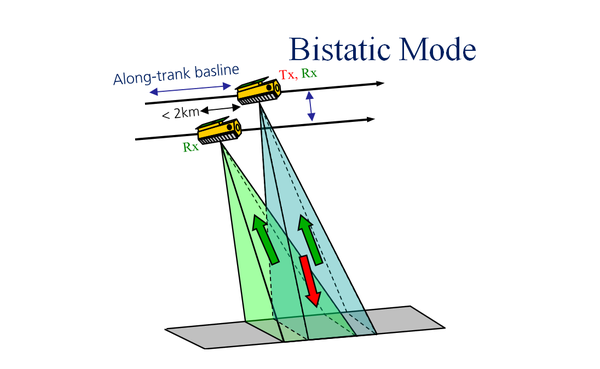
Operational DEM generation will be performed using bi-static mode (see figure below left). Its principle is characterized by the simultaneous measurement of the same scene and identical Doppler spectrum with 2 receivers, avoiding temporal decorrelation. To provide sufficient overlap of the Doppler spectrum, along-track baselines < 2 km are required while the effective across-track baselines for high resolution DEM’s have to be in the order of 1 km. PRF synchronization and relative phase referencing between the satellites are mandatory.

Pursuit Mono-static Mode

A secondary DEM generation mode is the pursuit mono-static mode, where two satellites are operated independently, avoiding the need for synchronization. The along-track distance is 30-50 km. The temporal decorrelation is still small for most terrain types with exception of ocean surface and vegetation in the case of moderate to high wind speeds. The interferometric height sensitivity is doubled with respect to bi-static operation, meaning that the baseline determination has to be more accurate.

Along-track Interferometry, ATI Mode

Along-track interferometry will enable accurate velocity measurements e.g. for monitoring ocean currents, sea ice drift and traffic. The required along-track baselines range from several hundred meters to several kilometers. The ATI mode benefits greatly from the 2x2 phase centers to resolve ambiguities in the velocity measurement, thereby providing a unique MTI system for accurate velocity measurements on a large scale.

Experimental Modes

Numerous experimental modes, mainly exploiting the bi-static measurement configuration and the polarimetric capabilities, are considered. Some of them could evolve during the mission from an experimental to an operational mode. A very promising candidate is polarimetric interferometry. Another is super resolution, an elegant way toimprove spatial resolution by a factor 2.

Technical Implementation

TerraSAR-X as a basis for TanDEM-X is not only a high performance SAR system with respect to SAR image and operational features, it is already built for repeat pass interferometry and thus provides several essential features for the TanDEM mission, like precise orbit control, Dual Frequency GPS for best localization knowledge, and excellent RF phase stability.


TanDEM-X Home
Science Home
Mission Goal
Scientific Justification
Scientific Areas
Technical Concept
Expression of Interest and Contact
Science Service
Proposal Submission Interface (The Science Service System is now open for the submission of scientific proposals)
- as above but secure connection -
Latest News
TanDEM-X Blog
TanDEM-X Meetings
4th TanDEM-X Meeting
3rd TanDEM-X Meeting
Pre-Launch Meeting
First Meeting (PDFs)
TanDEM-X Partners
Microwaves and Radar Institute (DLR-HR)
Earth Observation Center (EOC)
German Remote Sensing Data Center (DLR-DFD)
Remote Sensing Technology Institute (IMF)
German Space Operation Center (GSOC)
EADS Astrium GmbH
Infoterra GmbH
Brochures
TerraSAR-X Brochure (9.06 MB)
TanDEM-X Brochure (8.05 MB)
Tandem-L Brochure - in German (2.98 MB)
TanDEM-X Presentations
IGARSS 2010 - Hajnsek - TanDEM-X Scientific Contributions (2.03 MB)
IGARSS 2010 - Schwerdt - Monostatic Calibration of both TanDEM-X Satellites (2.61 MB)
IGARSS 2010 - Breit - Processing of Bistatic TanDEM-X Data (21.53 MB)
IGARSS 2010 - Huber - Validation of Tie-point Concepts by the DEM Adjustment Approach of TanDEM-X (0.41 MB)
IGARSS 2009 - Hajnsek - TanDEM-X: Science Activities and Proposal Submission (1.9 MB)
TGRS 2007 - Krieger - TanDEM-X: A Satellite Formation for High-Resolution SAR Interferometry (1.98 MB)
RADAR 10/2004 - Moreira - A Tandem TerraSAR-X Configuration for Single Pass Interferometry, HiRes (16.76 MB)
- as above but in low resolution - (1.88 MB)
IGARSS 09/2004 - Moreira - TanDEM-X: A TerraSAR-X Add-On Satellite for Single-Pass SAR Interferometry (1 MB)
Related Topics
Spacecraft Design, Testing and Performance
Earth Resources and Remote Sensing
Oceanography
Copyright © 2013 German Aerospace Center (DLR). All rights reserved.