DLR Portal
Home|Textversion|Impressum|Sitemap|Kontakt |English
Sie sind hier: Home:Abteilungen:Satellitennetze:Satellitenfunksysteme
Erweiterte Suche
Aktuelles
Wir über uns
Abteilungen
Satellitennetze
Optische Freiraumkommunikation
Netzwerke und Protokolle
Satellitenfunksysteme
Nachrichtensysteme
Navigation
Forschung
Projekte
Veröffentlichungen
Stellenangebote
Service & Links
Downloads
VersendenDrucken

Channel & Interference Simulation


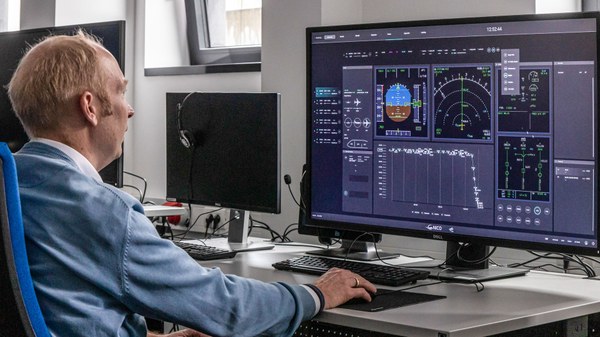
 GUI of the channel and interference simulator
zum Bild GUI of the channel and interference simulator
Multibeam satellite systems save a lot of power in the satellite in case of point-to-point connections, because the signals are transmitted in single narrow beams with high antenna gain so that the signals are not broadcast over huge areas where they are not needed. A drawback of multibeam systems is the interbeam interference, if frequencies are reused in different beams.
A channel and interference simulator has been developed by the BSS group taking following aspects into account:


  • Dynamic rainfield map simulator considers Multibeam satellite systems save a lot of power in the satellite in case of point-to-point connections, because the signals are transmitted in single narrow beams with high antenna gain so that the signals are not broadcast over huge areas where they are not needed. A drawback of multibeam systems is the interbeam interference, if frequencies are reused in different beams.
  • A channel and interference simulator has been developed by the BSS group taking following aspects into account:
  •  Time-series generated by the channel and interference simulator
    zum Bild Time-series generated by the channel and interference simulator
    Dynamic rainfield map simulator considers temporal and spatial correlation of rain fading in Ka-band and Ku-band
  • Scintillation model included
  • Detailed simulation of co-channel and adjacent channel interference in a multibeam system with non-homogeneous user distribution
  • Up-/downlink correlation of rain attenuation (frequency scaling) is considered

A graphical user interface makes it easy to configure a lot of system parameters and to generate time series of the received signal power of the useful and interference signal both in forward and reverse link, and to make statistical analysis. The generated time-series can be fed into the hardware satellite channel simulator produced by the Innnovationszentrum Telekommunkationstechnik GmbH (IZT).
The antenna beam pattern can be either manually configured via the graphical user interface or read from a file in GRASP format. The simulator assumes DVB-S2/RCS links with a configurable bursty traffic on the reverse link.


Kontakt
Dr.-Ing. Hermann Bischl
Deutsches Zentrum für Luft- und Raumfahrt (DLR)

Institut für Kommunikation und Navigation
, Satellitennetze
Oberpfaffenhofen-Wessling

Tel.: +49 8153 28-2884

Fax: +49 8153 28-2844

Projekte
Advanced DVB-RCS
DENISE
GeReLEO
NEXT
NICOLE
SatNEx
Abgeschlossene Projekte
Verwandte Themen im DLR
Meteorologie und Klimatologie
Copyright © 2012 Deutsches Zentrum für Luft- und Raumfahrt e.V. (DLR). Alle Rechte vorbehalten.