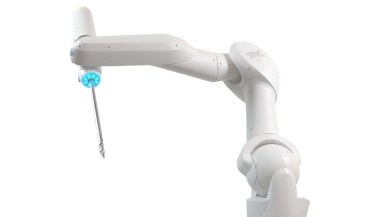
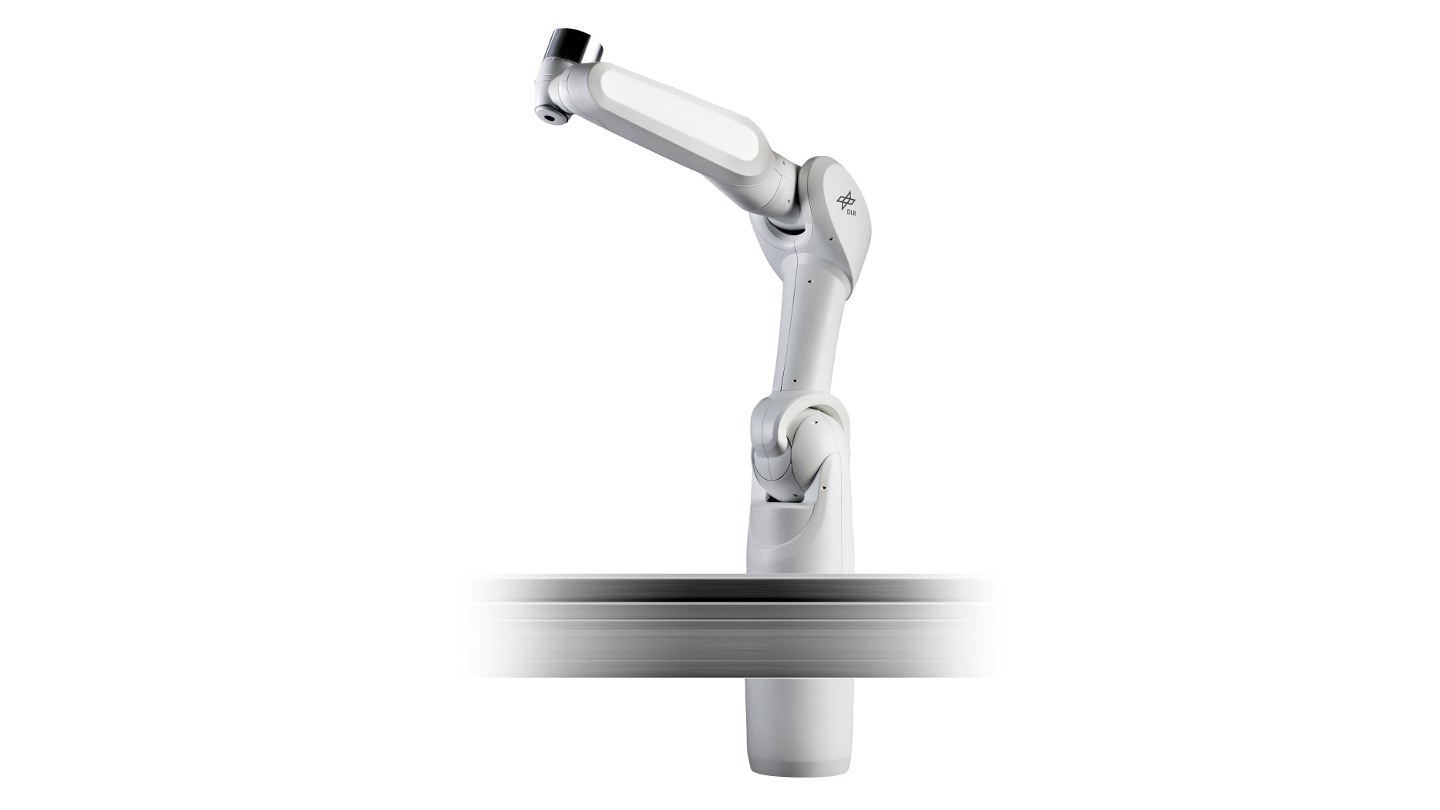
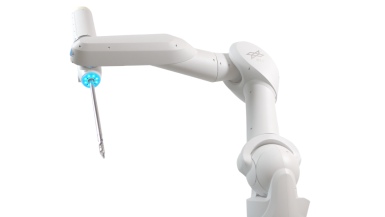
The DLR MIRO is a versatile robotic arm for medical applications, which was in 2008 presented to the public for the first time.
Technical data
Size:
Maximum arm length 1.1 m
Weight:
ca. 10 kg
Degrees of freedom:
7
Nominal payload:
3 kg
Workspace:
Optimized for various surgical interventions
Speed:
> 0.5 m/s
Control modes:
• Position control with active vibration damping • Impedance control (cartesian and in joint space)
Control Cycle:
3 kHz
Specifics:
• Completely torque controlled • Combinable with specialized instruments (MICA) • Combinable to MiroSurge, consisting of 3 MIRO robot arms
System description
The DLR MIRO is after the DLR KineMedic the second generation of versatile robot arms for medical applications, which were developed at the DLR Institute of Robotics and Mechatronics. Due to its low weight of about 10 kg and its compact size (comparable to a human arm), the MIRO can assist a surgeon directly at the operating table where space is scarce. The possible applications of this robot arm range from guiding a laser unit for precise cutting of bones in orthopedics over the setting of pedicle screws and robot assisted endoscope guidance to minimal invasive surgery.
Surgical robotic systems can be divided into two major groups: specialized and versatile systems. Specialized systems focus either on a dedicated surgical technique or on the treatment of a specific medical disease. In contrast, the design approach of the MIRO and its antecessor KineMedic aim at a compact, slim and lightweight robot arm as a versatile core component for various existing and future medical robotic procedures.
By adding specialized instruments and modifying the application workflows within the robot control, the MIRO robot can be adapted to many different surgical procedures. This versatility has been achieved by the design of the robotic arm itself and by the flexibility of the robot control architecture.
The DLR MIRO is a
light-weight,
kinematically redundant,
fully torque-controlled dexterous robot arm, with a
payload-to-weight-ratio of about 1:3.
The redundant kinematics with seven joints allows for a more flexible operating room (OR) setup and can be used to avoid collisions with other robots or operating room equipment. The joint units integrate both position and torque sensors. Therefore the robot can be used in impedance-controlled mode, allowing sensitive movements of the robot effected by the surgeon (“hands-on robotics”) and avoiding unintended collisions, as well as in position-controlled mode for very precise manipulation.
The close interaction with a technical system demands a basic understanding of the system by the user. Thus the predictability of the system’s movements is a central design issue of the MIRO robot. To achieve this, a serial kinematics with seven degrees of freedom which resembles those of the human arm has been developed and optimized for medical procedures. The robot's morphology divides the MIRO arm into a dedicated shoulder (roll-pitch-yaw), upper arm, elbow (pitch-roll), forearm and wrist (pitch-roll), each group with intersecting axes.
The MIRO robot arm is a highly integrated mechatronic system. Beside motors, gears and safety brakes, the robot arm integrates torque- and position sensors, power electronics and programmable logic electronics in each joint. The different joint electronics are connected by a high performance communication bus, which allows for outsourcing the joint control to the external supply module.
In addition to classical position control for movements along planned trajectories, the robot supports also the soft robotics approach. With the integrated torque sensing, the robot can be operated impedance controlled and gravity compensated. This allows the user to directly interact with the robot, because external forces and torques are sensed and used in closed-loop control algorithms.
Trivia
The housing design of the DLR MIRO, which was created by Tilo Wüsthoff, won the iF product design award 2009 in the category "advanced studies".
The DLR MIRO is also featured in a sequence of the science fiction movie "Ender's Game" (2013).
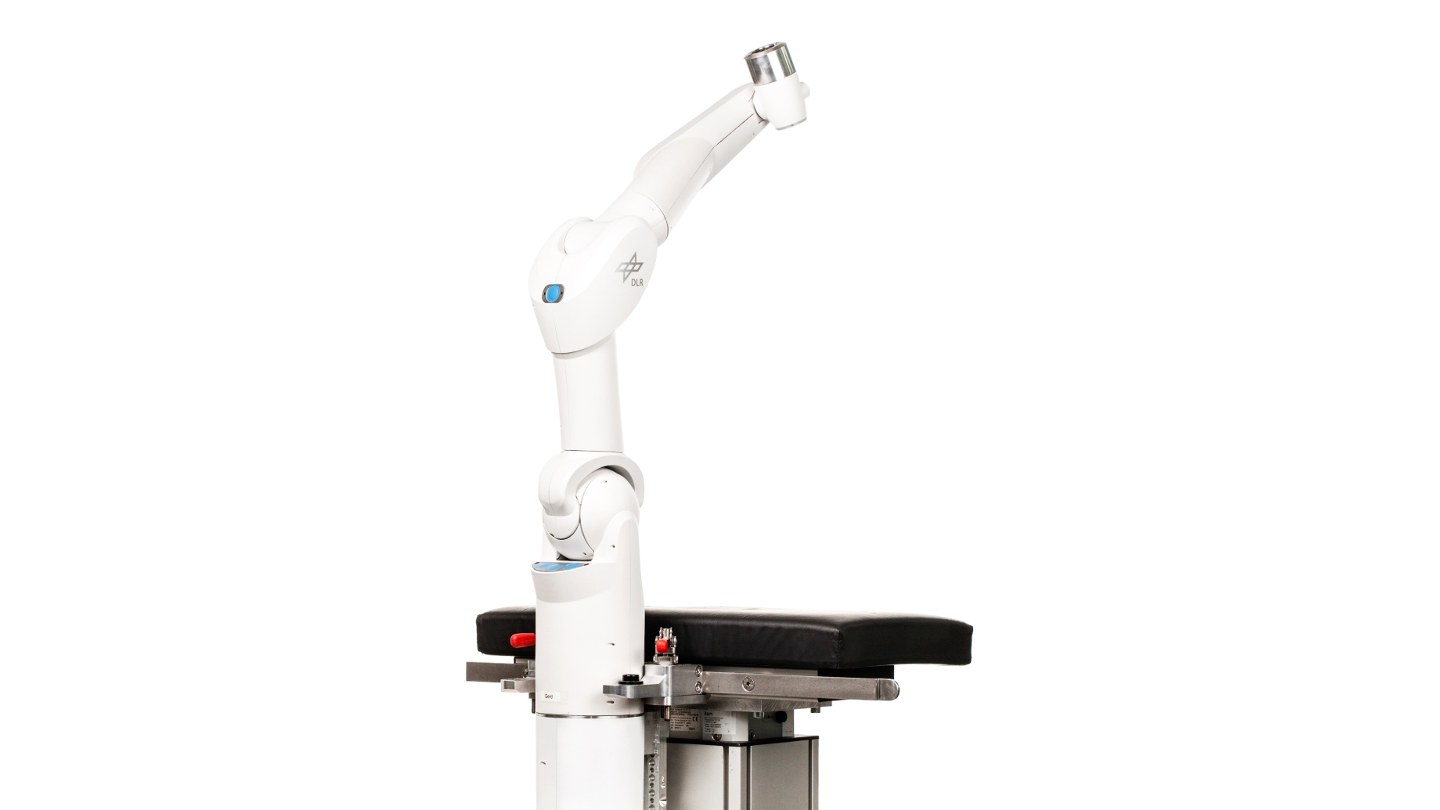
DLR MIRO at normed side rail
The compact and lightweight robot arm DLR MIRO can easily be attached to the standardized side rails of any OR table.
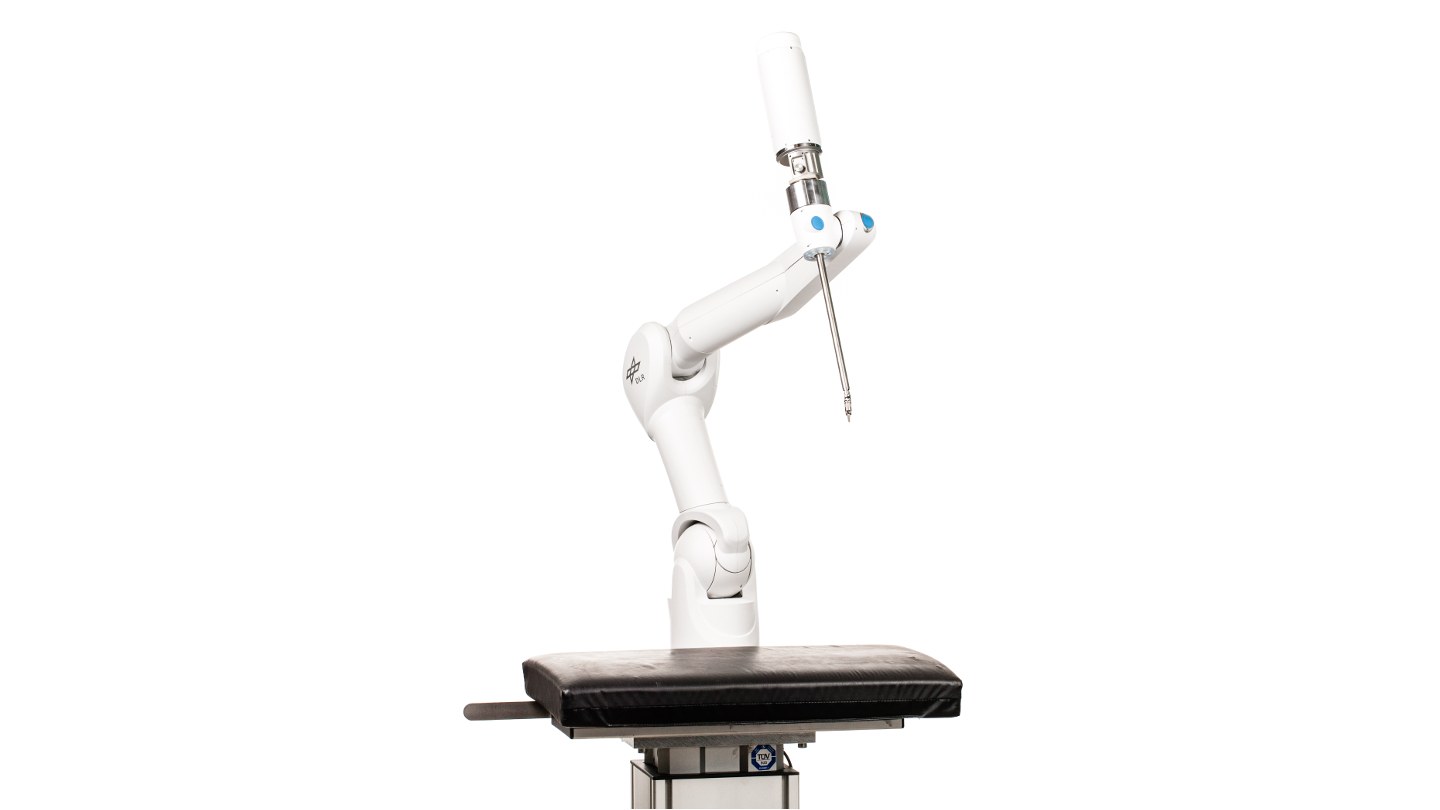
The specialization of the versatile DLR MIRO for a dedicated application is realized by mounting a specialized instrument to its instrument interface (here a MICA instrument for minimally invasive surgery).
Schlenk et al., "Robot Integrated User Interface for Physical Interaction with the DLR MIRO in Versatile Medical Procedures", Journal of Medical Robotics Research, vol. 3, no. 2, 2018.
Hagn, U., "The Aspect of Versatility in the Design of a Lightweight Robot for Surgical Applications", Ph.D. dissertation, University of Hannover, 2011.
Hagn et al., "Telemanipulators for Remote Minimally Invasive Surgery", IEEE Robotics and Automation Magazine, vol. 15, no. 4, pp. 28-38, December 2008.
Hagn et al., "The DLR MIRO: a versatile lightweight robot for surgical applications", Industrial Robot, vol. 35, no. 4, pp. 324-336, 2008.