
Laparoscopy


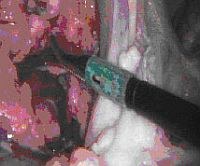



Laparoscopic surgery is minimally invasive, which offers the advantages of reduced pain, shorter hospital stay, and quicker convalescence for the patients. Unlike open surgery, laparoscopic surgery needs only several small incisions in the abdominal wall to introduce instruments like scalpels, scissors, etc., and a laparoscopic camera, such that the surgeon can operate using camera visual feedback only. The inconveniences of laparoscopic operations lie mainly in the difficulties in mutual understanding between the surgeon and the camera assistant who maneuvers the laparoscope according to the surgeon's instructions. Another problem with laparoscopic surgery is that the camera image may become unstable in a long operation due to fatigue of the camera assistant.
We developed a visual tracking method which is robust, simple, and operates at a maximum rate of 17Hz for stereo laparoscopes. The use of a stereo laparoscope enables the robot to track the instrument in both lateral and depth motions. Due to the multiplicity of problems coming up with shape analysis, we do not check the presence of any particular shape or structure. Instead, we use color information alone for instrument segmentation. Since the instrument color is not unique, we decided to use an artificial color mark to distinguish the instrument. We analyzed the color distribution of typical laparoscopic images and chose a color which does not usually appear to mark the instrument. Thus, even if only a very small part of the instrument is visible, reliable data can still be obtained for robot control. With color image segmentation, the mark can be correctly located in the image and used to control the robot motion. The image processing part was initially implemented on a commercially available image processing system, MaxVideo MV200, from Datacube, Inc., Danvers, MA. The robot we use is the AESOP 1000 (Automated Endoscope System for Optimal Positioning), from Computer Motion, Inc., Goleta, CA. The system was tested in a dummy abdomen used for surgery training. In December 1995, the system was also tested on a pig at the Klinikum Rechts der Isar, Technical University of Munich. After a major redesign, the system now runs without any special image-processing hardware on a general-purpose PC. It can be controlled by voice commands such as "faster", "slower", "track", and "stop".
Publications
- Arbter, K., Wei, G.-Q.: Tracking a mono- or stereo-laparoscope in minimally invasive surgery
- Arbter, K., Wei, G.Q.: Verfahren zum Nachfuehren eines Stereo-Laparoskops in der minimalinvasiven Chirurgie.
- Ungeheuer, A.(1), Arbter, K., Omote, K.(1), Feussner, H.(1), Wei, G.Q., et al.: Selbststeuernde farbcodierte Kamerafuehrung bei laparoskopischen Eingriffen. Minimal invasive Chirurgie, (1997), pp. 41-47
- Wei, G.Q., Arbter, K., Hirzinger, G.: Automatic tracking of laparoscopic instruments by color-coding. Proceedings First Int. Joint Conf. CVRMed-MRCAS'97, Grenoble, France, Mrch 20-22, 1997, Springer Verlag: Lecture Notes in Computer Science, (1997)
- Wei, G.Q., Arbter, K., Hirzinger, G.: Real time visual servoing for laparoscopic surgery. IEEE Engineering in Medicine and Biology, 16, (1997), pp. 40-45,
- Omote K., Ungeheuer A., Feussner H., Wei G.-Q., Arbter K., et al.: Selbststeuerndes Kamerasystem für die laparoskopische Chirurgie: Erste klinische Erfahrungen. 18. Kongress der DGE-BV, München, 25.03.1998, Deutsche Gesellschaft für Endoskopie und bildgebende Verfahren e.V., (1998)
- Omote, K., Ungeheuer A., Feussner, H., Arbter, K., Wei, G.Q., et al.: Self-guided robotic camera control system for laparoscopic surgery. MITAT Minimally Invasive Therapy & Allied Technologies, 7, 1, (1998), pp. 36-.
- Omote K. , Feussner H., Ungeheuer, A., Arbter K. , Wei G.-Q., et al.: Self-guided robotic camera control for laparoscopic surgery compared with human camera control. American Journal of Surgery, 177, 4, (1999), pp. 321-324,
- Arbter K., Feussner H., Wei G.-Q., Ungeheuer A., Hirzinger G., et al.: Autonomer Roboterassistent für die laparoskopische Chirurgie. 12. Forumsgespräch, Ulm, 17.11.2000, Gesellschaft für Biomedizinische Forschung in Ulm e.V., (2000)