
DLR Heart (2002–2004)
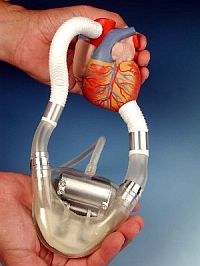
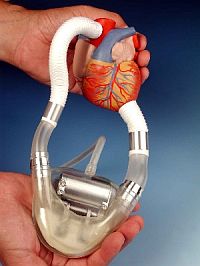
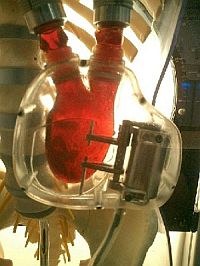

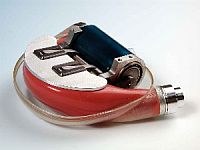
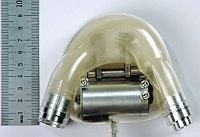
Cardiovascular failure is the most frequent death cause in Germany. In Bavaria, about 60.000 annually die of cardiovascular diseases, corresponding to approx. 50% of all deaths. A possible treatment is the implantation of ventricular assist devices. Such "artificial hearts " do not entirely substitute the natural organ. Rather it is enough to support the left ventricle, which pumps the fresh, oxygen-enriched blood into the systemic cycle.
The draft and the integration of a left ventricular assist system (LVAD) is a task in which primarily fluid mechanical, mechanical and energy-technical problems must be solved. Blood pumping should be done as carefully as possible to avoid hemolysis and thromboembolism.
The DLR Heart is designed as a completely implantable assist device (VAD). For left ventricular assistance, it is connected to the left heart chamber and pumps blood back to the aorta using high pressure. For bi-ventricular assistance, each chamber of the device is connected to one ventricle of the native heart. The DLR Heart works on the pumping principle of simultaneous suction and forward pumping with the aid of two chambers located on top of each other. This arrangement makes it possible for the unit to intake blood and pump it out simultaneously as one chamber is compressed and the other concurrently released. The two chambers lie very close together. Only if one chamber is compressed, the other can open. This allows for an extremely flat construction. Due to a special designed drive unit and flow-optimized pumping chambers, the energy consumption of the implantable device could be reduced to less then 6 Watt. For transcutaneous energy and data transfer a wireless transfer system was developed. This system is able to transmit up to 50 Watt to a small, implanted energy reservoir. The transmitted energy is automatically adapted to the requirement of the implant as well as to the load of the implanted accumulator. Due to the new concept and the high efficiency, the DLR Heart won the 2003 Innovation Award of the European Society of Artificial Organs (ESAO).
Publications
Th. Schmid, R. Gruber, W. Schiller, D. Liepsch, G. Hirzinger, and A. Welz, "Transcoutaneous energy system for implantable artifcial hearts", in Proc. Int. Artifical Organs, vol. 27, XXXI. Congress of the European Society for Artificial Organs, Warsaw, Poland, September 2004. elib
Th. Schmid, W. Schiller, A. Mittelschulte, D. Liepsch, B. Laschka, G. Hirzinger, and A. Welz, "Flow Measurements in the Chamber of a Pulsatile Left Ventricular Assist Device with Particle Image Velocimetry (PIV)", in Proc. Int. Artifical Organs, vol. 27, XXXI. Congress of the European Society for Artificial Organs, Warsaw, Poland, September 2004. elib
Th. Schmid, and W. Schiller, "A New Artificial Heart for Regeneration and Support of Severe Cardiac Insufficiency", Medical Technology in Bavaria, 2003. elib
Th. Schmid, W. Schiller, D. Liepsch, G. Hirzinger, and A. Welz, "Linksventrikuläre Unterstützung mit Hilfe einer voll implantierbaren, pulsatilen Zweikammerpumpe", 3. Jahrestagung der Deutschen Gesellschaft für Biomechanik, Munich, Germany, May 2003. elib
Th. Schmid, W. Schiller, D. Liepsch, B. Laschka, G. Hirzinger, and A. Welz, "A New Implantable Left Ventricular Assist Device With Two Chambers", The 7th Conference of the European Society for Engineering and Medicine (ESEM), Halle/Saale, Germany, September 2003. elib
Th. Schmid, W. Schiller, D. Liepsch, B. Laschka, M. Marcus, G. Hirzinger, and A.Welz, "The DLR Left Ventricular Assist Device: First In Vitro and In Vivo Results", Int J Artif Organs, vol. 26, no. 7, 2003.
Th. Schmid, D. Liepsch, W. Schiller, M. Nadler, G. Hirzinger, A. Welz, and E. Richter, "Flow visualisation and flow measurement with particle image velocimetry (PIV) in the chamber of a new left ventricular assist device (DLR-Heart)", Proceedings of 13th Conference of the European Society of Biomechanics, vol. 4, pp. 522-523, Wroclow, Poland, September2002. elib
Th. Schmid, W. Schiller, D. Liepsch, and G. Hirzinger, "The DLR-Heart: A New Implantable, Left Ventricular Assist Device", presented at 12th International Conference on Mechanics in Medicine and Biology (ICMMB), Lemnos, Greece, September 2002. elib