Spaceflight is the incitement to develop advanced robotic systems within the Robotics and Mechatronics Center (RMC). Robots play a dominant role in the exploration and conquest of our outer space. Compared to human beings they can adapt much better to the extreme conditions encountered in free space and on celestial bodies like moons, planets or even asteroids. This enables robots perfectly to set up robotic outposts and hence to pioneer the interplanetary manned space flight. RMC has a long tradition in space robotics research and developments, specifically in near-Earth or orbital applications. Outstanding examples of great success are: ROTEX (1993), GETEX (1998) and ROKVISS (2003-2010). Worldwide, RMC has currently the most experience on this space robotics area.
The relevant work area in RMC is focused on three key topics:
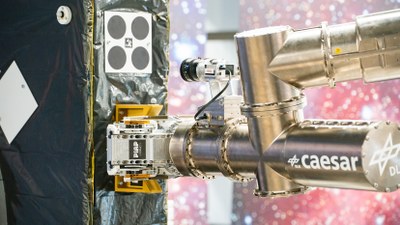
Main goal is the development of systems that effectively and cost-efficiently allow to operate in near- or far-Earth orbits in order to
Research topics:
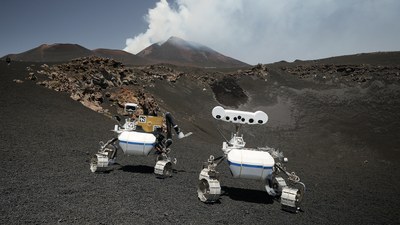
Three robotic key functionalities have gained essential importance for the exploration of large surface areas on planets and moons: mobility, autonomy and manipulability. Present planetary landing systems inherently are stationary, and their exploration area is very strongly limited to a very small area around their local site. Nowadays, the scientific community requires to collect samples from far remote sites and their transportation back to a lander system for processing or even to return a sample to Earth. These novel scenarios and the increased operational spectrum on planets pose a great challenge on the mechatronic system to be developed and used.
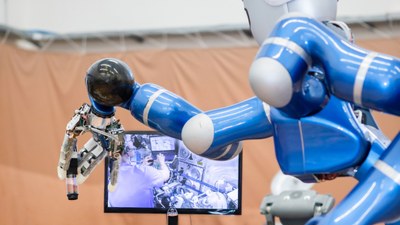
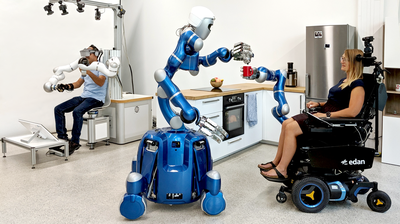
So far, being a vision in science fiction literature, the human arm and hand extensions into non-reachable or dangerous environments, such as space, is now a focal point to be realized within the key topic Telepresence and Virtual Reality.