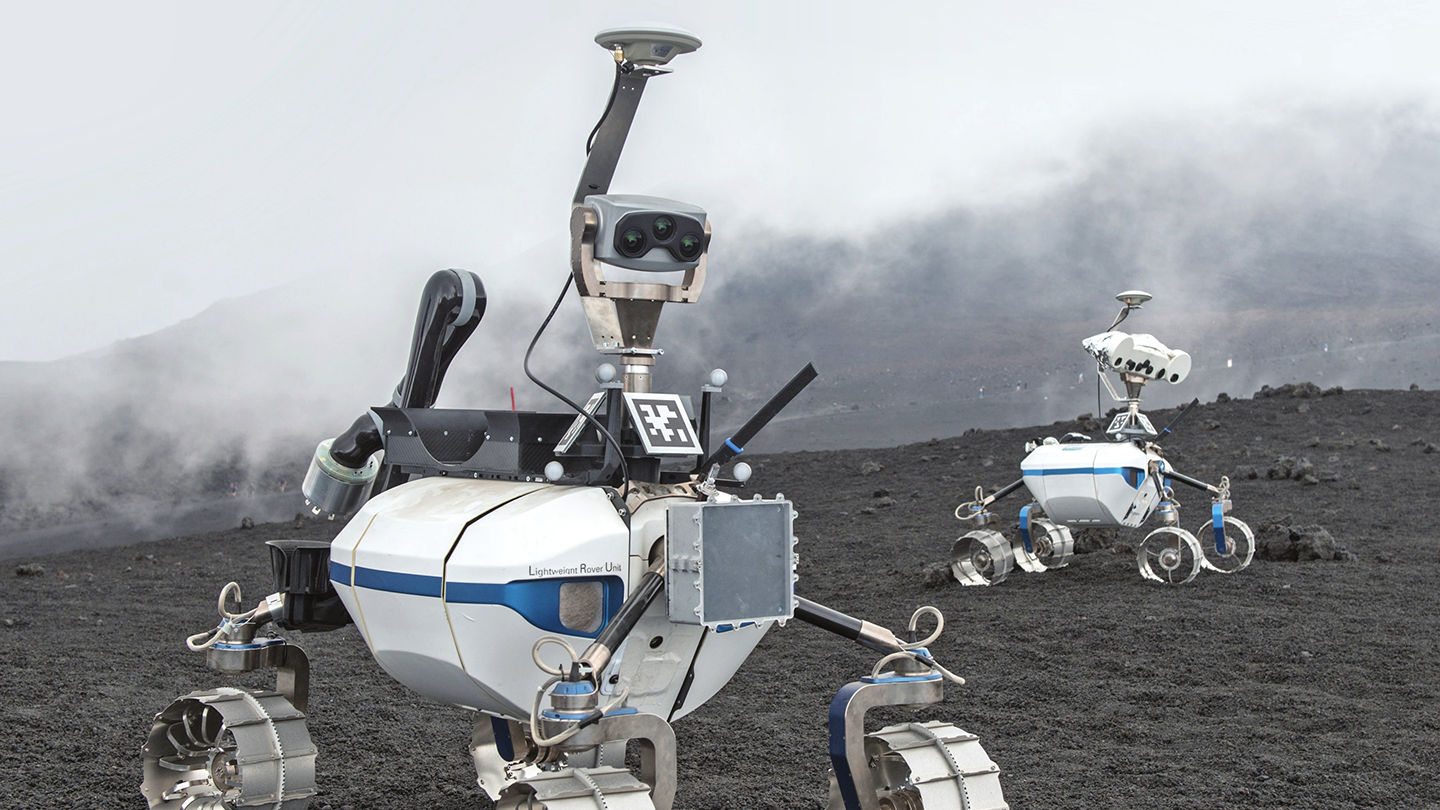
The LRU (Lightweight Rover Unit) is the prototype of a semi-autonomous robot for the exploration of the moon or Mars. It combines a variety of state-of-the-art technologies developed at the Institute of Robotics and Mechatronics, such as the drive and steering units, whose motors have already proven their suitability for space travel for five years on the ISS in the ROKVISS experiment.
Planetary exploration robotics is the key for future space applications maximizing the scientific return, and reaching destinations—inaccessible for humans so far. With DLR’s contributions we are continuing to be an essential partner for national and international missions to extraterrestrial bodies in our solar system. Our main activities in this domain are focused on demonstration and space-flight missions.
To pave the way for these missions, we focus on the development and deployment of mobile systems such as rovers, and legged robots. In addition, we have also spearheaded the qualification and enhancement of the technology readiness level (TRL) with key components and technologies, as well as with the development of methods and skills for advanced robotic systems. The robots operate in an unstructured and unknown extraterrestrial environment, which poses many challenges, ranging from mass and size constraints, to the development of sensors and actuators suitable for extraterrestrial environment conditions. The modular robotic systems developed for these activities are small to medium size and able to collaborate together. They can be equipped with different scientific and robotic tools, which would allow them to be tailored to a wide range of future planetary missions. Furthermore, the efficient operation of robots requires a high level of autonomy to cope with the complex scenarios in combination with significant communication delays. To meet these mission and design goals, we employed a holistic approach of system level development to ensure that all necessary robotic capabilities are sufficiently addressed, including perception, navigation, localization, and object manipulation. DLR’s Mobile Asteroid Surface Scout (MASCOT) lander is part of the on-going Hayabusa 2 mission of JAXA, which should reach its destination of asteroid 1999JU3 Ryugu in 2018. Once successfully landed on the asteroid, its mobility would be provided by the novel mobility unit developed by DLR.
The Robotic Exploration of Extreme Environments (ROBEX) demonstrator mission aims to validate the necessary competence for a complete robotic exploration mission scenario, and has been carried out successfully on the volcanic terrain of Mount Etna, Italy. This mission exercised advanced navigation, localization and object retrieval skills in a complex lunar-analogue terrain, as well as a major scientific application: the exact placement of a seismometric sensor array for deep subsurface signal reconstruction.
With Mt. Etna’s close resemblance of lunar soil and planetary terrain, we have been able to validate key technologies necessary for the next international missions to the Moon and Mars. The core objective of this major effort is to supply robotics technology and assets for NASA missions, and to actively shape national and European space exploration strategies, together with the planetary science program of DLR.