'Urban Liner' by the Technical University of Munich
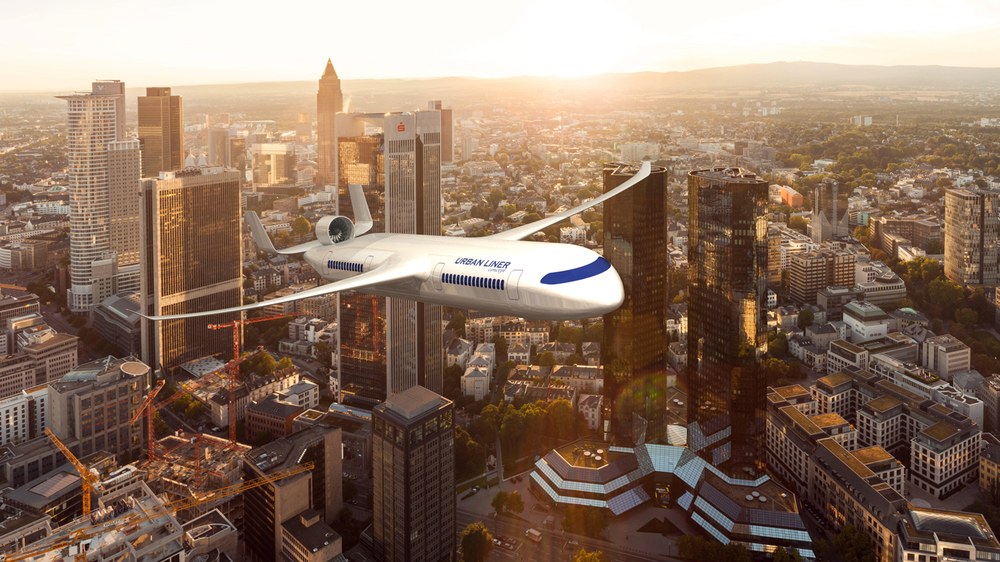
The Munich team's Urban Liner represented a rather unusual-looking aircraft with a hybrid propulsion system. Its most striking feature is the single engine located at the rear between the twin vertical stabilisers. The students calculated that the fuel consumption could be halved and nitrogen oxide emissions reduced by an impressive 80 percent.
Image: 1/3, Credit:
TU München (CC-BY 3.0)
The winning German team from the Technical University of Munich
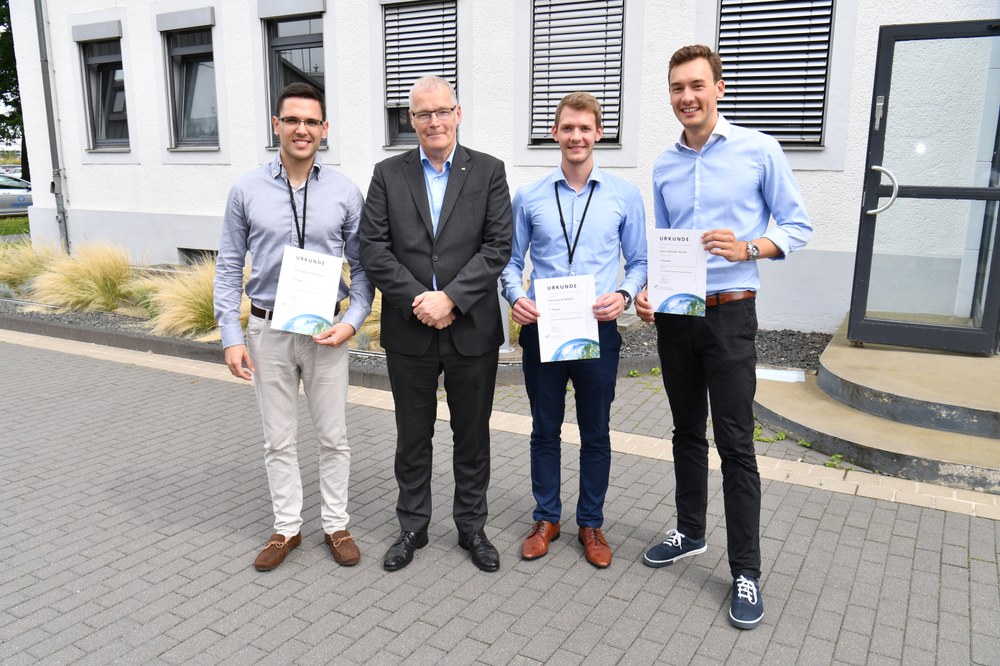
The winning German team of the NASA/DLR Design Challenge (from left to right): George Finelli, Aeronautics Research Director at the NASA Langley Research Center; the Technical University of Munich team of Christian Decher, Daniel Metzler and Soma Varga; and Horst Hüners, DLR Programme Director for Aeronautics Research.
Image: 2/3, Credit:
NASA.
Winners' symposium at the NASA/DLR Design Challenge
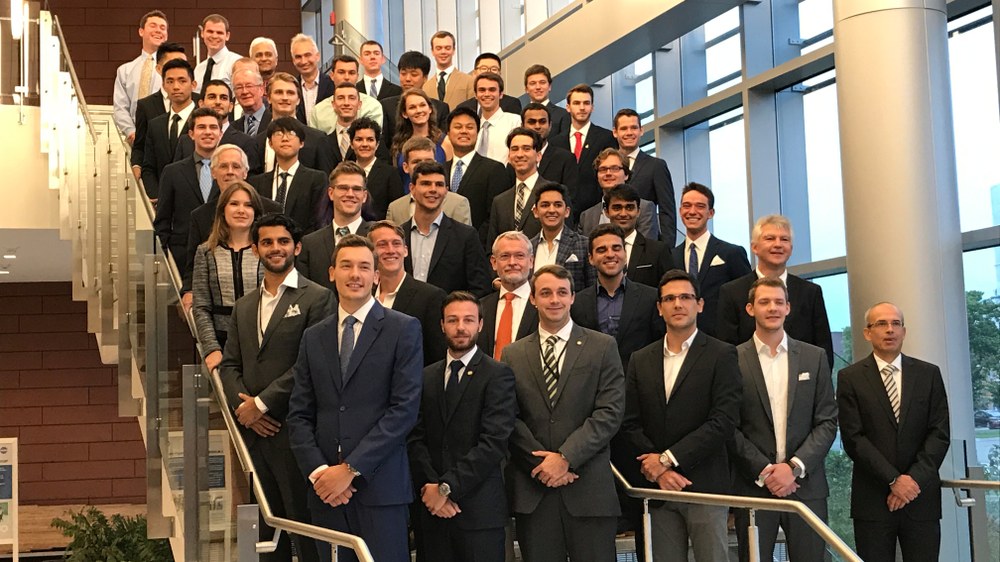
Alongside the winning team from the Technical University of Munich, five US teams presented their future aircraft designs.
Image: 3/3, Credit:
NASA
The first NASA/DLR Design Challenge took place in 2017 and saw students develop a concept for the aircraft of the future.
Sixty-three students from ten teams took part in the competition.
The team from the Technical University of Munich won over the judges with their 'Urban Liner' concept, taking first place.
The first NASA/DLR Design Challenge took place in 2017, asking entrants to submit design proposals for quieter aviation and efficient supersonic jets. The participating teams in Germany and the USA could choose to enter either the 'Low Noise Subsonic Challenge' or the 'Commercial Supersonic Design Challenge'.
Category 1: Low Noise Subsonic Challenge
The goal here was to develop an unconventional commercial aircraft design for entry-into-service between 2025 and 2035 that offered clear improvements, particularly in terms of noise, fuel consumption and emissions. The design needed to cover the entire aircraft and integrate suitable new technologies and innovative configurations. Consideration was to be given to advanced and low-noise propulsion concepts such as open rotors or novel turbofan engines. The aircraft was to be designed to hold at least 200 passengers and deliver efficient flight operations. The targets were to reduce noise emissions by approximately 32 to 42 decibels, reduce nitrogen oxide emissions by approximately 80 percent and to improve energy efficiency by 50 to 60 percent compared to the benchmark 2005 value. Designs had to demonstrate the technical feasibility of these targets through a combination of configuration, propulsion and technologies.
The task here was to put together a highly efficient, eco-friendly supersonic aircraft design that could be brought into operation in 2025 and would allow for commercial supersonic flights while meeting modern-day environmental standards. When creating their design, entrants needed to pay particular attention to the challenges of sonic boom, fuel efficiency, emissions at high flight altitudes and noise – at take-off, landing and along the flight path. The aircraft was required to have a cruising speed of Mach 1.6 to 1.8, a range of 4000 nautical miles and a payload of six to twenty passengers. It was also necessary to achieve fuel efficiency of approximately 3.55 passenger-kilometres per kilogram of fuel and adhere to a maximum runway length of 2133 metres. The design had to integrate suitable high-lift systems and technical solutions aimed at reducing noise and emissions whilst ensuring efficient supersonic flight. Moreover, entrants had to consider concepts that enabled the practical integration of the aircraft into future aviation systems and airport infrastructures.
Ten teams presented their designs in 2017
Following the kick-off event in February 2017 in Hamburg, the ten participating teams were given five months to design their aircraft concepts and write up their summary reports. At the closing event in August in Braunschweig, all teams got the opportunity to present their designs to a judging panel made up of DLR experts. The team from the Technical University of Munich won over the judges with their Urban Liner design, securing first place. Overall, on the German side, 63 students from seven universities took part. The number of teams from various universities on the US side also reached double digits. In autumn 2017, the winning German team visited NASA in the USA, where they presented, alongside the US winners, their work in a symposium featuring internationally renowned aeronautics researchers. "This joint initiative not only fosters young talent but also further strengthens the excellent collaboration between DLR and NASA in the field of aeronautics," commented Rolfe Henke, who was DLR Executive Board Member for Aeronautics at that time.
Aircraft design entries: an overview
First place: 'Urban Liner' by the Technical University of Munich
The Munich team's Urban Liner represented a rather unusual-looking aircraft with a hybrid propulsion system. A core feature is the single engine located at the rear between twin vertical stabilisers. The students estimated that fuel consumption could be halved and nitrogen oxide emissions reduced by an impressive 80 percent.
Winning team from the Technical University of Munich
From left to right: Soma Varga, Rolf Henke (DLR Executive Board Member for Aeronautics), Daniel Metzler and Christian Decher.
Second place: 'HORUS 3000-300' by Aachen University of Applied Sciences
Aachen University of Applied Sciences (FH Aachen) – HORUS 3000-300
Credit:
FH Aachen (CC-BY 3.0)
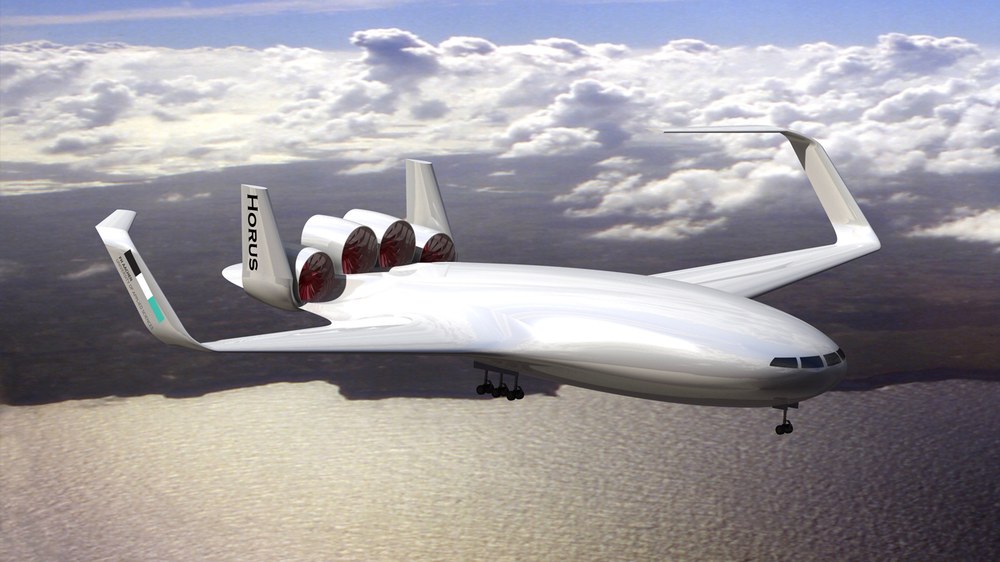
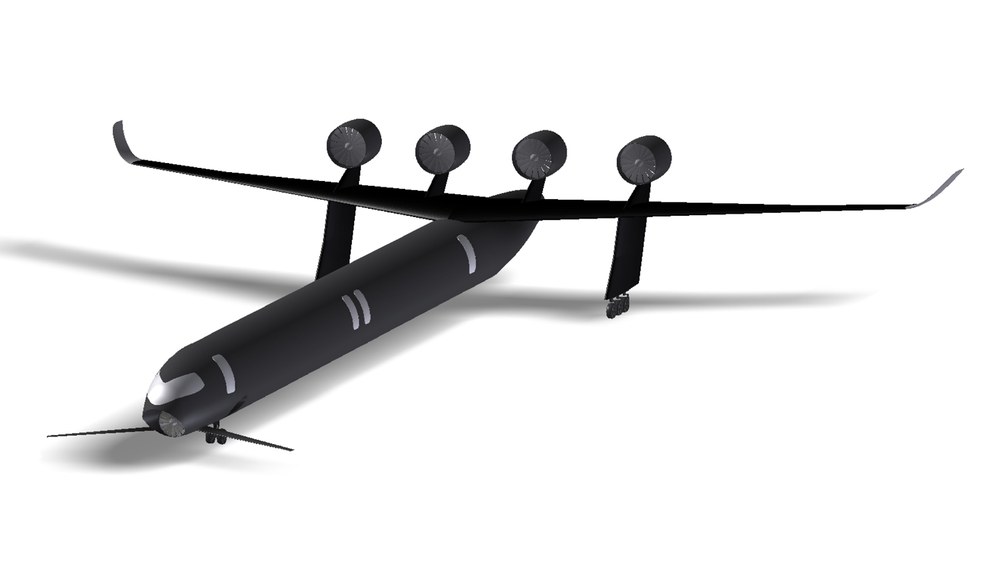
The FH Aachen team combined a blended-wing body with a C-wing. The unswept wing is designed to reduce fuel consumption. A hybrid propulsion system provides the four electrically powered ducted propellers with energy. The choice to replace windows with high-resolution screens reduces the weight. Overall, the potential reduction in fuel consumption was estimated at 33 percent.
Team: Jan Frederik Bremen, Christian Franke, Ole Bergmann, Daniel Hardt, Christina Heitsch, Yohan John, Benjamin Licht, Felix Möhren, Carolina Muñoz, Robert Plante, Johannes Rommeler, Philip Schreiber, Carsten Schabroch and Darius Weber.
Third place: 'HELESA' by the University of Stuttgart
'HORUS 3000-300' by Aachen University of Applied Sciences (FH Aachen)
Credit:
Universität Stuttgart
An innovative concept for supersonic flight – a potentially more eco-friendly successor to the Concorde – was presented by the University of Stuttgart team. Their HELESA concept proposed an elongated aircraft with forward-swept wings. This configuration is designed to keep the sonic boom under 75 decibels.
Team: Daniel Silberhorn and Dominik Schaupp
Fourth place: 'Low Noise Hybrid Passenger Aircraft' by RWTH Aachen University
RWTH Aachen – Low Noise Hybrid Passenger Aircraft
Credit:
RWTH Aachen (CC-BY 3.0)
Forward-swept canard wings and non-retractable tailwheel landing hear – the design submitted by RWTH Aachen University incorporates unconventional ideas to reduce noise and fuel consumption. A gas turbine in the nose powers the ducted propellers.
Team: Jason Bonni, Bianca Burghoff, Eray Dincer, Jonas Felix, Lambert Eichler, Thomas Ferguson, Humza Mirza, Miguel Nuno and Martin Valley