Exoplanet examined, remarkable discovery made: CHEOPS space telescope brings in a rich 'harvest'
| Space
Exoplanet examined, remarkable discovery made: CHEOPS space telescope brings in a rich 'harvest'
Planetary system around the star LHS 1903
This artist's impression shows the planetary system surrounding LHS 1903, a small red M-dwarf star. The system's architecture poses a challenge to planet formation theory, as the sequence of rocky planet – gas planet – gas planet – rocky planet within a single planetary system is unusual and rarely observed. CHEOPS was able to examine this fourth planet in detail. This outer rocky planet, which may have formed later than the others, orbits its star beyond the gas giants.
Credit:
ESA / ATG Europe
The CHEOPS (CHaracterising ExOPlanet Satellite) space telescope has now been operating successfully for six years. Flying at an altitude of 700 kilometres in a polar orbit around Earth, CHEOPS observes individual, carefully selected stars around which planets have already been discovered. Its highly precise photometric measurements record the brightness of these stars to capture transit events.
Happy Birthday, CHEOPS!
The CHEOPS space telescope has been in operation for six years, delivering outstanding contributions to exoplanet research. The DLR Institute of Space Research is part of the scientific team.
Credit:
CHEOPS Consortium
Transit events occur whenever a planet passes in front of its star, causing a slight dim from the observer's perspective. The degree of this decrease in brightness can then be used to determine the planet's radius. If the time between two transit events – the transit period – is known, one can anticipate when to point the telescope at that particular system. This more detailed observation is CHEOPS's core task.
The mission is not primarily designed to search for new planets – the European Space Agency's (ESA) PLATO space telescope will do that from 2027, as the Kepler telescope did between 2009 and 2018. Instead, CHEOPS focuses on individual, already known planetary systems in order to characterise them in greater detail.
Space detective CHEOPS – an ESA mission with DLR components
CHEOPS is an ESA mission led by the University of Bern. The DLR Institute of Space Research in Berlin – established in 2025 through the merger of the DLR institutes of Planetary Research and Optical Sensor Systems – developed two electronic modules for CHEOPS that enable the required measurement precision – and which continue to operate successfully today.
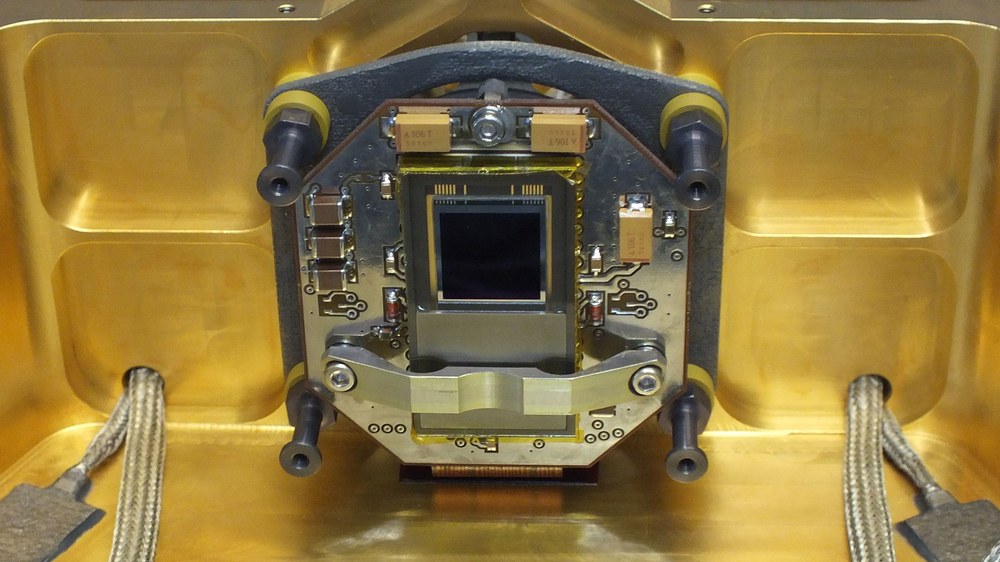
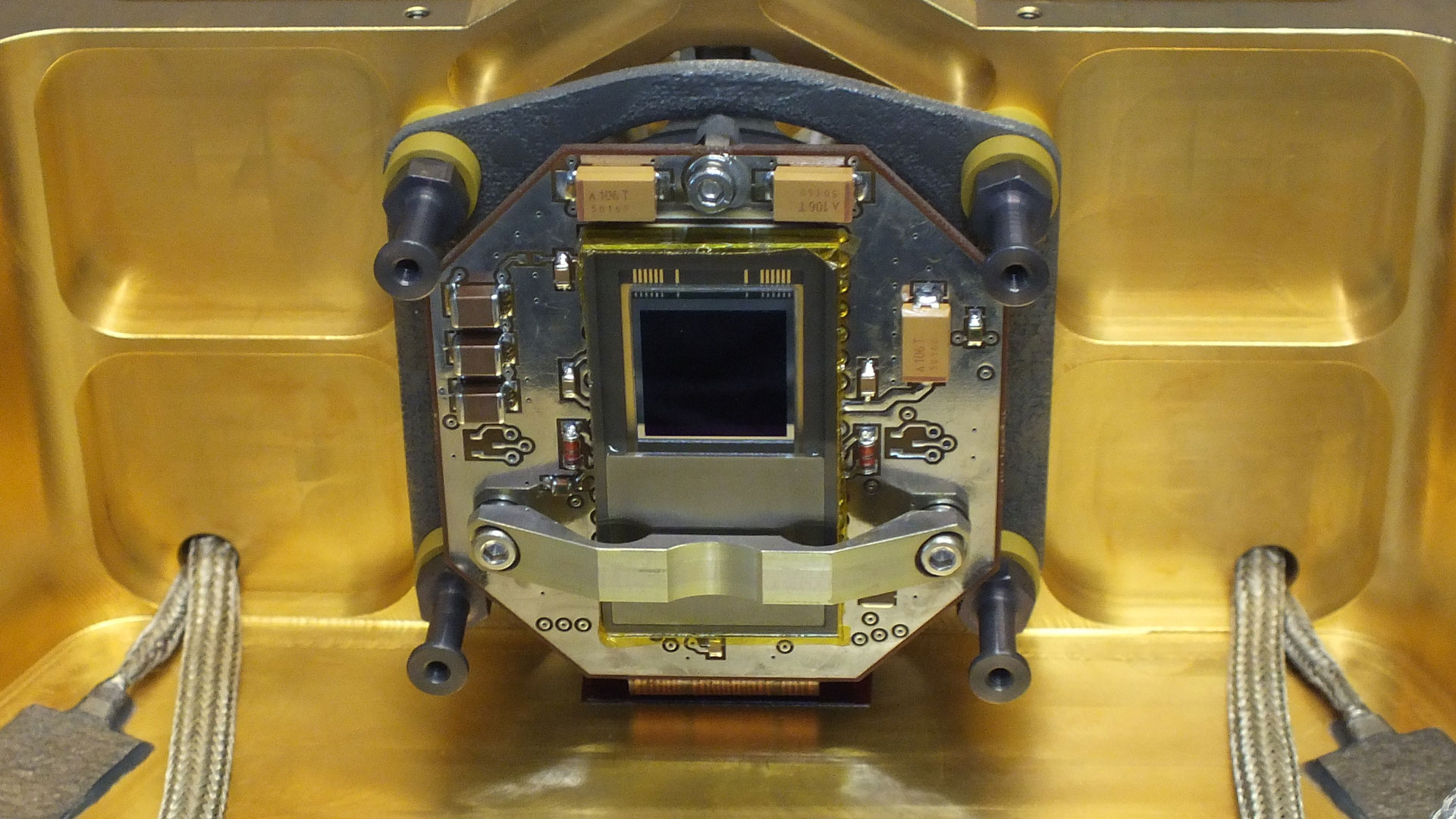
View of the CCD array
The image shows the CCD array inside the focal plane module onboard the CHEOPS space telescope.
The requirements for the thermal stability of the image sensor – a CCD detector, similar to the imaging chip in a digital camera – and the associated low-noise electronics are extremely strict. A precise operating temperature must be maintained at all times, with fluctuations not exceeding one hundredth (1/100) of a degree Celsius. This thermomechanical stability is achieved through a high-precision thermal control system consisting of a passive cooling element – a radiator – and an active heater. The instrument structure, known as a focal plane module, was manufactured from a special beryllium alloy, chosen for its very low thermal expansion and low mass. Only under such conditions can the CHEOPS science team achieve its research goals.
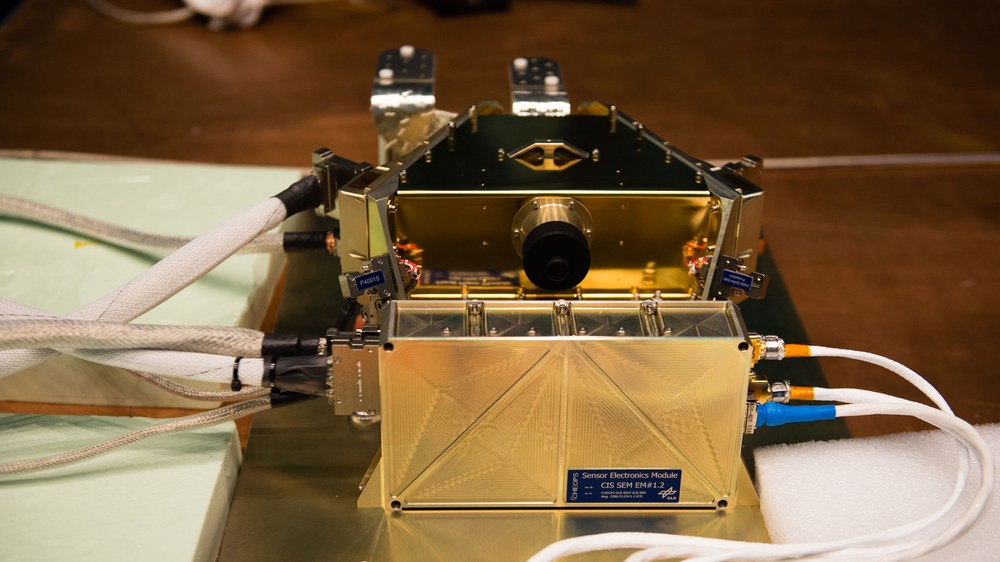
The two DLR units onboard CHEOPS
The Focal Plane Module (FPM, the triangular unit) and the Sensor Electronics Module (SEM) were both developed by the DLR Institute of Space Research in Berlin. The FPM contains the image sensor – the CCD detector array – and the front-end electronics (FEE). The SEM houses a power supply unit and a processor that controls the FEE and reads out the CCD chip. Thermally conductive straps on the back of the FPM provide it with a thermal connection to the heat sinks that keep the CCD's operating temperature of minus 40 degrees Celsius.
Credit:
ESA / C. Carreau
This highly stable temperature control was not present on the CoRoT satellite (2006–2013), nor will it be present on the PLATO telescope, scheduled to launch in early 2027. In both cases, temperature fluctuations in the detector are corrected retrospectively from the light curves.
The 'harvest' of this outstanding engineering work is the scientific data which DLR has been significantly involved in analysing. And, as is often the case in research, there are always surprising findings that could not have been expected or planned for.
A recent example is the planetary system around the LHS 1903, a red dwarf star located 116 light-years away that is roughly half the size of the Sun. Four planets orbit this star – although this was not immediately clear because in astronomy, too, "Rome was not built in a day", and planets are neither confirmed nor characterised through a single observation with a single telescope. Initial data from NASA's TESS satellite, collected between 2019 and 2023, suggested the presence of three planets. Ground-based telescopes confirmed this and provided additional information, including the spectral properties of the star. High-precision measurements with CHEOPS also allowed the planets to be identified and their radii determined more accurately – and even led to the discovery of a fourth planet.
That discovery is not unusual. What challenges our expectations is the arrangement of the planets. In our Solar System, rocky planets are close to the star, then gas giants are on the outside, farther out. But the planets around LHS 1903 follow a different pattern. The innermost planet is rocky, followed by two gas planets. But then the established logic breaks down: the newly identified outermost planet is, once again, rocky.
One possible explanation is that this outer planet formed significantly later, at a time when much of the gaseous material had already been 'used up' by the other two inner gas planets. This poses a challenge to the current theory of planetary formation and evolution, as described in an article recently published in the journal Science.
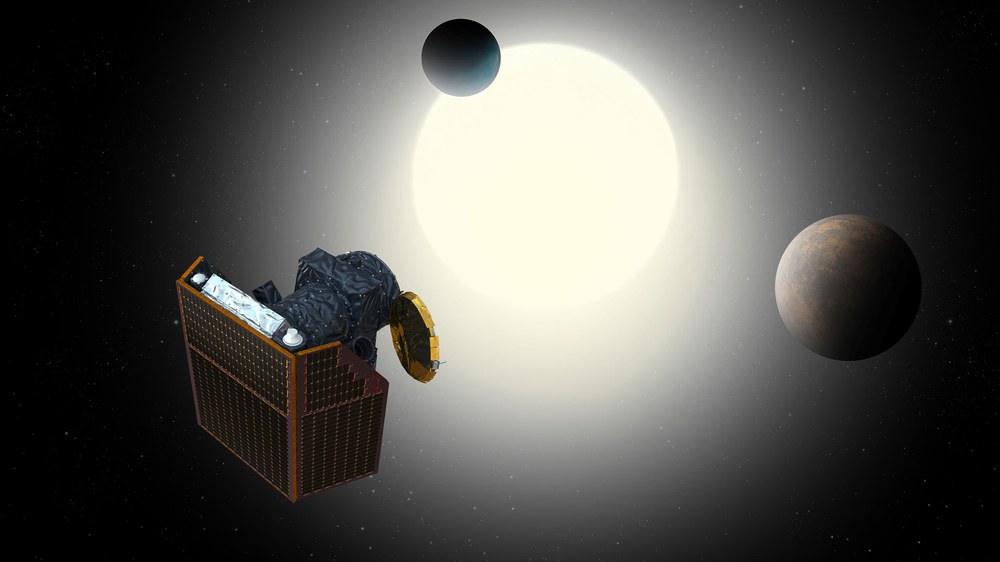
Artist's impression of the CHEOPS satellite
CHEOPS orbits the Earth every 98 minutes, precisely measuring individual exoplanet systems to characterise them more accurately – particularly their radii. The space telescope precisely measures the size of planets as they pass in front of their host stars during transit events. These measurements, combined with existing knowledge of planetary masses, allow a planet's density to be estimated, providing an initial indication of whether it is gaseous or rocky. This first characterisation of these distant worlds – many of which have no counterpart in the Solar System – is a crucial step towards understanding the formation and evolution of exoplanets.
Credit:
ESA / ATG medialab
The CHEOPS mission
CHEOPS captured its first image in February 2020 and has now been operating flawlessly for six years. In 2023, its original mission duration was extended by a further three years, with the possibility of operations continuing through to 2029 – the onboard resources would certainly allow for it. This means CHEOPS could soon be operating in parallel with the PLATO mission. The two missions work in different ways: CHEOPS targets individual stars, while PLATO will observe thousands of stars simultaneously. Because CHEOPS can also observe parts of the PLATO field of view, synergies could arise – for example, during the calibration of the PLATO instrument at the start of the mission.