Congratulations on the milestone – Voyager 1 is now one light-day away
| Space
Congratulations on the milestone – Voyager 1 is now one light-day away
Artist's impression of the Voyager probe
NASA's Voyager 1 probe launched into space in 1977 and has now reached a distance of one light-day from Earth.
Credit:
NASA/JPL
When we have a class reunion, I'm usually part of the organising team. That’s because I live less than 500 metres from our old school. The rest of our class has scattered across the globe: Mark lives in Dubai, Moni in Paris and Akiko is a professor somewhere in Japan. I could visit someone in Prague or in Spain… Only I have literally not 'got very far' in my life so far – I still live in the region where I grew up and I work at DLR's German Space Operations Center (GSOC) in Oberpfaffenhofen.
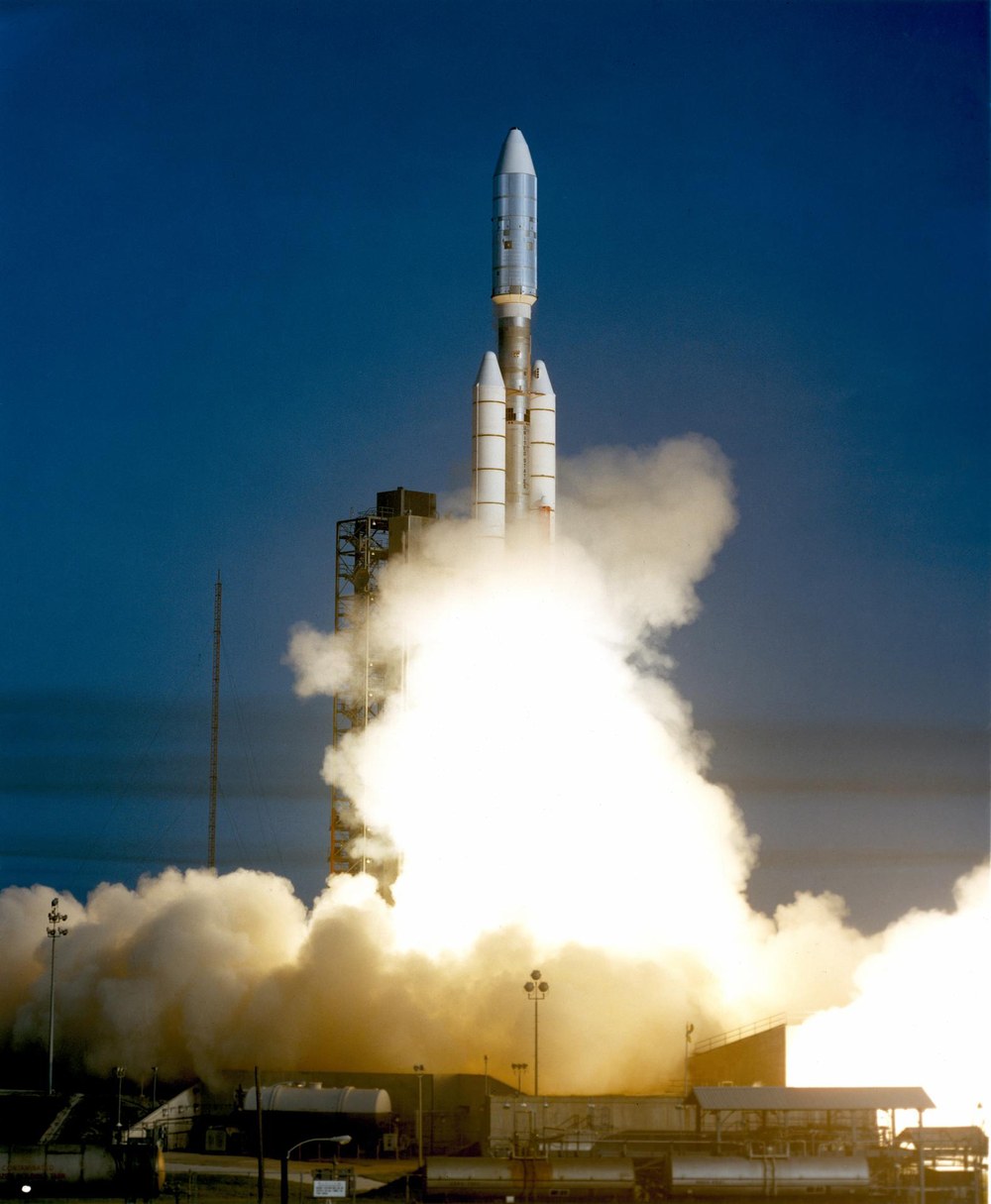
Launch of the Titan IIIE-Centaur rocket carrying Voyager 1
On 5 September 1977, the Voyager 1 probe launched aboard a Titan IIIE-Centaur rocket from Cape Canaveral in Florida (USA).
Credit:
NASA
If you ask yourself how far humankind has got so far, we've set a new record this year. In crewed spaceflight, Artemis II has taken humans further into space than ever before: all the way to the Moon – and a few thousand kilometres beyond.
But setting crewed missions aside, how far have robotic probes already ventured into the Universe? On 18 November 2026 at 11:16 CET, Voyager 1 will be exactly one light-day away from Earth! That is a distance of approximately 26 billion kilometres. We at GSOC would like to offer our warmest congratulations on this milestone in space exploration! The lone wanderer left the region we call our Solar System in 2012 and is now travelling through interstellar space.
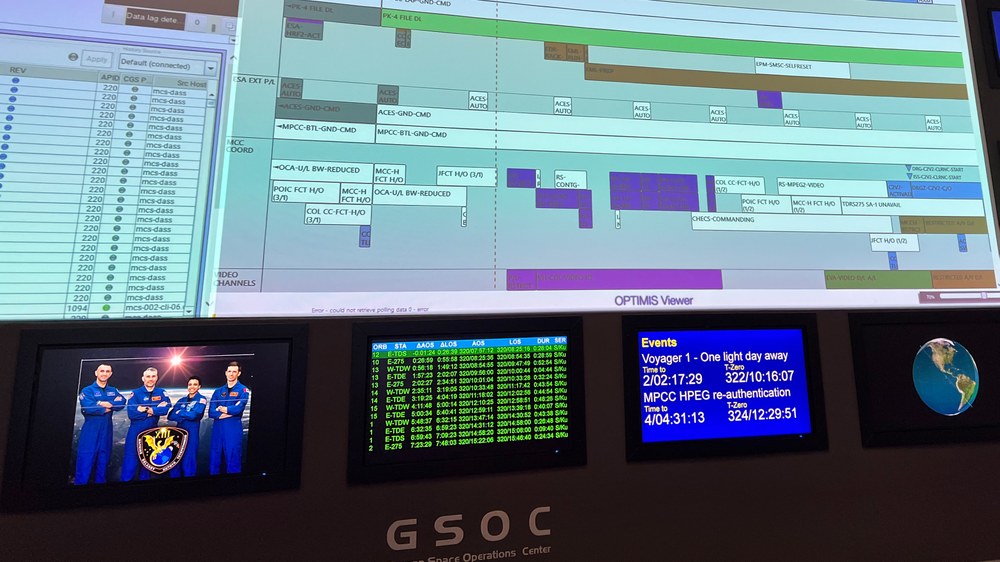
Countdown to the light-day
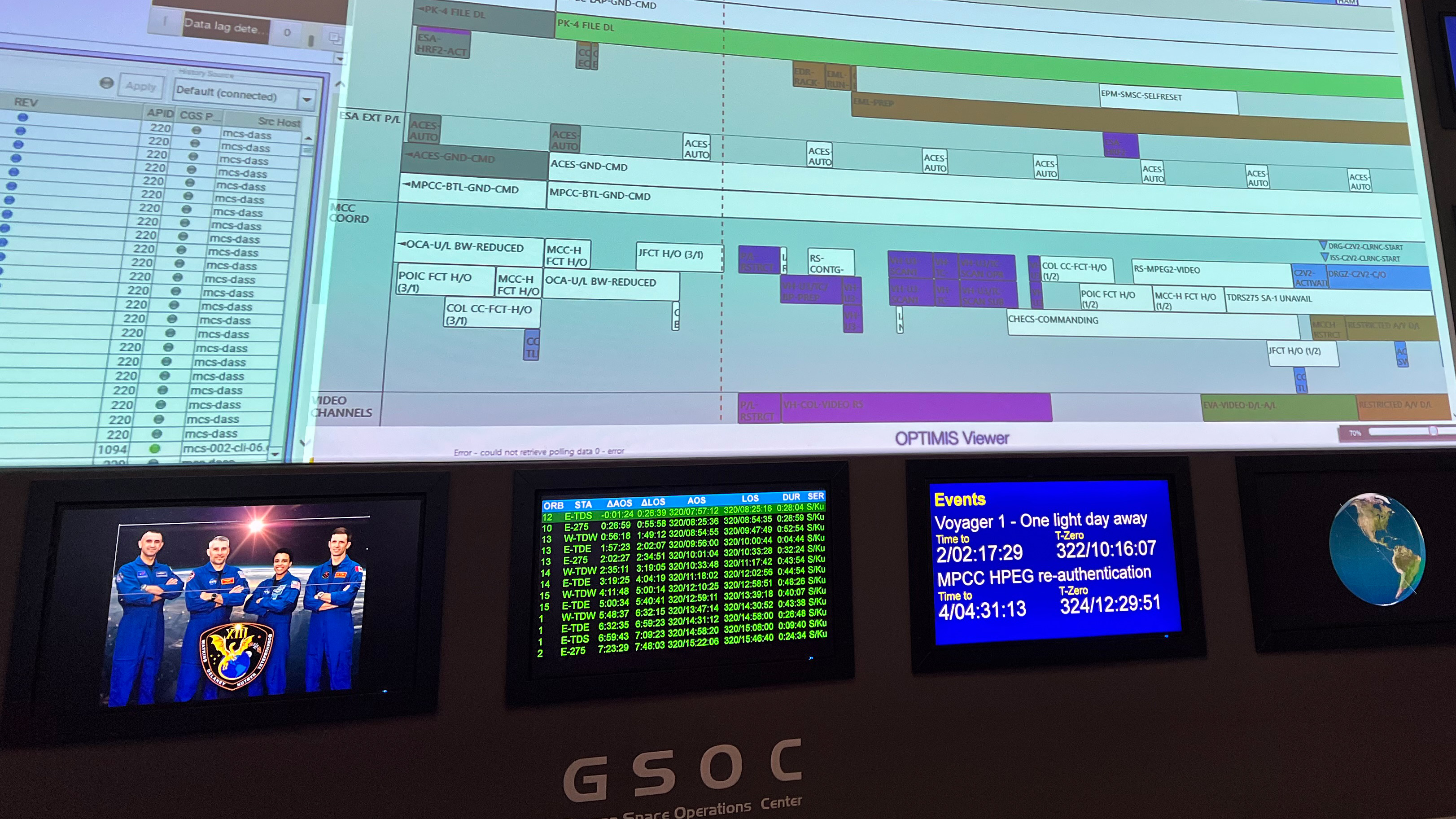
At DLR's German Space Operations Center (GSOC) in Oberpfaffenhofen, staff are eagerly following the countdown to Voyager 1's 'light-day milestone'. The data can be seen on the small blue screen at the bottom right.
A final visual greeting – Voyager 1 sent back family photos of our planets
The NASA probe was launched in 1977 from Cape Canaveral in Florida, the United States, aboard a Titan IIIE-Centaur rocket. We owe most of our knowledge of the outer planets to it and its sister spacecraft, Voyager 2. The probe had its heyday in 1979 and 1980, when it first explored the Jupiter system and then the Saturn system – followed by its sister probe, which subsequently became the only spacecraft so far to visit the planets Uranus and Neptune.
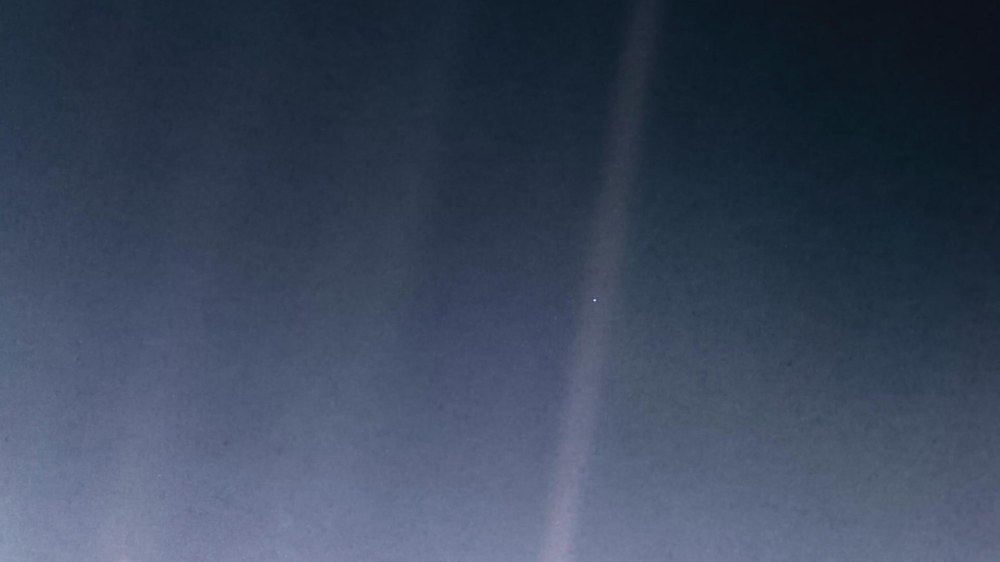
Detail from the 'Pale Blue Dot' image
This detail shows the famous 'Pale Blue Dot' image that Voyager 1 took of Earth in 1990. In it, Earth can be seen in the middle of the photo as a tiny blue dot in the Universe.
Credit:
NASA/JPL-Caltech
In 1990, Voyager 1 made history once again when its camera captured a final, famous series of photographs – a family portrait of our Solar System, featuring all the planets except Mercury and Mars. Earth was visible as the famous 'Pale Blue Dot', which later also gave its name to the mission of ESA astronaut Alexander Gerst in 2014.
Jupiter with its moons Io and Europa
During its flyby, Voyager 1 photographed Jupiter with its moons Io (left) and Europa. This photo dates from 13 February 1979.
Credit:
NASA/JPL
Into the vastness of space at 17 kilometres per second
With every year of the mission, with every kilometre travelled, the distance from Earth increases and, with it, the time it takes for the signal carrying the telemetry data to reach us. Currently, Voyager 1 is covering an incredible 17 kilometres per second – so, by the time you have finished reading this text, Voyager 1 will have covered roughly the distance from Oberpfaffenhofen in Germany to New York. On 18 November, the signal – travelling at the speed of light – will therefore take exactly one day to get home.
But a distance of one light-day means that our NASA colleagues at their control centre in Pasadena (USA) only ever know how the probe was doing the day before. And commands to the probe also take a whole day to arrive, so two days pass before anyone at the console knows whether the command did what it was supposed to do.
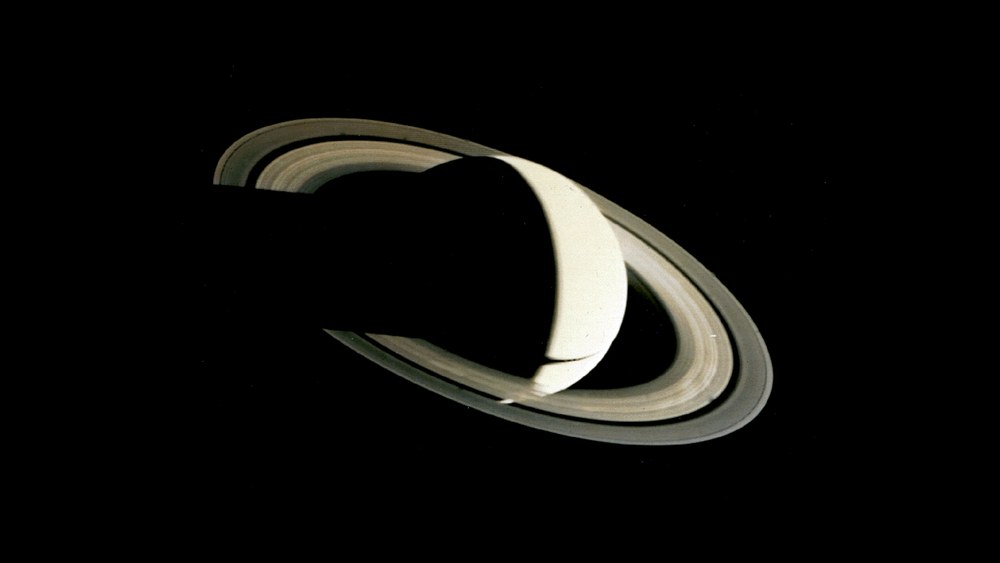
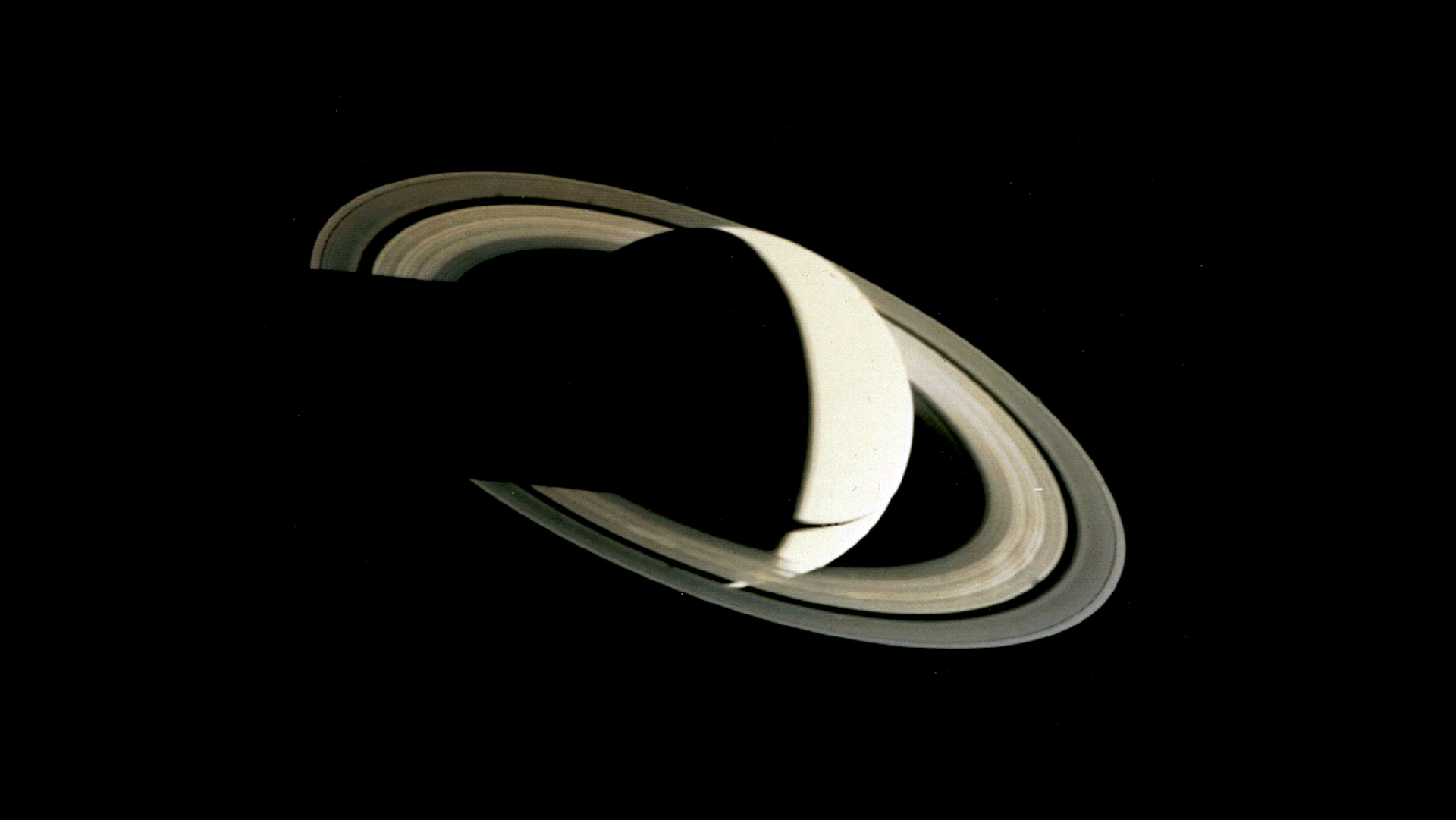
Voyager 1 passes Saturn – an iconic image from the 1980s
Saturn research reached a first high point when, in the course of the Space Age, the space probes Pioneer 11, Voyager 1 and Voyager 2 flew past the Saturn system and studied the planet, its moons and its ring system from very close range. These passes produced unique images that delighted not only scientists. This image from Voyager 1, taken in 1980, became an iconic picture published in countless media outlets: never before had people seen what is, for many, the most beautiful planet in the Solar System so close up and in so much splendour.
That is not the only difficulty. The flight controllers have to work with technology that was developed in the 1970s. Today, an electronic car key has more computing power than the entire spacecraft, and a small light bulb in a fridge uses more power than the on-board transmitter. The content of this website alone would exceed the probe’s total storage capacity many times over.
Many of the instruments on board have now been switched off, and the probe's signal is also getting ever weaker. It can now only be detected with huge antennas and with receivers cooled to minus 269 degrees Celsius. A fraction of a billion-billionth of a watt still arrives… unimaginable! A bacterium has a power 'output' millions of times higher.
A cosmic message in a bottle tells the story of Earth
The golden record of the Voyager probes
Each of the Voyager probes carries a golden record that contains information about life on Earth.
Credit:
NASA/JPL-Caltech
Anyone who tells the story of Voyager must also mention the golden record, which is intended, like a cosmic message in a bottle, to tell any extraterrestrials who may find it the story of humankind and of Earth. Its content would be worth a whole book – for how do you describe our Earth to 'those out there'? How do you convey how this record can be played, how fast it has to turn and how the data on it can be converted into images?
What can one assume is 'shared knowledge' even with super-intelligent extraterrestrials? Perhaps the binary number system? Perhaps the fourteen pulsars that 'pulse' at particular frequencies, chosen by NASA experts to describe the position of the Solar System relative to them, are also known elsewhere in the Universe and can serve as signposts? And with what symbols can all of this be communicated?
The nearest star is more than three light-years away
Will anyone marvel at the golden record any time soon? Now that we, as humankind, and our message in a bottle have got as far as a light-day? Unfortunately, I must dampen the euphoria a little and say a few more words about cosmic distances. The nearest neighbouring star to the Sun in Voyager 1's direction of travel will be Gliese 445, which is moving in our direction. Voyager will pass within about 1.6 light-years of it in approximately 40,000 years, by which time the star will be just 3.45 light-years away from our Sun. Let’s do a rough calculation: we at GSOC in Germany could, in theory, congratulate Voyager 1 on reaching a distance from Earth of one light-year in approximately 18,000 years – but it would then be only a third of the way to Gliese 445.
Despite these huge distances, the whole journey would still be a tiny flea hop within our Milky Way, which is a few thousand light-years ‘thick’ with a diameter of approximately 100,000 light-years. If we suppose that alien record lovers may be in another galaxy, delivery would take a little longer – our nearest neighbour, the Andromeda Galaxy, is 2.5 million light-years away. At Voyager's current speed, that would take 45 billion years to reach – more than three times the current age of the Universe. Once it arrived, who knows what it would see there? Anyone it came across would no longer have to go looking for our Solar System, which would have perished many billions of years earlier.
On these cosmic scales, then, despite Voyager 1's current enormous distance of one light-day, you could say that humankind is a bit like me – we haven't got especially far yet…