
RAMSES mission: RPS and MARIE to investigate asteroid Apophis' passage through Earth's magnetosphere


ESA-Science Office
In previous DLR blog posts, I wrote about the preparations for the scientific investigation of asteroid Apophis by the RAMSES mission – a joint mission of the European Space Agency (ESA) and the Japanese space agency JAXA. At that time, RAMSES had not yet been approved and was officially selected at the ESA Ministerial Council meeting in Bremen at the end of November 2025. The RAMSES space probe is a replica of ESA's Hera mission, with minor modifications to the spacecraft and some new instruments. Like Hera, RAMSES will also deploy two small satellites: the CubeSats 'Farinella' and 'Don Quijote'. However, there is a new feature in the mission profile of Don Quijote: the CubeSat is planned as a lander, with the main objective being to land on Apophis.
Above all, however, I would like to report on the two scientific instruments that are financed almost exclusively with funds from Germany, through the National Space Programme: the RAMSES Plasma Spectrometer (RPS) and the MARIE magnetometer (Magnetosphere-induced Apophis Response Investigation Experiment).
Plasma spectrometer RPS uses journey through Earth's radiation belts
MPS
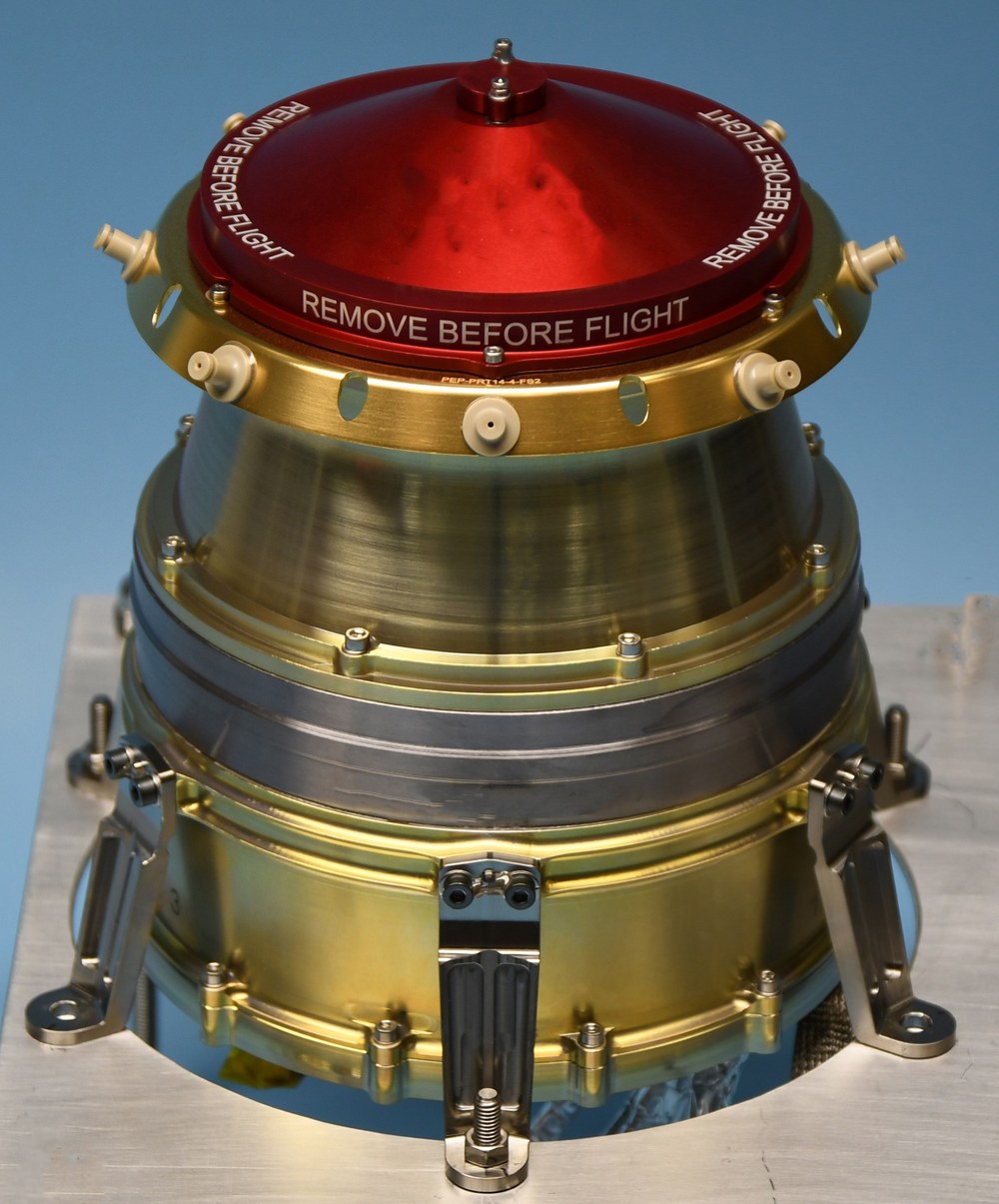
The story of the RAMSES plasma spectrometer does not lead directly from Earth to Apophis but takes a 'small' detour via the planet Jupiter. This is because RPS is an almost identical twin of the PEP–JEI instrument (Particle Environment Package – Jovian Electron and Ion Sensor), which was built for ESA’s JUICE (Jupiter Icy Moons Explorer) mission. The JUICE spacecraft was launched in 2023 and is designed to explore the gas giant Jupiter and its three large moons, Ganymede, Callisto and Europa.
To ensure that problems with instruments can be dealt with at short notice just before the start of the mission, flight 'spare models' are normally built, allowing for a quick replacement if necessary. Fortunately, the spare model was not needed, so it was available at short notice for the RAMSES mission and was selected as an 'opportunity payload'.
The Apophis asteroid will definitely miss Earth, but it will come very close by astronomical standards – at a distance of approximately 32,000 kilometres, it will fly so close that it passes through Earth's outer radiation belt. The plasma environment there is significantly different from that in the solar wind, which is 'free' space not directly influenced by a planetary magnetic field.
RAMSES is the first asteroid mission to carry a high-resolution spectrometer with RPS for measuring positively and negatively charged particles. The mission thus offers, for the first time, the opportunity to study in situ and in detail the different plasma environments of an asteroid and their interactions with its surface. It may also be possible to use the instrument to detect the lifting of dust. At present, the plasma spectrometer is being adapted for the new mission, as a new space probe also has new mechanical and electrical interfaces to the instrument. A small part of the electronics is currently being newly manufactured.
Landing on Apophis with the MARIE magnetometer
IGEP/TU Braunschweig/Magson GmbH
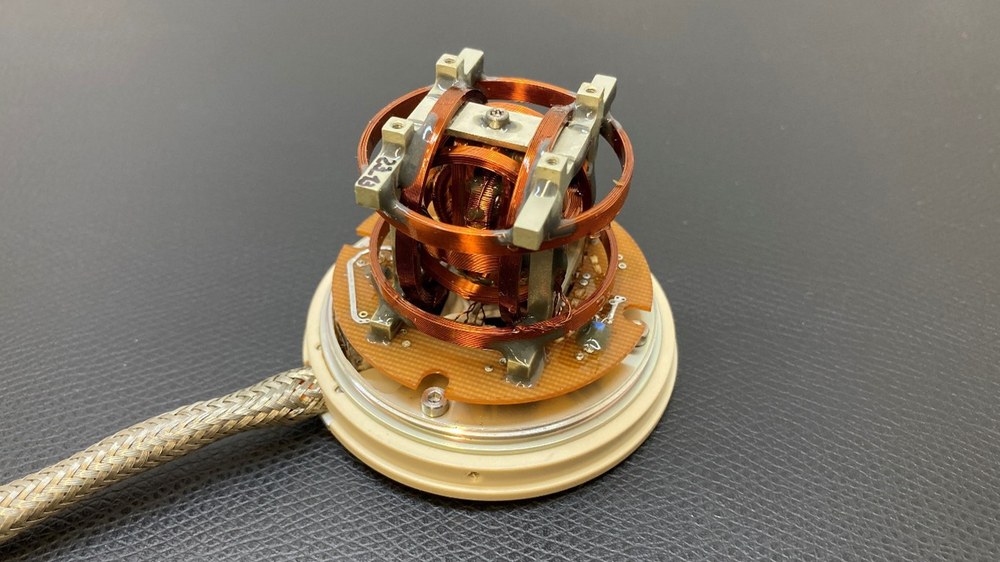
The story of the MARIE magnetometer is quite different. In 2023, the German government's space strategy set out the goal of using small satellites for space exploration. And so began the technological development of a miniaturised scientific magnetometer for small satellites.
The MARIE magnetometer was therefore conceived purely as a technology development project – but the RAMSES mission has now provided an opportunity for its inaugural flight earlier than expected. The plan is for the instrument to fly as a payload on Don Quijote, which is to land on the asteroid. As the lander is a completely new development, the final design of the system, including its scientific payload, has not yet been finalised. However, thanks to ongoing technological development, it will be easy to adapt the instrument to the lander.

ESA
The RAMSES mission offers two highlights for measurements with a magnetometer. Thanks to the possibility of landing on the asteroid, its magnetisation can be measured during approach and landing. Researchers will thus be able to investigate the relationship to meteorites found on Earth and, based on the distribution of possible magnetisation, draw conclusions about the internal structure of the rock. Apophis' close flyby of Earth is also a unique opportunity to study the interaction of a large body with the Earth's magnetosphere. The electrical conductivity and magnetisation of Apophis, as well as dust stirred up by tidal forces or the CubeSat Don Quijote itself, will leave signatures in the magnetic field and plasma. These could then be recorded by the magnetometer on the landed CubeSat.
Findings for Solar System research and asteroid defence
The RPS and MARIE instruments will be able to work together optimally: the orientation of the magnetic field measured by MARIE is valuable information for RPS, as it allows the path and thus the origin of detected charged particles to be reconstructed.
The scientific findings of the RAMSES mission and its instruments will serve to improve our knowledge of asteroids and thus of the formation of our Solar System. They may also one day be useful for planetary defence – for example in the event that it is necessary to actively deflect an asteroid from a collision course with Earth. Although there are currently no known celestial bodies likely to collide with Earth, the better we understand asteroids, the better prepared we will be able to address hazards in future.
Technology developments made in Germany
The Max Planck Institute for Solar System Research in Göttingen is responsible for developing the PEP-JEI and RPS instruments. Part of the electronics is manufactured at the Swedish Institute of Space Physics (Institutet för rymdfysik; IRF). The MARIE magnetometer is being developed by the Institute of Geophysics and Extraterrestrial Physics (IGEP) at the Technical University of Braunschweig. Magnetic field instrument specialist Magson is contributing to the development of the sensor electronics. RPS and MARIE are being supervised at the programme level and financially supported by the German Space Agency at DLR with funds from the Federal Ministry of Research, Technology and Space (BMFTR).
Related links
- DLR blogpost – German scientists present proposals for exploring Apophis
- DLR blogpost – Serendipitous science from asteroid Apophis' Earth near miss
- DLR press release – German-built ESA space probe HERA is ready to take a closer look at near-Earth asteroids
- JUICE – Exploring Jupiter and its moons
- The German Federal Government's Space Strategy
Tags: