Development of a hybridised wood-based material for (semi-)structural components by forming a strand-based composite semi-finished product for mobility applications
The "HyEnd-Wood" project was dedicated to the challenge of replacing conventional materials in the automotive industry with an innovative, sustainable wood-based material. Funded by the Federal Ministry of Food and Agriculture (BMEL) via the Agency for Renewable Resources (FNR), a consortium of six industrial and scientific partners pooled their expertise for three years.
The core objective of the project was the development and evaluation of a novel, hybridised wood-based material designed for (semi-)structural components in vehicles with a significant wood content of over 60 %. The central project objectives included the lightweight construction aspect, which envisaged the realisation of a weight-neutral technology demonstrator with the same or superior functionality compared to existing reference assemblies. Another focus was on high sustainability and resource conservation. This was achieved through a load flow-optimised design using simulation and the possibility of cascading use. Finally, demanding requirements had to be met, including relevant mechanical specifications as well as comprehensive safety, fire and wood protection concepts.
Production of the developed material
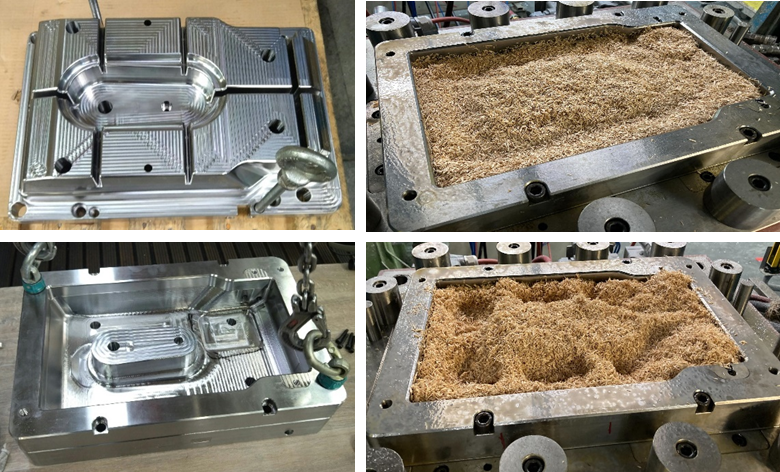
The developed material utilises a combination of strands, a special adhesive system including additives and a finish for wood protection. The result is a free-form, "green" structural material that can be processed in a two-stage process based on the familiar BMC and SMC processes from the CFRP and GFRP sectors. In principle, fresh, residual and waste wood can be used for this without the material properties differing significantly.
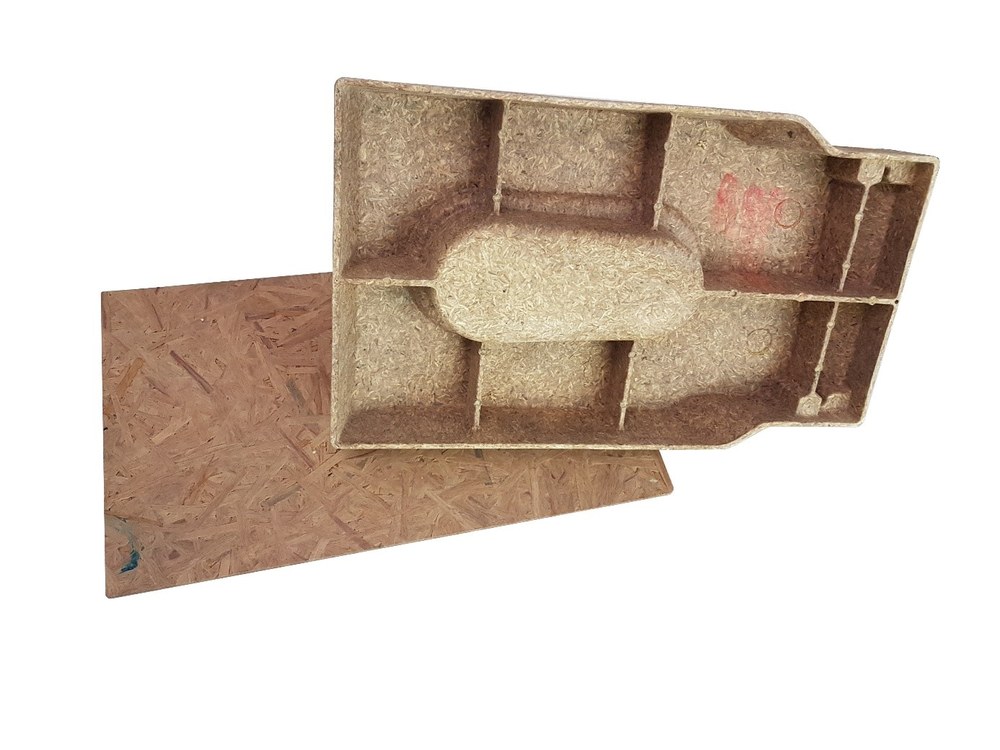
The beech wood-based materials are, on the one hand, a semi-finished product consisting of free-flowing glued beech chips. In a hot pressing process, this is moulded into components of complex geometry that are already very close to the final shape. The wood content of these components is 68 per cent; their mechanical properties are comparable to or better than those of OSB/3 boards.
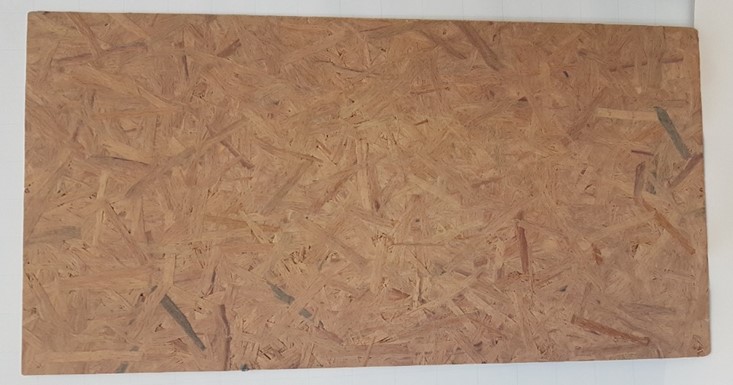
The second material contains 62 per cent wood and consists of beech strips that are first processed into loose semi-finished panels and then into near-net-shape components. It scores with higher strength and stability compared to the first material, but with poorer free-formability.
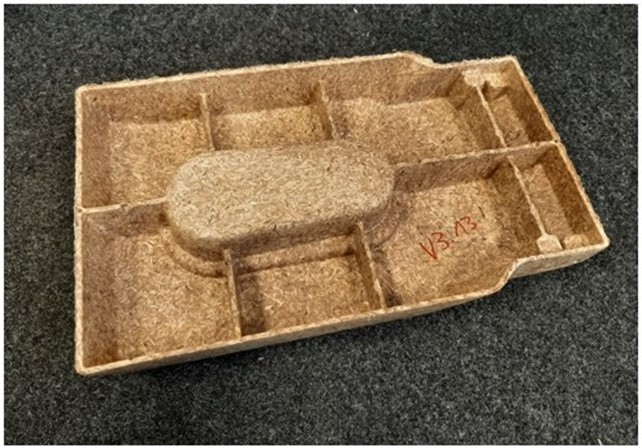
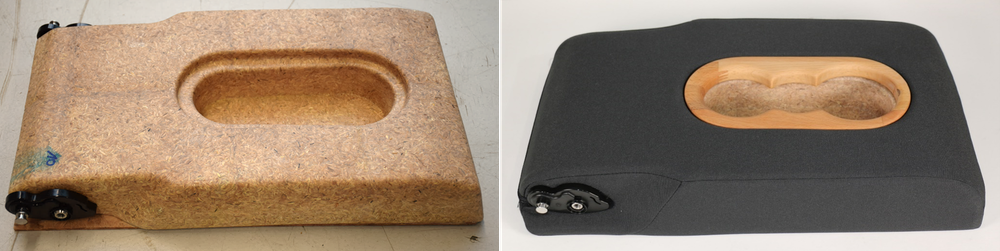
A centre armrest of a mid-range car was chosen as a concrete demonstrator component.
Two material variants in detail:
Process
Wood content
Starting material
Properties
BMC-process
68 %
free-flowing beech chips
High free-formability in hot pressing process for complex geometries; properties comparable to OSB/3 boards.
SMC-process
62 %
beech strips
Better strength and stability than the BMC variant with reduced free-formability.
The demonstrator component was a centre armrest of a mid-range car
Image: 1/3, Credit:
MiTRAS Composites Systems GmbH
Demonstrator component was a centre armrest from a mid-range car.
Image: 2/3, Credit:
MiTRAS Composites Systems GmbH
The demonstrator component was a centre armrest of a mid-range car
Image: 3/3, Credit:
MiTRAS Composites Systems GmbH
Results and conclusion: Proven technical feasibility
The project participants came to the conclusion that conventional materials can be successfully replaced in suitable components, taking into account mouldability, rigidity and production restrictions. The new wood-based materials fulfil many of the required mechanical properties and, in terms of performance, lie between typical wood-plastic composites (WPC) and pure wood panel products.
Top of the armrest in its raw state and upholstered and fabric-covered armrest
Credit:
DLR/Volkswagen AG
Ecological impact and potential
The ecological balance makes these materials a promising option for future vehicle components.
The CO₂ balances already show savings of around 75 per cent in the production phase compared to conventional armrests.
The components have measurable lightweight construction potential and enable recycling and downcycling processes.
Although the technology demonstrator is currently still slightly heavier than the reference (1.635 kg compared to 1.542 kg), there is great potential for further weight optimisation. Before a market launch, specific material and process weaknesses, such as the adhesive system or wood protection in the event of waterlogging, must be eliminated. However, the technical feasibility and sustainability have been clearly demonstrated. Future hybridisations with conventional materials such as steel or aluminium for local reinforcement are conceivable where this is technically feasible.
MiTRAS Composites Systems GmbH, the Fraunhofer Institute for Wood Research Wilhelm-Klauditz-Institut WKI, the Department of Separating and Joining Manufacturing Processes at the University of Kassel and the Institute of Vehicle Concepts at the German Aerospace Centre (project management) worked on the above-mentioned technological developments as partners in the project. They were actively supported by the associated partners Volkswagen AG and Jowat SE.