
A shaker table, deafening noise and icy cold – the PLATO space telescope put through its paces

ESA / G. Porter
The PLATO (PLAnetary Transits and Oscillations of stars) space telescope is scheduled to launch in early 2027, with the goal of searching for Earth-sized planets orbiting Sun-like stars. But before the spacecraft can lift off from the European Spaceport in Kourou, French Guiana, aboard an Ariane 6 rocket, it must demonstrate that it and its scientific payload are fit for launch.
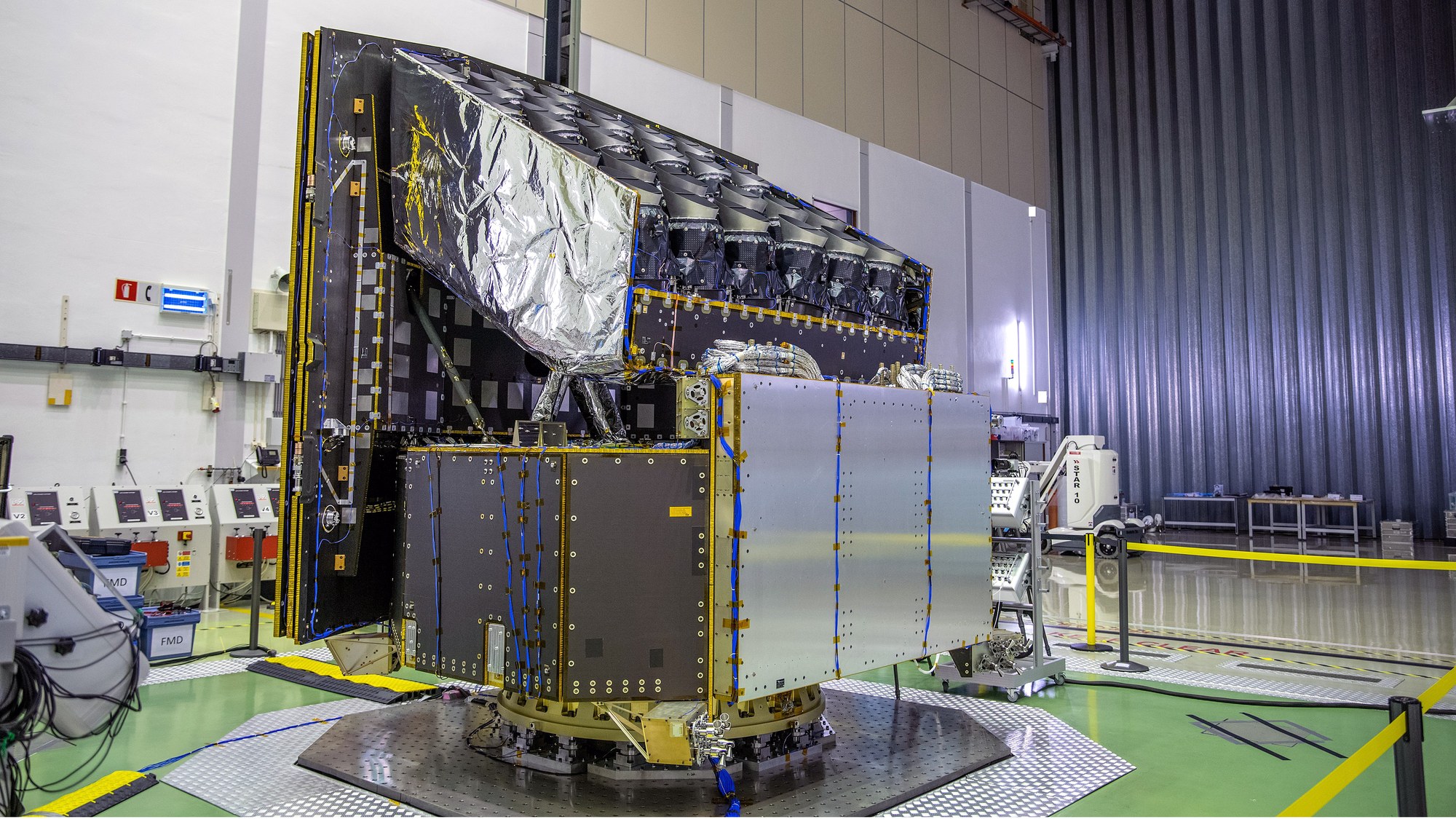
This can only be proven through extensive testing. To that end, the scientific instrument was transported last year from Oberpfaffenhofen, Germany – where it had been assembled by OHB System AG – to the European Space Agency's (ESA) ESTEC test centre in Noordwijk, the Netherlands. The instrument consists of a platform with 26 individual cameras. At ESTEC, the solar panels and sunshield were first installed on the spacecraft, after which the test campaign began to check PLATO's readiness for space.
Shaken, not stirred – PLATO on the shaker
The first examinations were vibration tests, which investigated the behaviour of the instrument when accelerating along all three spatial axes. These tests simulated the intense shocks and vibrations that PLATO will be exposed to during launch. The vibration tests were initially carried out in the vertical direction, along the Z-axis, and then with a lateral shaker along the other two directions (X and Y axes).
Each test run lasted one minute, during which the frequency of the vibrations was gradually increased from five to 100 hertz. At higher frequencies, the rapid movements are no longer visible to the naked eye, but the rumbling inside the satellite caused by the intense shaking can be heard. The sound comes in bursts and gets louder as the shaker reaches resonance frequencies and causes the spacecraft to vibrate more intensely.
The first few minutes after a satellite is launched are the toughest, due to the extreme vibrations generated during the rocket's lift-off. These tests help ensure that no parts of the space hardware are damaged during launch and that the satellite behaves as expected.
Hellish noise during acoustic testing
ESA / G. Porter
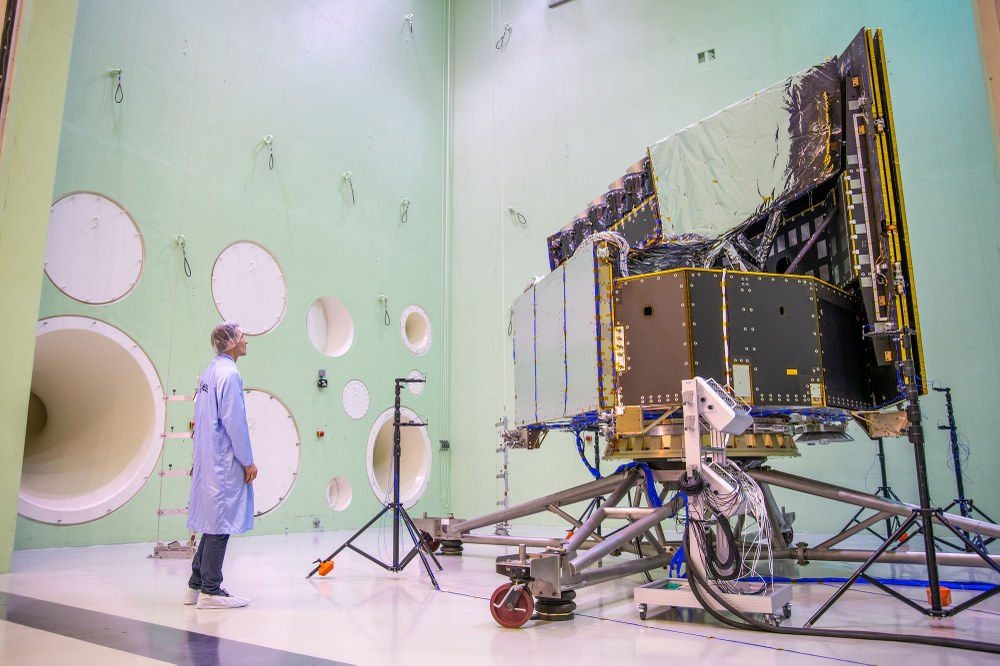
Following the vibration tests, PLATO was transferred to ESA's acoustic test chamber, the Large European Acoustic Facility (LEAF). There, the spacecraft was blasted with deafening noise similar to the roar of a launch. During lift-off, the mechanically transmitted loads caused by vibrating air arise from the payload fairing, which protects the satellite from pressure and heat as it ascends through the atmosphere. PLATO also passed this test with flying colours.
Such vibration and acoustic tests, as well as the subsequent thermal tests, are individually tailored to each spacecraft and carried out in a defined sequence. This allows potential weak points to be identified in advance. Before testing, sensors are attached to the satellite and monitored in real time to verify that it behaves as expected. Functional tests are then conducted to determine whether the tests have had any negative impact on the system.
Deep freeze at almost minus 200 degrees Celsius

ESA 2002
The next trial for PLATO will take place in Europe's largest vacuum chamber – ESA's Large Space Simulator. In this large cylindrical container – 15 metres high and ten metres in diameter – tests will be carried out to determine whether PLATO can withstand the harsh environmental conditions of space. The ESA team will simulate extreme space temperatures, vacuum conditions and solar radiation.
Space-like temperatures are recreated by cooling the chamber walls with liquid nitrogen to approximately minus 198 degrees Celsius (77 kelvin). Despite these extremely low temperatures, heat still has to be managed: unlike on Earth, in space the heat generated by power consumption or solar radiation is not dissipated by air. Instead, it is conducted through materials to a 'radiator', which then radiates the thermal energy into space. These systems can only be tested under vacuum conditions.
The vacuum generated in the chamber corresponds to a pressure of 5 x 10⁻⁴ pascal. This is equivalent to approximately 1014 molecules per litre and is therefore roughly 100 million times thinner than Earth's normal atmosphere. Space itself is even 'emptier', with only approximately 1000 molecules per litre – conditions that cannot be reproduced on Earth.
Once all tests have been successfully completed, PLATO will be ready for transport to South America and its launch in January 2027.
Related links
Tags: