January 15, 2026 | Search for Earth-like planets in the Milky Way
PLATO exoplanet telescope passes vibration test
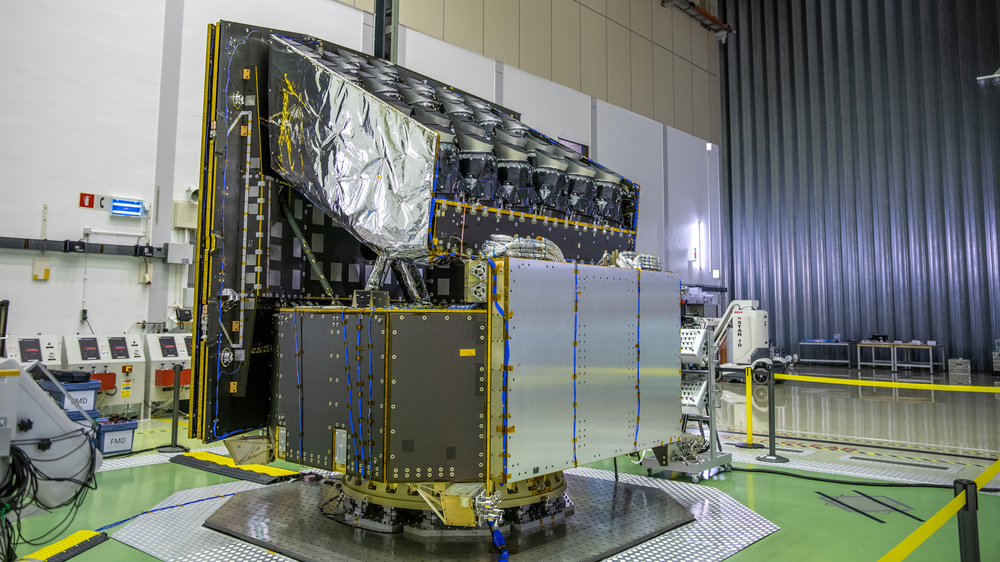
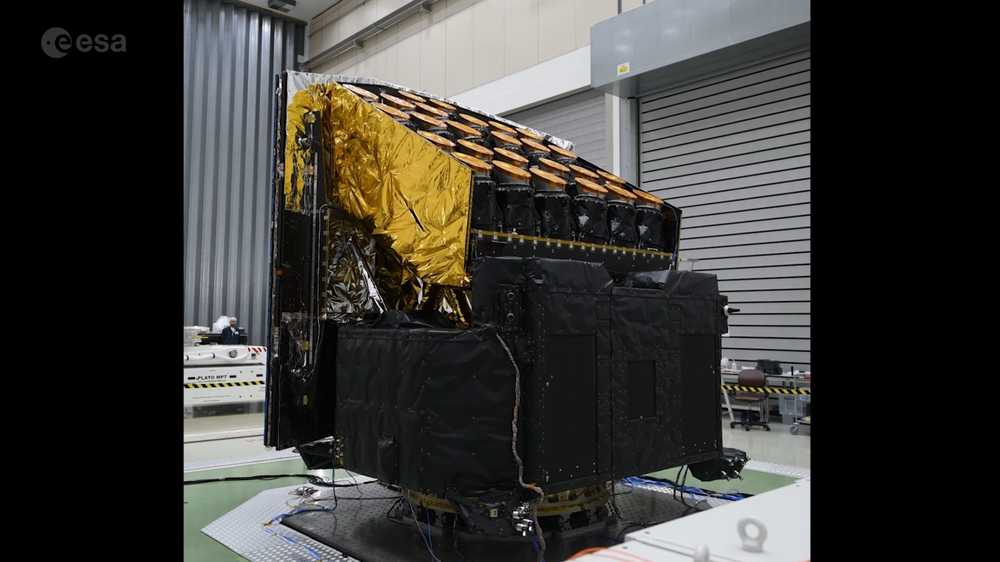
PLATO space telescope on the QUAD shaker at ESA's ESTEC test centre
PLATO positioned on ESA’s QUAD shaker to simulate the vibrations experienced during rocket launch. This test is important to ensure that the spacecraft can withstand the first few minutes of launch, when the strongest vibrations occur. PLATO is equipped with 26 cameras.
Image: 1/3, Credit:
ESA / G. Porter
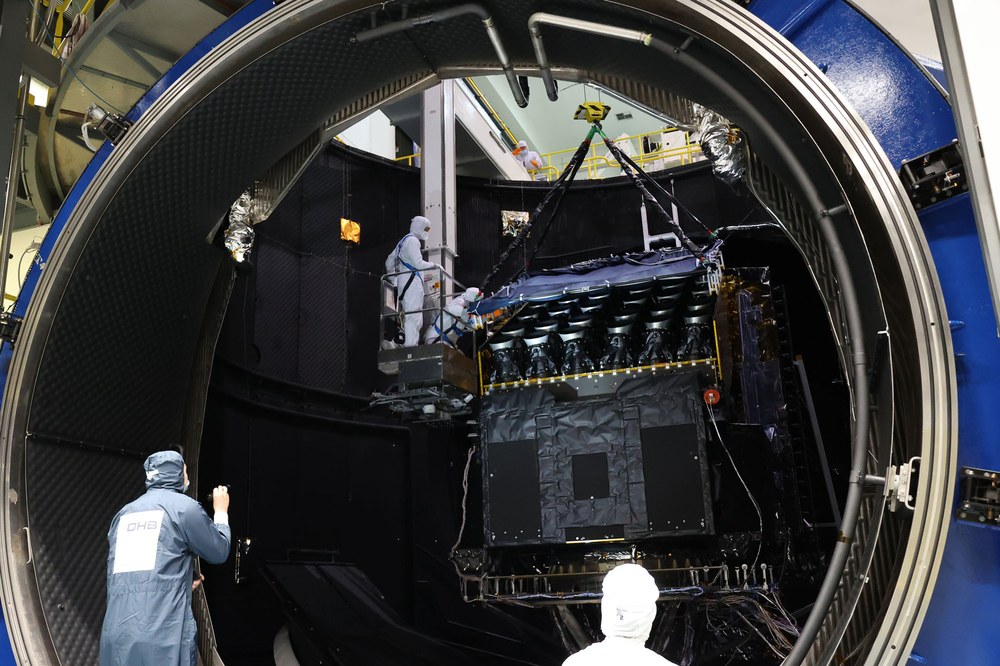
PLATO in the Large Space Simulator (LSS) at ESA's ESTEC test centre
After completing the stress tests in ESA's Large Space Simulator (LSS), where space-like conditions can be recreated on Earth, the PLATO satellite is lifted out of the facility using a special crane. PLATO is scheduled to launch in early 2027.
Image: 2/3, Credit:
ESA
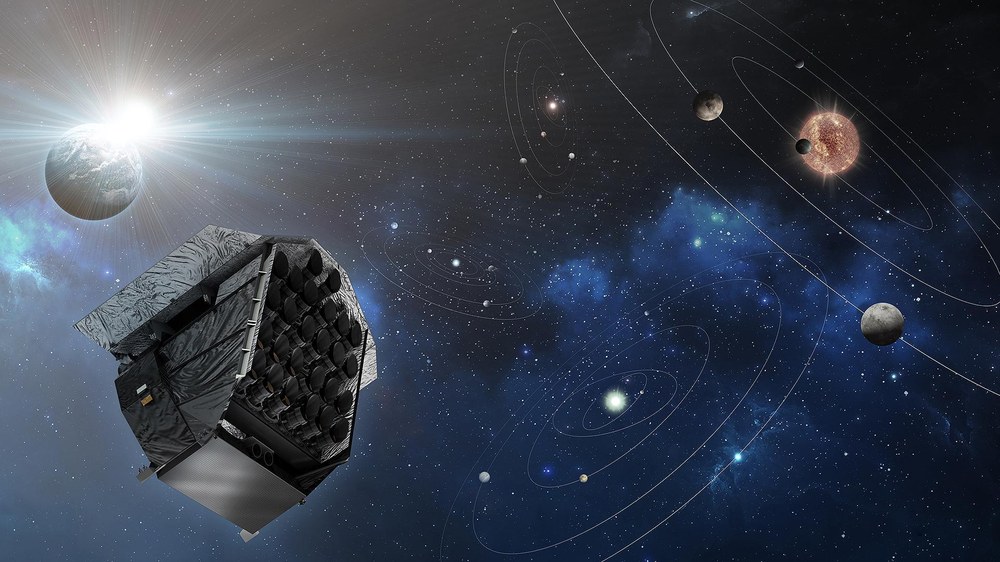
Space exploration – PLATO (artist's impression)
PLATO (PLAnetary Transits and Oscillations of stars) is a space telescope and the third of five missions by the European Space Agency (ESA) as part of the Cosmic Vision 2015-2025 programme. PLATO is cheduled to launch in early 2027, the mission will then begin its search for Earth-sized planets outside our Solar System.
Image: 3/3, Credit:
OHB System AG
ESA's PLATO spacecraft is currently undergoing a series of environmental tests, necessary to ensure it can withstand the stresses of launch and the harsh conditions of space.
The tests carried out so far – most recently the vibration test – have been completed successfully.
From 2027, PLATO will search for Earth-like exoplanets orbiting Sun-like stars.
Focus: Space, space exploration, exoplanets
+++ Update: 23 April 2026 +++
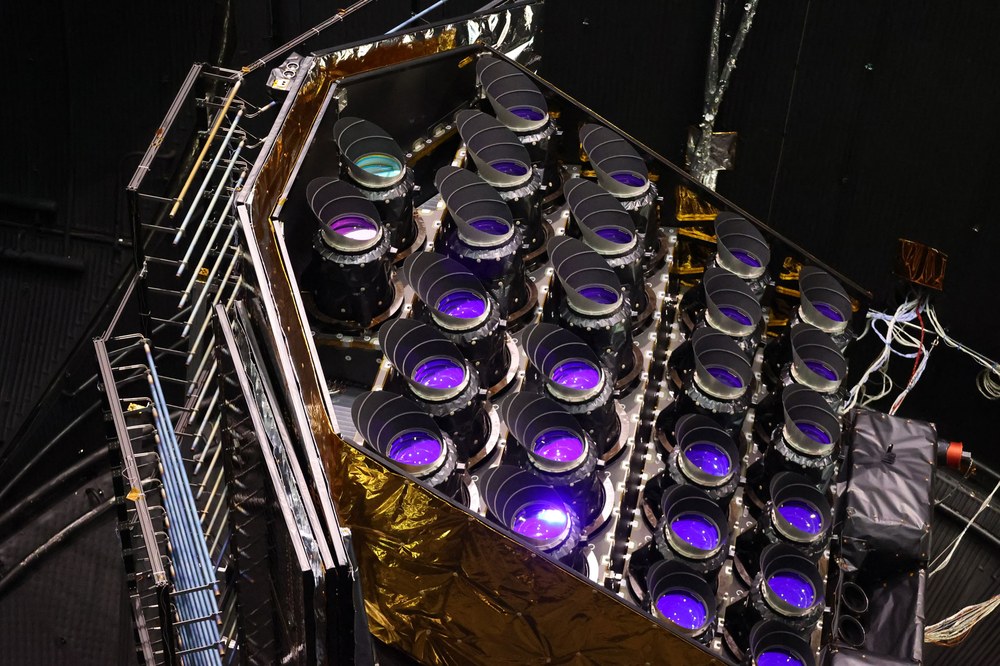
View of the PLATO camera system in the space simulation chamber
The top of the PLATO satellite inside the Large Space Simulator (LSS) at ESA after the chamber was reopened following tests. Visible are the 26 highly sensitive cameras. With these, the mission will observe over 150,000 bright stars from 2027 onwards and search for Earth-like planets in orbit around them. The tests conducted in the LSS aimed to verify the functionality of the cameras under the harsh conditions of space.
Credit:
ESA
The PLATO space telescope has passed its latest rigorous tests. In the Large Space Simulator (LSS) at ESA’s ESTEC test centre in Noordwijk, the Netherlands, PLATO was exposed to the harsh conditions of space with all components in full operation: vacuum and extreme temperatures ranging from minus 90 up to 150 degrees Celsius. The satellite passed all tests and has thus taken another significant step towards its planned launch in early 2027.
PLATO's eyes under stress test
PLATO will search for Earth-sized planets – which may also turn out to be Earth-like once further insights have been gathered through ground-based measurements as part of the PLATO mission. To achieve this, the precision of the 26 highly sensitive cameras must be ensured at all times. For this reason, special tests were also conducted in the LSS to verify the correct operation of the cameras onboard PLATO under the thermal conditions of space. One crucial aspect is that the focus of the cameras (required for the necessary sharpness of the images) must always be maintained through very precise temperature control within the satellite.
PLATO (PLAnetary Transits and Oscillations of stars) – the European Space Agency (ESA) mission to discover Earth-like exoplanets – has successfully passed its first series of tests. These ensure that the spacecraft will be fit for launch and for its stay in the harsh environment of space. On board is the PLATO telescope. Scheduled to launch in early 2027, the mission will then begin its search for Earth-sized planets outside our Solar System. Germany is playing a major role in the construction of the telescope, its operation and the scientific analysis of its data. German contributions and the international science team are coordinated by the German Aerospace Center (Deutsches Zentrum für Luft- und Raumfahrt; DLR).
The vibration tests are divided into three phases. In the ESA video, PLATO can be seen mounted on a 'quad shaker', where it is shaken up and down along the Z-axis. In the other two phases, the spacecraft is shaken back and forth on a 'lateral' shaker along the X and Y axes.
Each test run lasts one minute, during which the frequency of the vibrations is gradually increased from five to 100 hertz (vibrations per second). At higher frequencies, the motion is no longer visible to the human eye, but a low 'rumbling' sound can be heard from inside the spacecraft.
As this video shows, the tests involve vigorously shaking PLATO to simulate the strong shocks and vibrations that the spacecraft will be exposed to during launch.
Video: PLATO all shook up – the vibration test
Your consent to the storage of data ('cookies') is required for the playback of this video on Quickchannel.com. You can view and change your current data storage settings at any time under privacy.
Video: PLATO all shook up – the vibration test
As this video shows, the tests involve vigorously shaking PLATO to simulate the strong shocks and vibrations that the spacecraft will be exposed to during launch.
Credit:
ESA
Stress tests for the demanding launch into space
Due to the extreme vibrations during rocket lift-off, the highest loads on a spacecraft occur in the first few minutes after launch, when it sits atop the rocket. This makes extensive ground testing essential to ensure that no hardware components come loose or are damaged during launch. Following the vibration tests, the spacecraft was taken to the acoustic test chamber, where it was exposed to deafening noise similar to that experienced during launch, which can also cause damage. This test was also completed successfully, as expected.
Next on the agenda for PLATO is ESA's Large Space Simulator – Europe's largest vacuum chamber – where the spacecraft will be tested to check whether it can withstand the extreme temperatures and vacuum conditions of space.
The ESA mission PLATO (PLAnetary Transits and Oscillations of stars) will use 26 cameras to search for Earth-sized planets orbiting Sun-like stars. Its goal is to identify exoplanets that orbit in the 'habitable' zone around their host star.
PLATO's scientific instruments – cameras and electronic units – were provided as part of a collaboration between ESA and the PLATO mission consortium, which consists of various European research centres, institutes and industrial companies.
DLR coordinates international cooperation
DLR leads the international PLATO mission consortium and contributes supporting hardware and software, particularly for the calibration, operation and execution of the readout electronics of the two fast cameras, as well as the payload computer and parts of the on-board data processing. DLR is also responsible for demonstrating and verifying overall system performance at various stages of the PLATO project and is involved in the scientific evaluation of the data.
Parts of the payload development, the data centre, the data pipelines and the operation of the payload from early 2027 onwards are financed by the German Space Agency at DLR with funds from the German government.