
Solar eclipse 2026 – pitch-black Sun and 'falling stars'

ESO
- On 12 August 2026, the next solar eclipse will take place in the northern hemisphere from 17:34 until approximately 22:00 CEST.
- In Europe, the total solar eclipse will be best observed under cloudless skies in Iceland, the Iberian Peninsula and the Balearic Islands.
- Across Germany, the partial solar eclipse will be visible as early as 19:12 CEST (Sylt) until sunset at 21:04 CEST (Kleve) at the latest. In the southwest (along the line from Freiburg im Breisgau to Konstanz on Lake Constance), the maximum percentage of the Sun’s disc covered will reach 90 percent.
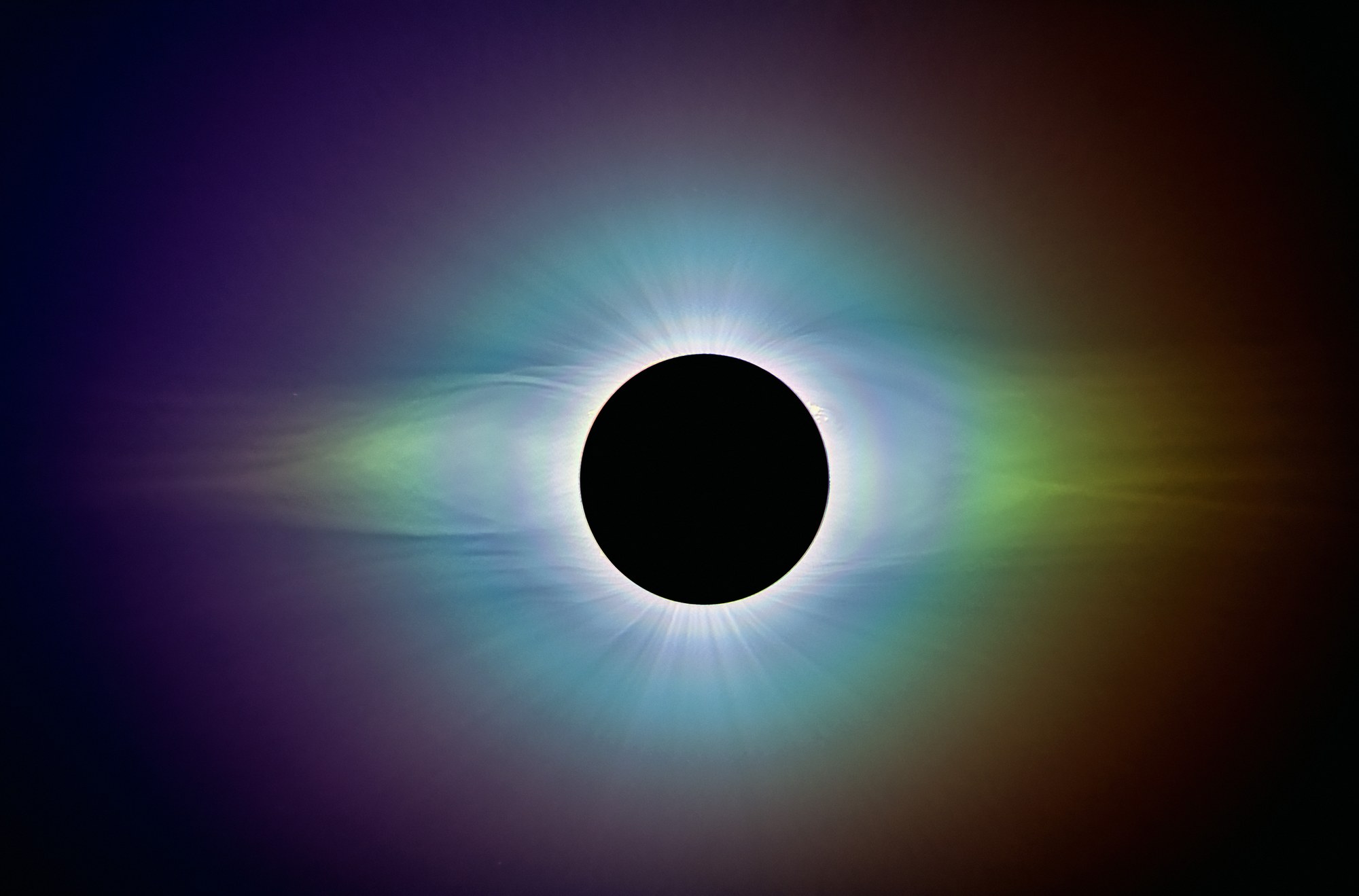
A total solar eclipse captivates almost everyone. Even for those unable to experience this moving natural spectacle within the narrow zone swept by the new moon's umbra – the dark, inner core of its shadow – the partial obscuring of sunlight by Earth’s companion in space is still extremely impressive. On 12 August 2026, it will happen again.
Global path – from the Bering Sea to the Cape Verde Islands
Eclipse Predictions by Fred Espenak, www.EclipseWise.com
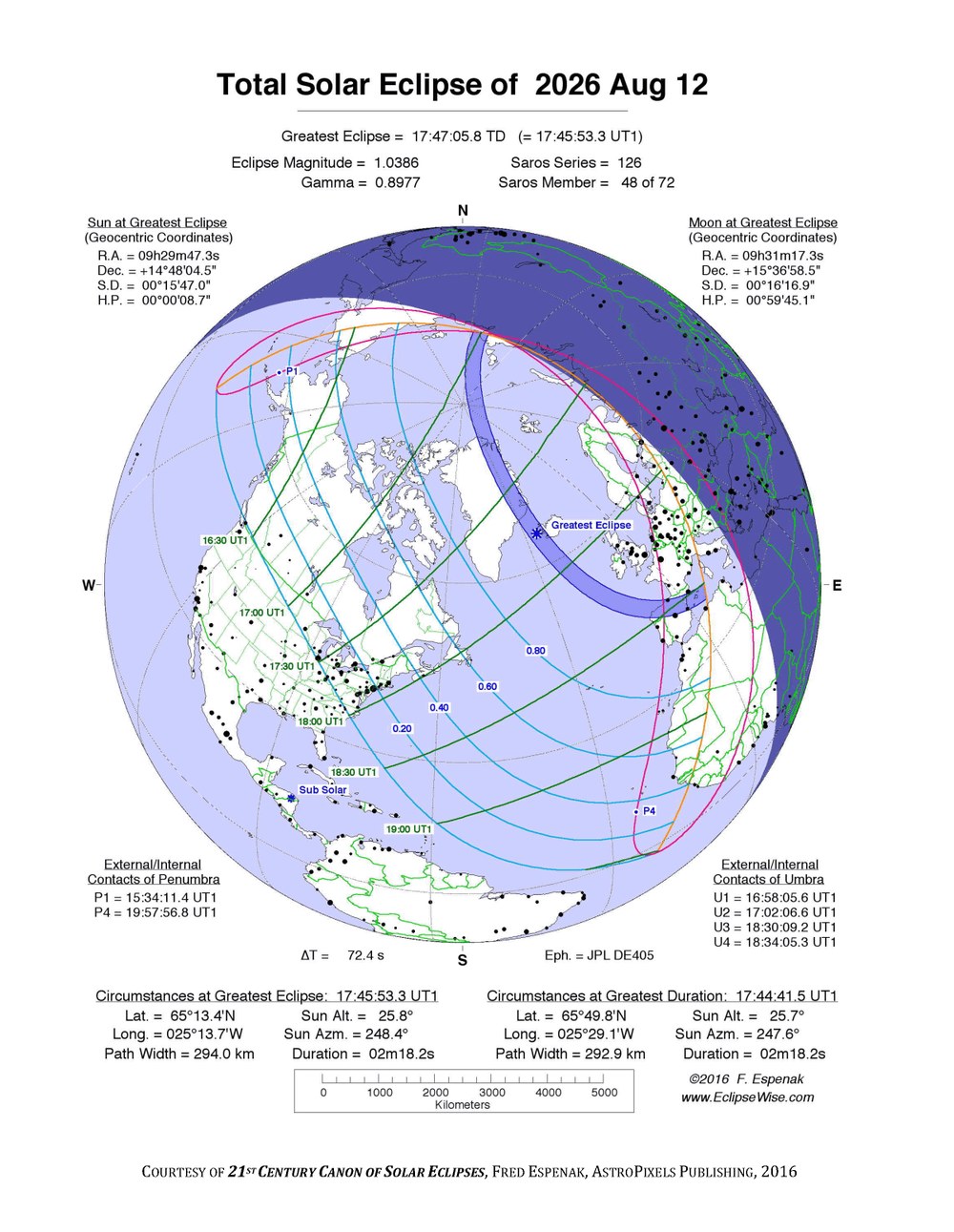
The very first contact of the Moon’s partial shadow, or penumbra, will occur shortly after 17:34 CEST in the Bering Sea, 120 nautical miles east of the US island of St. George.
About half an hour later, around midnight local time, the Moon’s umbra will make its first contact with Earth's surface in the eastern part of Russia’s remote Taymyr Peninsula.
From there, it will move in a north-westerly direction, passing east of the Severnaya Zemlya archipelago towards the North Pole, which it will 'miss' by about 100 kilometres.
Observing the total eclipse in Europe
The path continues in an arc across the Arctic Ocean and the inhospitable eastern ice fields and fjords of Greenland, towards western Iceland, where, off the Westfjords in the Atlantic, the maximum of totality will be reached, lasting two minutes and 18 seconds. The Icelandic capital, Reykjavik, will also – provided visibility is good – experience one minute of totality, with the Sun at an altitude of just under 25 degrees.
From Iceland, the umbra races across the Atlantic towards the Iberian Peninsula, first grazing it at almost the same moment near the Estaca lighthouse and the Cabo Peñas lighthouse. At both locations, totality will last for about two minutes, with the evening Sun at an altitude of approximately 10 to 11 degrees.
On the Iberian Peninsula, cities such as León, Valladolid, Burgos, Zaragoza and Valencia will be popular starting points for many eclipse-watching excursions. Madrid can also be counted among them, since in the north-eastern suburbs of the capital, the Sun will be completely obscured by the Moon for just under half a minute.
Finding the best spot for eclipse watching on the Balearic Islands
A total eclipse of a special kind awaits locals and tourists on the Balearic Islands. At the start of the penumbral phase, the Sun will still be 12 to 13 degrees above the horizon, but during totality only about 3 degrees. By the end of the subsequent partial phase, it will have already set into the sea. It is therefore advisable to find a good vantage point near the centre line of the path of totality in good time for the 'sunset eclipse', inspect it thoroughly in advance and, if necessary, carry out a trial run before the natural spectacle takes place. Relief maps are also helpful when selecting a suitable location, as they show how the uneven terrain is shaded by the low angle of sunlight – particularly the rugged Sierra de Tramuntana on Mallorca.
In less than ten minutes, the Moon's shadow will have swept across the Iberian Peninsula, including the Balearic Islands, and will rapidly recede off the Earth again in the western Mediterranean. Even those unable to see the fully 'black' Sun can still look forward to the event with anticipation if they are in southern France, Andorra or Portugal – where an eclipse coverage of more than 95 percent will be reached in many places. The eclipse will end globally just before 22:00 CEST, south of the Cape Verde Islands.
The solar eclipse over Germany
Outside the 'umbral zone' – the path of totality – the partial obscuration of the Sun will be visible for approximately 90 minutes in Canada, Alaska, western Africa and Europe. In Germany, the degree of coverage will increase from north-east to south-west, from 84 percent at the latitude of Szczecin to more than 90 percent in the High Black Forest. In Cologne, the maximum of 88.3 percent will be reached at 20:13 CEST, with the Sun at an altitude of 6 degrees. Such a high degree of coverage will not be reached again in Germany until 13 July 2075.
Protecting your eyesight – tips on eclipse glasses and more
ESA
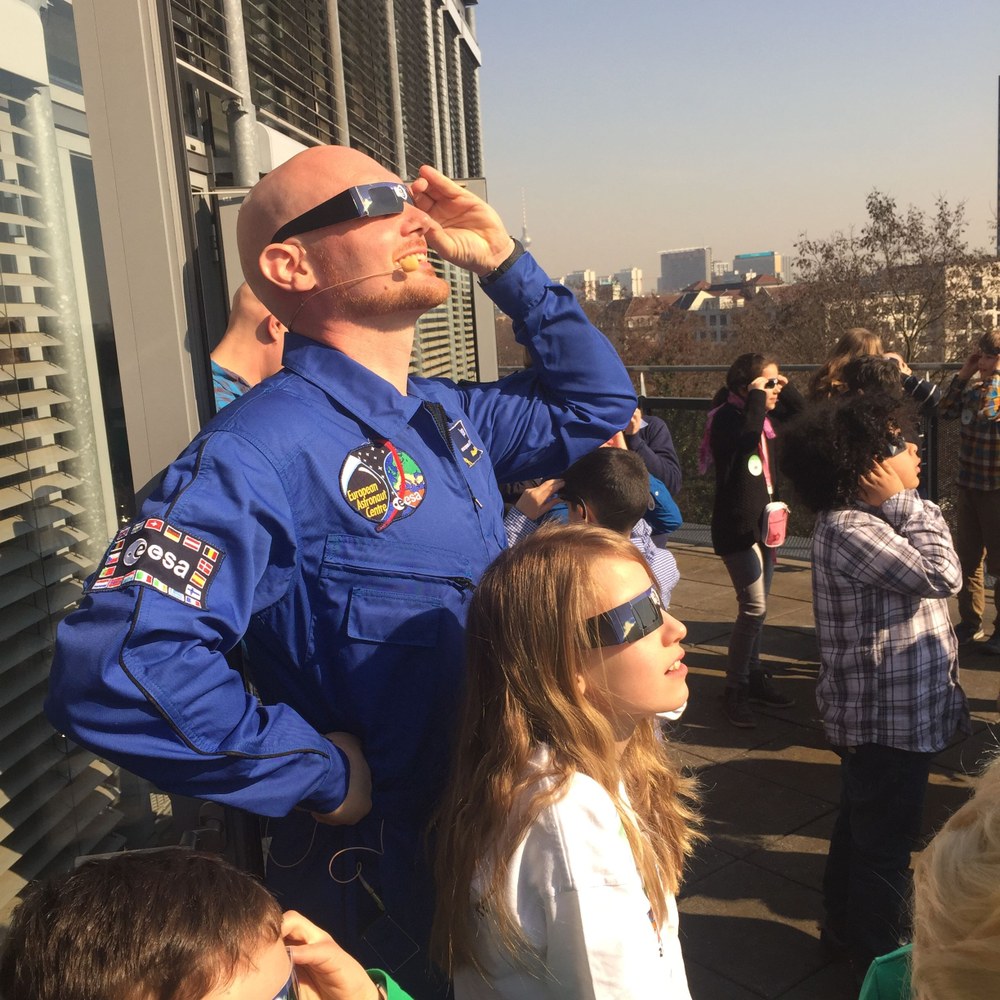
Whenever observing the Sun, you must protect your eyesight safely and properly against intense radiation. This is particularly important during a solar eclipse, as the blink reflex is reduced due to the lower light intensity. Adequate protection is provided by certified solar eclipse glasses, which can be bought for a few euros, preferably from specialist astronomy retailers or opticians. These protective glasses effectively shield your eyes from the wavelengths of sunlight that damage the retina – wavelengths that remain too intense even when the Sun’s disc, obscured by the Moon, has become no more than a razor-thin crescent.
However, anyone unable to get hold of solar eclipse glasses in time should visit a public observatory, planetarium or astronomy society in their local area. In Germany, as part of the 'Long Night of Astronomy', you’ll be able to observe the solar eclipse in the company of like-minded people, under professional supervision and with expert commentary, while watching large-screen live broadcasts from the path of totality. Useful guidance on what to bear in mind when observing the Sun can also be found in the document published by the Federal Office for Radiation Protection (Bundesamt für Strahlenschutz; BfS).
Under no circumstances should eclipse glasses be used to observe the Sun through binoculars or a telescope – they are intended solely for observation with the naked eye. When observing through an optical instrument, appropriate protective films and filters must be fitted in front of the objective lens. Eyepiece solar filters must be avoided, as they can become so hot from solar radiation that they may suddenly shatter.
The next solar eclipse in Europe
Eclipse Predictions by Fred Espenak, www.EclipseWise.com
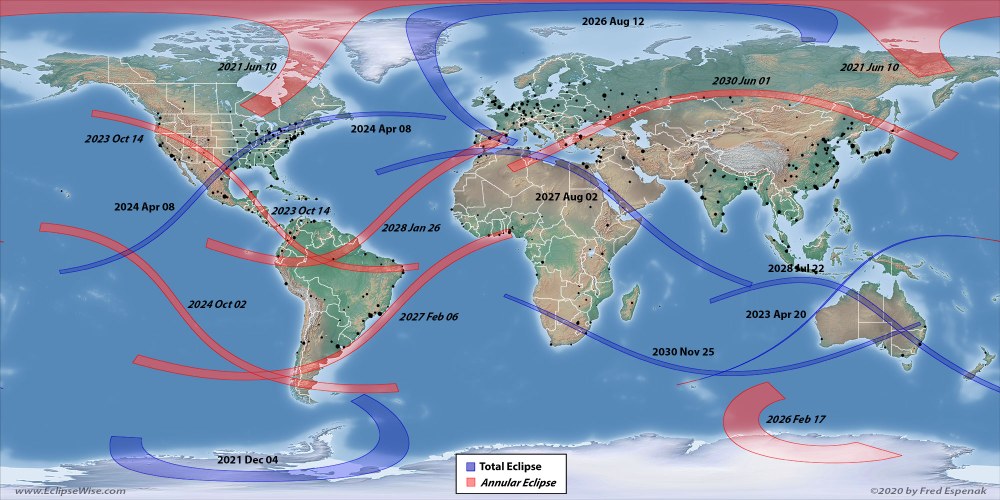
From an astronomical perspective, the coming years will deliver a run of luck for Spain. As early as next year, on the morning of 2 August 2027, residents south of the line between Almería and Jerez de la Frontera will experience another total solar eclipse, lasting up to four and a half minutes, with the Sun at an ideal altitude of approximately 40 degrees above the horizon. Just under half a year later, on the afternoon of 26 January 2028, the same region will again witness a central but only annular solar eclipse – as is typical in January due to the Sun's larger apparent disc. Statistically speaking, a solar eclipse only recurs at the same location every few centuries – so this coincidence is practically a gift from the heavens.
Solar eclipses in a geological context
The fact that we are able to experience solar eclipses at all is, first and foremost, down to the existence of the Moon. As far as we know today, it was formed 4.5 to 4.4 billion years ago when a Mars-sized protoplanet collided with Earth. This event ejected an enormous amount of rocky material from Earth's mantle into near-Earth orbit, where it accumulated, condensed relatively quickly under gravity and formed Earth's satellite. This hypothesis is supported by isotope analysis of the lunar rocks brought back to Earth by the Apollo astronauts. Comparison with terrestrial rock suggests that the Moon was indeed formed by such a collision. It is, in a sense, Earth's eighth continent – upon which humanity now seeks to set foot once more.
Tim Bertelink (CC BY-SA 4.0)
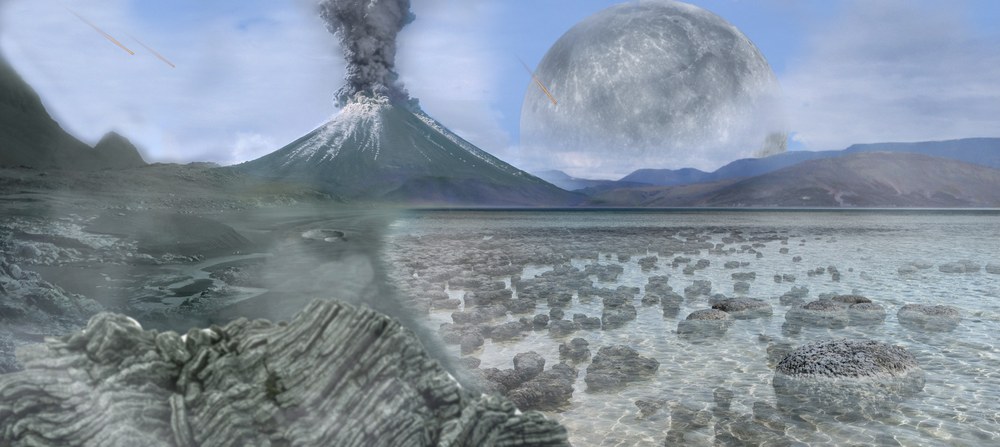
In the early days of our planet, the Moon – formed from the debris cloud – orbited at an average distance of just a few tens of thousands of kilometres from Earth, and, with an apparent diameter more than ten times larger than it is today, shone strikingly bright in the sky. Owing to the relative size of the Moon and Sun at that time, total solar eclipses occurred more frequently on the early Earth and, despite the Moon's orbital speed being three times higher and the Earth’s rotation twice as fast, lasted on average longer at any given location than they do today. The umbra, some 3000 kilometres wide, swept at breakneck speed across the continents and oceans of the primordial Earth. During such an eclipse, the solar corona is likely to have glowed only fleetingly at one edge of the Sun until it was swiftly obscured by the Moon, while on the other side, it would have appeared just as abruptly, rather than emerging gradually as it does today.
Why total solar eclipses are shorter in winter
As a result of tidal friction, the Moon has, over the course of Earth's history, now reached a distance at which its apparent size matches that of the Sun. Today, the lunar and solar discs have – sometimes a little more, sometimes a little less – an average diameter of 32 arcminutes, approximately half a degree. The variation is determined by the changing positions of Earth on its slightly elliptical orbit around the Sun, and of the Moon on its orbit around Earth. When the Moon is relatively close to Earth, and Earth is still at its furthest point from the Sun during the northern-hemisphere summer, conditions are excellent for a longer period of total solar coverage by the Moon. Total solar eclipses in the (northern) winter are accordingly statistically shorter than those in summer; the longest total solar eclipses, with more than seven minutes of a pitch-black Sun, therefore all occur between late May and early August.
The differences in distance, and the resulting size ratios, give rise to the three different types of central eclipses: annular, total and annular-total (hybrid). However, whether an eclipse actually occurs depends largely on the 'nodal condition'. According to this, an eclipse can only take place if the new moon (in the case of a solar eclipse) or the full moon (in the case of a lunar eclipse) falls within a narrow tolerance range around one of the two points where the Earth's and Moon's orbits intersect – the ascending or descending node. These two orbits are inclined to one another by 5 degrees of arc. For only then are the Sun, Moon and Earth (almost) in a straight line, such that the Moon’s shadow falls on Earth or Earth’s shadow falls on the Moon.
Another 600 million years until the final total solar eclipse
This also explains why a lunar or solar eclipse does not occur every month at full moon and new moon. In the early days of Earth, when the apparent diameter of the Moon was close to the angle of the Moon’s orbital inclination, the situation was different. The tolerance ranges around the lunar nodes – the nodal distances – were wider, so that many new Moons occurring in rapid succession could cover the Sun either completely or partially. Today, this happens at most five times in a calendar year, or, for a single lunar node, at most twice.
Very similar nodal conditions and size ratios recur every 65851/3 days. This period corresponds, in whole numbers, to 223 synodic, 242 draconitic and 239 anomalistic orbital periods of the Moon. Since the time of the astronomer Edmond Halley (1656–1742), this period of just over 18 years has also been known as a 'saros'. The initial celestial dynamics then result, after 65851/3 days, in an eclipse that is similar in timing and geographical location to the previous one, though in each case shifted 120 degrees of longitude westwards. This can be clearly seen, for example, by comparing the path of the eclipse of 11 August 1999 with that of its 'saros daughter' on 21 August 2017.
Total solar eclipses will continue to be observable for at least another 600 million years or so. Only then will the Moon have moved so far away from Earth that, even at its closest approach, the area of the full moon's disc will be too small to completely cover the Sun at its furthest distance from Earth. As a result, only annular and partial solar eclipses will occur; the spectacular glow of the solar corona – the highlight of this natural spectacle – will then be a thing of the past, and can only be produced with the aid of a coronagraph.
Total solar eclipses as a gateway to astrophysics
In the days of the Chaldeans and other ancient peoples, solar eclipses were seen as irrefutable messages from the gods to rulers, heralding good or bad fortune. Later, they served as reliable chronological markers for historians; according to legendary accounts, they are even said to have served as a supernatural sign during battles, becoming a symbol of peace. Those who could predict them more accurately were held in high esteem in feudal societies, and seafarers are said to have used this ability to impress indigenous peoples and their chiefs. A total solar eclipse, which came upon most people unexpectedly, for centuries frightened people far more than it amazed them.

‘Astronomy for amateurs’ – D. Appleton and company, 1904 (The Library of Congress)
Centuries passed before solar eclipses were finally better understood within the heliocentric world view and could be used to advance scientific knowledge. Christophorus Clavius (1538–1612), a Jesuit and outstanding mathematician of his time, led the commission for the Gregorian calendar reform and was among the first to observe the solar corona as a distinct narrow ring within the Sun, encircling the entire Moon on all sides. His descriptions, recorded in 1581 in his work In sphaeram Ioannis de Sacro Bosco commentaries, are currently being discussed again scientifically. Johannes Kepler (1571–1630) was also aware of the corona, but believed it to be part of the Moon’s atmosphere.
Furthermore, in 1695, the versatile astronomer Halley, in a treatise on the ancient city of Palmyra, recommended determining a suspected acceleration in the Moon's motion from the progression of eclipses – something now known to result from the decrease in the eccentricity of Earth's orbit and the tidally-driven slowing of Earth's rotation. Halley also studied the path of the umbral shadow during the eclipse of 3 May 1715, which passed over England, and was thus able to improve his calculations for the solar eclipse of 22 May 1724 on the basis of observed deviations.
A few years later, prominences in the solar corona were mentioned for the first time by Birger Vassenius (1687–1771), a Danish lecturer in mathematics, who, during the eclipse of 13 May 1733 in Gothenburg, noticed three or four reddish spots. The largest of these consisted of three small clouds that, in his view, were floating in the (then presumed) lunar atmosphere. Other strange phenomena discovered during total solar eclipses were described sporadically, but had no impact on 18th-century science.
Scholarly debate over the solar corona
The scientific study of total solar eclipses only really began in earnest with the eclipse of 8 July 1842, which passed over southern France, parts of northern Italy and Austria. It had been precisely predicted in advance, and many excellent astronomers were stationed at various observation points, ready to describe in detail all the events and phenomena occurring during totality. The prominences in particular caught observers' attention, but in the end no consensus was reached as to what they actually were. Some believed they were mountains on the Moon, illuminated brightly by sunlight in some way; others assumed they were mountains on the Sun; and yet others thought they were flames on the Sun. Some even denied their existence altogether, regarding them merely as an optical illusion caused by Earth’s atmosphere.

‘The total solar eclipse of July 18th, 1860, observed at Rivabellosa, near Miranda de Ebro in Spain’ – Warren de la Rue (Wellesley College Library)
In the decades that followed, given the many new questions and contradictions, solar eclipse expeditions became one of the top priorities of the fledgling field of astrophysical research. Thus, on 28 July 1851, the first photograph of the eclipsed solar disc was successfully taken, making it clear that the corona belongs to the Sun and not the Moon, and that prominences too have a genuine solar origin, most likely consisting of gases. During the solar eclipse of 18 August 1868, this assumption was then confirmed spectroscopically. This eclipse also led to the discovery of the element helium on the Sun, 14 years before it was found in terrestrial lava rock from Mount Vesuvius, Italy.
The wealth of scientific knowledge gained during the solar eclipse expeditions between 1860 and 1871, with the aid of instrumental observation methods, proved to be of immense value for the subsequent development of solar and stellar physics. These unique natural spectacles helped verify theories and hypotheses and led to new discoveries. Following this well-established scientific approach, half a century later, in 1919, another expedition set out to observe a long total solar eclipse, in order to determine whether the deflection of starlight at the Sun’s edge, as predicted by Einstein’s general theory of relativity, was accurate.
"I stood, entirely occupied with counting the oscillations of my chronometer, so as to note precisely the moment of the complete disappearance of the solar disc, in deepest silence, in the midst of a crowd that had densely filled the streets, the public squares, and the windows of the houses, and whose attention was completely absorbed by the spectacle unfolding before it. At the very instant when the last ray vanished, I was startled by an outburst of applause and cheers that rose up from the midst of this immense crowd. A shudder ran through my body, and, trembling, I turned my gaze to the Sun; I stood before the most enchanting spectacle one could imagine. The Sun and Moon, those two mighty heavenly bodies, hung opposite one another between heaven and Earth – a pitch-black round patch, surrounded by a brilliantly shining crown of rays. At this sight, amazement held me spellbound; I lost a great part of the precious minutes and was in danger of forgetting the very purpose of my journey. From the descriptions I had read beforehand, I had expected to be able to perceive some light from the Sun, albeit weak and twilight-like; instead, I saw a bright crown of rays, whose brilliance was very vivid close to the edge of the lunar disc, then diminished more and more, vanishing at a distance of roughly the diameter of the Moon. I had suspected nothing of the kind beforehand. I soon recovered from my astonishment, however, and, having removed the dark glass filter, put my eye to the telescope again, when a new surprise seized me. The crown of rays surrounding the lunar disc was interrupted in three places by enormous purple flames, whose diameter was almost 2 arcminutes. They appeared to stand still and looked like the snow-covered peaks of the Alps illuminated by the rays of a setting Sun. It was impossible to tell whether these flames were clouds or mountains. While I was still occupied with examining them more closely, the first ray of sunlight broke onto the dark surroundings; it revived nature all at once, but it plunged me into that melancholy mood one feels when one sees the object of one's ardent desires disappear just as one is on the point of grasping it."
Francis Baily (1774–1844), discoverer of the 'string of beads' phenomenon, or Baily's beads, on the solar eclipse of 8 July 1842, which he observed in Pavia; a retranscription of a German version in E. Pringsheim's 'Physik der Sonne'.
The nocturnal 'fireworks' after the eclipse

NASA/JPL
Immediately after the total solar eclipse on the evening of 12 August, it will be well worth keeping an eye out, from 22:00 to 23:00 CEST, for the Perseids, which sends a shower of shooting stars 'raining down' from the sky every year between mid-July and late-August. In folklore, they are also known as the Tears of St Lawrence. They generally reach their peak between 9 and 15 August. This year's peak falls on the night of 12–13 August. According to forecasts, despite the excellent conditions of a dark new-moon night, we can expect around 20 shooting stars per hour at best in German latitudes.
The Perseids themselves consist of tiny dust particles shed by Comet 109P/Swift-Tuttle during its close approaches to the Sun, which have spread out along its orbit as elongated dust filaments of varying density. Once a year, Earth passes through this region on its path around the Sun, and the comet's particles enter Earth's atmosphere at a speed of approximately 60 kilometres per second, where most of them are 'ground down' and vaporise at an altitude of approximately 80 kilometres, colliding with air molecules. In the process, the molecules are ionised, producing the characteristic bright, sometimes coloured, streaks of light that we admire as shooting stars. Since the individual meteors appear to originate from a point in the constellation Perseus, they are known as the Perseids. And, of course, when you see a shooting star, you shouldn't forget to make a wish, as is the custom – perhaps, for a perfect view of the near-total lunar eclipse that awaits us in Germany at dawn on 28 August.
Related links
- Timeanddate – Information on the total solar eclipse
- Heavens-Above – general and local conditions
- Eclipse Atlas – The total solar eclipse of 12 August 2026
- Eclipsophile – Weather forecast during the solar eclipse
- The 2026 solar eclipse in Iceland
- Bundesamt für Strahlenschutz – 6 Tips for a safe view of the sky
- Lange Nacht der Astronomie (German only)
- Directory of astronomical institutions in Austria, Germany and Switzerland
- The Eye Center at Medical Center, University of Freiburg – The solar eclipse of 11 August 1999 (German only)
- Timeanddate – Live Stream of the solar eclipse
- Official ESA broadcast – Total solar eclipse 2026
- Exploratorium – Live telescope broadcast of the solar eclipse
Tags: