
“We’re working on it ourselves”
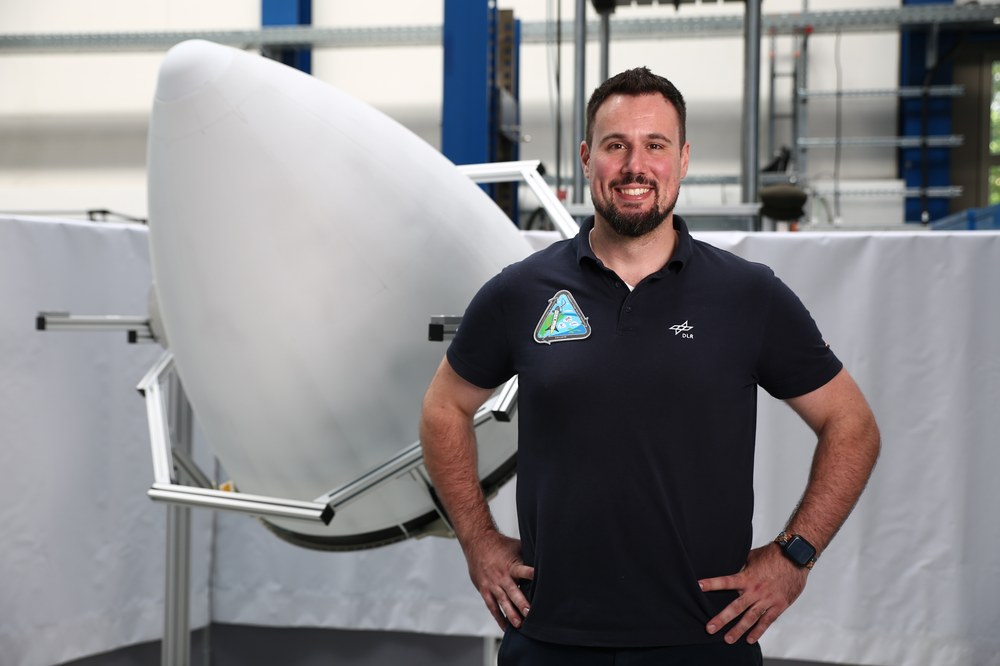

Whenever a helicopter or aeroplane flies overhead, 33-year-old Felix Krziwanie automatically looks up. He studied aerospace engineering in Stuttgart, and he’ll probably always be a fan of both kinds of aircraft. “But spaceflight is the ultimate – because it involves every kind of extreme, and we’re living in a time when an awful lot is happening in that field.” Take, for example, the Artemis missions to the Moon, the many space-related start-ups in Germany or the development at DLR of a reusable launcher such as Callisto. Elon Musk has shown with SpaceX that reusable rockets can succeed – but Europe must create its own system if it wants to remain independent and competitive. Working at the DLR Institute of Structures and Design, Felix will play a part in this project: together with colleagues, he is responsible for the structure and thermal protection of Callisto’s landing legs.
Teams from Germany, France and Japan are collaborating on the Callisto spacecraft, which is designed to take off and land vertically. The rocket – 14 metres tall and more than one metre in diameter – is a technology demonstrator intended to show that the concept works on a small scale; the next step could be a reusable rocket that launches satellites and experiments into space. The flight hardware is currently being manufactured. “We already have the fairing and fins; the landing legs are currently in production,” he explains.
Joing the DLR as a student
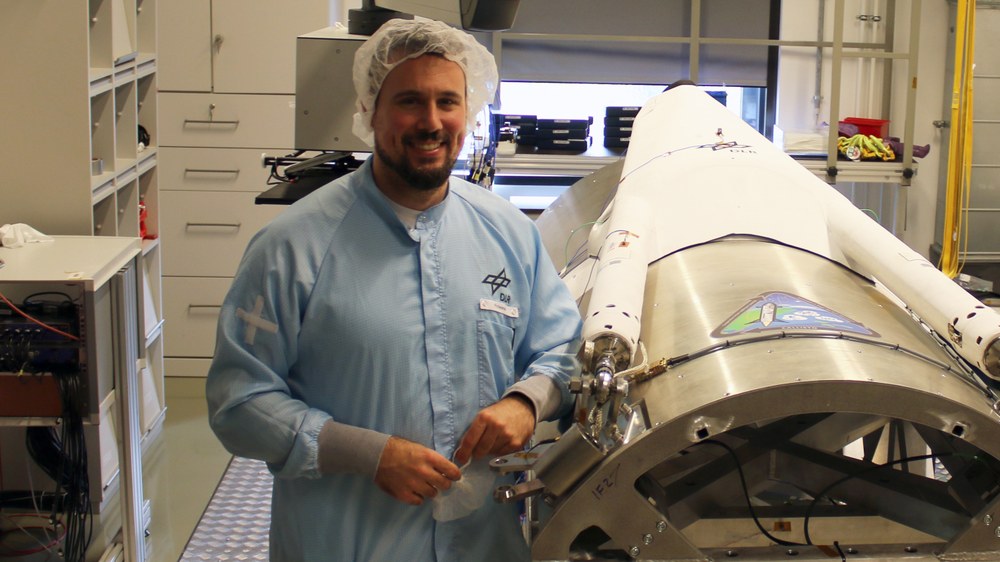
During his studies, Felix specialised in design, engineering and materials and, he notes: “The field is very broad and isn’t limited to either aeronautics or space.” He can therefore apply his knowledge to both areas. The fact that he ended up in spaceflight, following a research assistant post at the university’s Institute of Aircraft Design and an internship in helicopters, is partly down to two lectures. One was given by his current institute director, Prof. Heinz Voggenreiter, and the other by his current head of department, Hendrik Weihs. As a research organisation, DLR is not only physically close to the University of Stuttgart. This led to his master’s thesis and – “a stroke of luck for me” – a successful application, coinciding with his graduation, for a newly advertised post in the Callisto team.
From concept to flight
Felix is working to ensure that a reusable rocket stage not only lifts off stably but can also touch down stably on its landing legs. “Our department is very closely involved with the hardware; we’re working on it ourselves.” Space projects require patience; in 2027, the landing legs are due to be shipped to Europe’s spaceport in French Guiana, to equip Callisto for its test flight. Throughout his work on the project, however, Felix always keeps his eyes on the prize and knows that what he’s putting his heart and soul into will take off and fly: “And I’ll be standing right there when it does!”
National and international teamwork
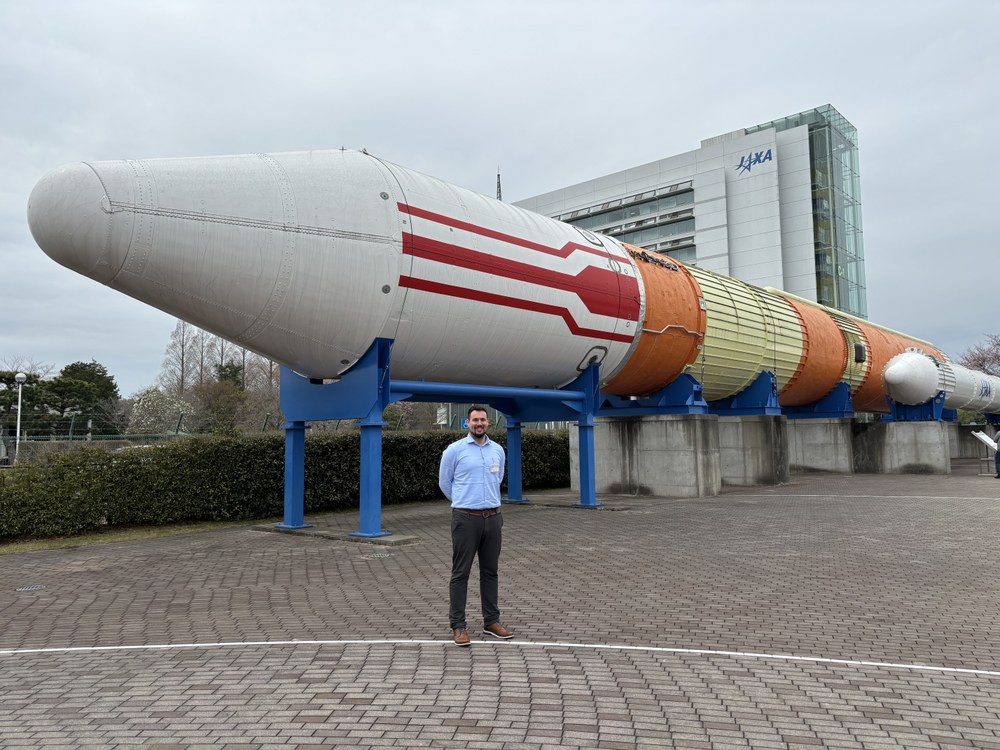
The engineer has already visited the French and Japanese space agencies, CNES and JAXA, on several occasions to discuss the next milestones for the project. Project management for DLR’s contribution is handled by the DLR Institute of Space Systems in Bremen – where regular workshops are also held to share updates. In Japan, he says, people tend to be more formal and reserved to begin with; with CNES, he is working with a large space agency, whilst his colleagues at DLR have an extremely interdisciplinary approach. “These are all different ways of working that you have to understand and get used to,” he says – adding that he welcomes this diversity: “You have to look beyond your own working environment.”
The 33-year-old is a team player, and not just at work. In his spare time he has been playing handball since primary school – he retains his enthusiasm for the sport and played in the regional league until 2024. This hobby is not just a pastime, but also a way to unwind and clear his head after work. “It’s certainly challenging to have so many ‘projects’ on the go at the same time, but I also see it as an advantage,” says Felix. “The learning curve is extremely steep, especially in the early years.” And, he’s very busy, with online meetings, documentation, collaboration with international partners, the start of campaign planning for the launch, test campaigns at the DLR facilities in Stuttgart, Bremen and Lampoldshausen, and the integration of hardware – depending on the project phase, the tasks vary greatly and are also tightly scheduled. “But how often in life,” he wonders, “do you get the chance to develop a launcher? And to do so from A to Z, as is possible at DLR.”
Tags: