ACTIVe and semi-Active TEchnologies for transonic flutter control
ACTIVATE
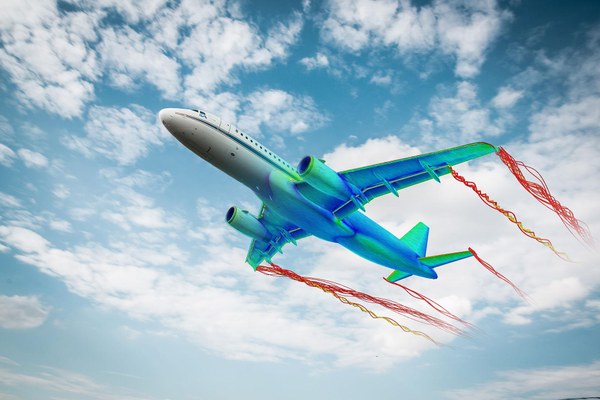
In order to reduce global greenhouse gas emissions, there is an interest in improving the efficiency of aircraft. Configurations with high aspect ratio wings in lightweight construction are favored, for example, to minimize drag and thus reduce fuel consumption. However, such configurations can exhibit altered aeroelastic stability behavior. In this context, the ACTIVATE project (ACTIVe and semi-Active TEchnologies for transonic flutter control) is researching technologies for flutter suppression in the transonic regime for next-generation transport aircraft.
The DLR Institute of Data Science adds its expertise in the field of data analysis to this project. The aim is to contribute to a better understanding of the flutter behavior of aircraft wings, in particular of so-called limit cycle oscillations. For this purpose, we are developing data-driven methods from the field of causal inference that can derive causal and functional relationships from data and apply them to simulation data. To this end, we are developing novel methods with which limit cycle oscillations can be modeled and understood better than before. In this way, we are helping to increase the maturity level of technologies with regard to flutter control.
Specifically, we are pursuing the following methods:
Data-based reconstruction of causal relationships in differential equations: This part involves developing algorithms that investigate the relationships between the various system variables, such as the influence of the speed of the up and down movement of the wing on its oscillation behavior. In addition, a qualitative understanding of which variables are decisive for the vibration behavior of the wing is to be achieved.
Estimating the parameters of differential equations: Based on typical differential equation models, the dynamic behavior of the wing should be described as accurately as possible. To this end, we are developing algorithms to reconstruct the parameters of the various differential equation models from vibration data of the wing.