
GAUSS+
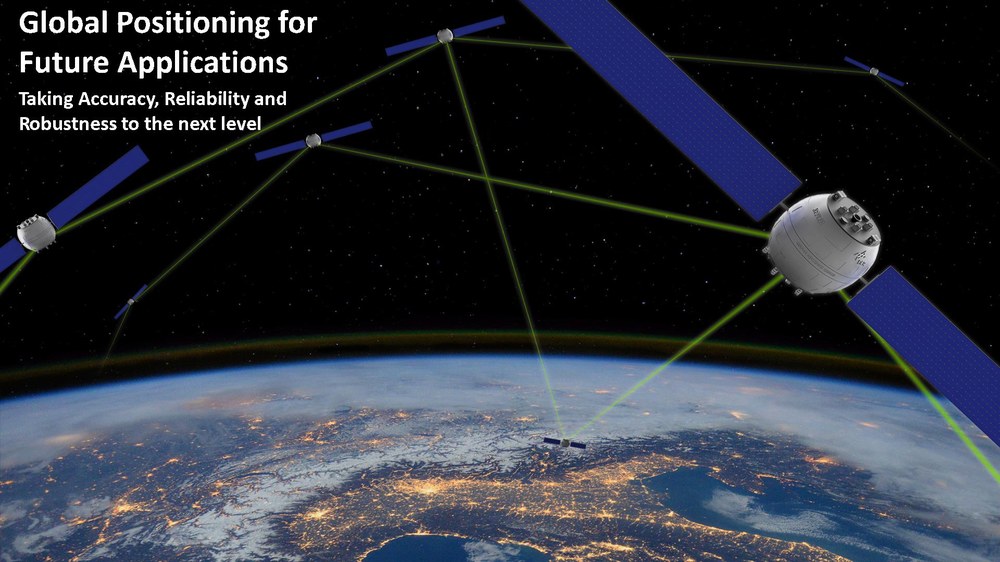

Project goals
A total of three goals have been identified.
- Development of a global integrity concept for the provision of space-based augmentation
- Planning, development and implementation of an IOD-mission for key technologies and core concepts
- Modelling of the ionosphere to determine ionospheric influences on monitoring performance
All three goals build upon one another, but each focuses on different sub-themes.
- Integrity concept
A key objective is the identification, development and implementation of necessary technologies and concepts, required to precisely determine the orbits of LEO satellites such that they can be utilized as space-based monitoring stations. Furthermore, another focus in this area is the planning and evaluation of various monitoring capabilities on board the LEO satellites. These are to be used to examine in greater detail the received navigation signals at multiple frequencies from selected MEO-GNSS-constellations. A third sub-area in the development of a global integrity concept is the aim of developing suitable integrity algorithms. The integrity algorithms are used to detect so-called ‘feared events’ in the received navigation signals and to extract suitable integrity information from them. The information is made available to users worldwide. - IOD-mission
There are also subordinate objectives within the planning, development and execution of the IOD mission. These include the development of a mission architecture, including the definition of a CubeSat-based GNSS monitoring payload. To ensure the mission’s success, various ride-share opportunities and platforms are also identified and incorporated into the mission architecture and planning. The procurement, integration and testing of equipment, payload and platform are also key milestones here. Finally, the launch and operation of the IOD mission are scheduled. - Modelling of the ionosphere
Current models of ionospheric influences are designed to provide suitable information to users on the Earth’s surface. This study also relies solely on measurements taken at the Earth's surface. For the proposed monitoring stations in space, these concepts must be extended to enable the modelling of propagation delays in GNSS signals among MEO-LEO paths. To extend this modelling, corrections to mitigate ionospheric/plasmaspheric effects are incorporated.
Contribution to electric flight
The urgent need to relieve pressure on urban (ground) traffic calls for the sustainable development of the associated airspace. Electric flying is particularly well-suited to this purpose, as it is exceptionally resource-efficient and reduces noise pollution. All electric flight concepts rely heavily on positioning and navigation solutions based on GNSS, as safety for people and the environment is always the top priority!
There is currently an urgent need for research in this area, as existing navigation systems (primarily GPS and Galileo) do not meet the high integrity standards required and therefore cannot guarantee them. This is precisely where the augmentation concept developed in GAUSS+ comes into play, to ensure that GNSS integrity can continue to be guaranteed for applications in the field of electric flight.
Summary
It is almost impossible to imagine everyday life without global navigation satellite systems (GNSS), such as GPS or Galileo. The use of associated PNT (Positioning, Navigation and Timing) services is, for example. so seamlessly integrated into our mobile devices that we take it for granted, but these services also play a pivotal role in many other sectors, such as agriculture, finance and transport. However, an increasing number of applications, particularly in the aviation sector, require improved performance, especially in terms of integrity, which cannot be provided by GPS or Galileo alone.
The GAUSS+ project aims to design a global space-based augmentation system in the field of integrity. In addition to the design of the global system, the project also covers the planning, development and implementation of GERMAIN, an in-orbit demonstration mission (IOD-mission). Here, key technologies and concepts will be demonstrated using small test satellites (CubeSats) to consolidate the overall concept. Using a "NewSpace" approach, the launch is scheduled to take place as early as the end of 2028. The main focus is on defining the integrity concept. Here, various architectures and monitoring approaches are to be compared. Results from the IOD-mission will be used to refine and adapt the global concept..
Kontakt
Prof. Dr.-Ing. Michael Meurer
Projektdaten | |
|---|---|
Term | 01/2026–12/2028 |
Participating Institute | |
In participation of |
|