
TINKER

Project goals
In its Flightpath 2050 strategy paper, the European Commission has set out targets for the aviation sector: compared with a reference aircraft from 2000, CO₂ emissions are to be reduced by 75%, NOₓ emissions by 90% and noise emissions by 65%. Alongside hydrogen technologies, hybrid-electric propulsion systems are also a key approach to reducing emissions through electrification. Whilst hybrid systems are already established in the automotive sector, aviation applications are still at the concept stage.
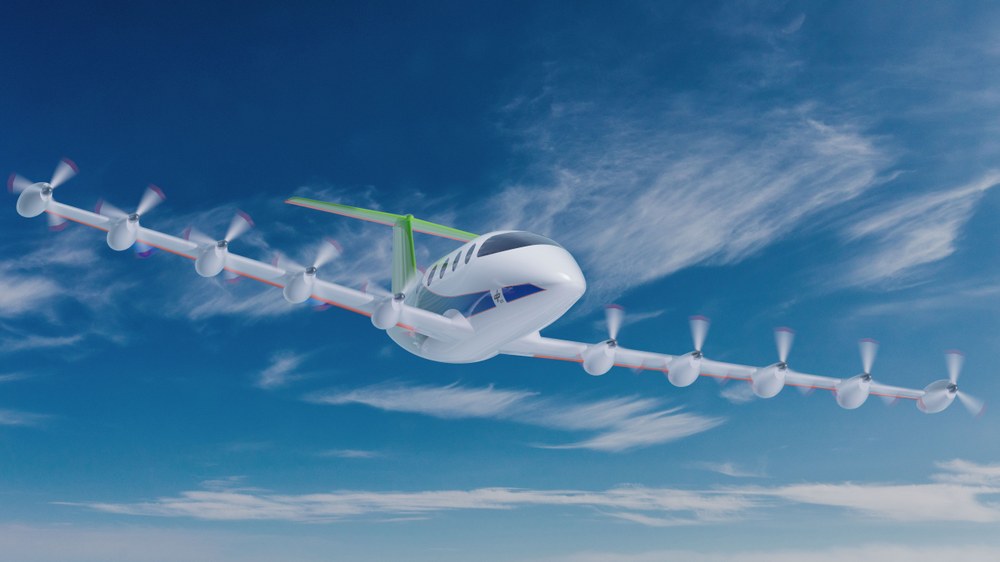
In the TINKER project, the hybrid-electric powertrain derived from FGAA for a 9-seater light aircraft is being developed in greater detail, thereby raising the technology readiness level (TRL) from concept TRL1 to a functional demonstration TRL3. This will involve conducting a requirements analysis and system evaluation from the operator’s perspective, as well as further developing the preliminary design and concept of such a powertrain and integrating it into the GTlab software platform to enable the design of future-proof hybrid powertrains.
DLR’s own collaborative software framework, GTlab, already contains more detailed tools for the performance analysis and simulation of conventional powertrains. An existing module contains the essential components for direct, coupled simulation and optimisation of hybrid-electric powertrains; however, these still need to be linked via appropriate interfaces and algorithms. In TINKER, the validation of analytical calculations is also to be carried out at the level of the electrical network.
For the operation of hybrid-electric powertrains, the consideration of dynamic scenarios is also of interest; these can currently only be modelled to a limited extent in GTlab. This initially requires detailed analytical investigation and method development for transient processes such as engine start-up and changes in load conditions, which must subsequently also be validated.
Drive system design requires validation data to verify calculations, quantify errors and reduce them. In particular, there is a lack of experimentally obtained data for the entire drive system when implementing transient calculations. To this end, a powertrain demonstrator is to be built and investigated within the project. This involves planning, building and commissioning an electric powertrain, and providing for the integration of a gas turbine with a suitable generator. This is intended to generate operational data for validation. In a follow-up project, both are to be combined within the complete powertrain demonstrator and tested.
Contribution to electric flight
The electrification of aviation is a key component in reducing emissions. Hybrid-electric propulsion systems and energy storage technologies are key candidates for low-emission aviation, as they can significantly reduce the emissions typically associated with combustion engines. The integration of a turbo-electric gas turbine into an electric powertrain is currently still at an early stage of technological development. The project addresses the development of these hybrid propulsion systems and energy storage solutions and aims to enhance market readiness and competitiveness, whilst improving the understanding of hybrid-electric propulsion systems and the safe operational capability of battery systems in aviation. The project thus contributes to the development of market-ready hybrid systems and allows conclusions to be drawn regarding hybrid propulsion systems in higher power classes.
Summary
In the FGAA project, hybrid-electric propulsion systems – combining gas turbines and batteries – proved to be a promising approach for small aircraft. They offer an energy-efficient alternative to pure gas turbine systems and are lighter than pure battery-powered systems, which significantly reduces emissions whilst enabling long ranges and operational flexibility.
In the follow-up project TINKER, the hybrid-electric powertrain for a 9-seater small aircraft derived from the FGAA project is being developed in greater detail. To this end, tools for performance analysis of gas turbines and electric propulsion systems are being integrated, enabling coupled calculations and thus a holistic performance analysis of turbo-hybrid-electric propulsion systems. Furthermore, specific extensions are being developed regarding the transient modelling of gas turbines and selected electrical components, in order to directly capture take-off behaviour and load changes. When considering the integration of the powertrain into the aircraft, the focus is on fault and risk analysis, and a certification concept is being developed. Finally, validation data is generated using a scaled demonstrator of the battery-electric powertrain, and the foundation is laid for subsequent hybrid-electric test benches.
Project data | |
|---|---|
Term | 01/2026-12/2028 |
Participating institutes |