Machine Learning for Fast Simulations in Crisis Management
ML4CM
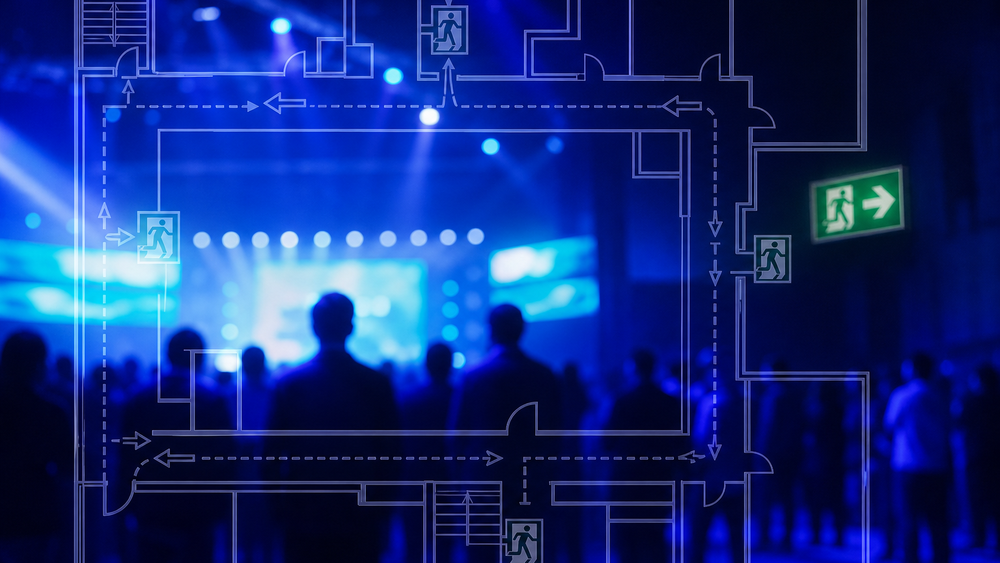
Emergency Plan for an Event
Credit:
Shutterstock / Visuta / teilweise mithilfe von KI generiert
Duration: 2026-2028
In crisis situations, every second counts. To ensure that decision-makers—such as those in the fire department—can act quickly and correctly, they need to know how a released hazardous substance will spread. Current models are often too slow or cannot account for details such as buildings and terrain.
In the ML4CM project (Machine Learning for Rapid Simulations/Forecasts in Crisis Management), we therefore combine physical principles with artificial intelligence (AI) to provide fast and reliable simulations for various crisis scenarios. There is a significant need for research, particularly in the area of near-field emergency dispersion modeling that accounts for topographical elements such as buildings while delivering results within a short time.
Crowd management likewise requires simulations with detailed environmental data and at the same time with high computational speed. This technology can help safely direct crowds and identify bottlenecks in a timely manner during large-scale events or evacuations. Crisis managers can thus quickly run through various scenarios in seconds and create well-founded evacuation plans. This saves lives in an emergency.
From a technical perspective, we are further developing Physics-Informed Neural Networks (PINNs) into Finite Element Neural Networks (FENNs) within the ML4CM project. These methods integrate physical principles and methods for preconditioning the mathematical problem into the machine learning process. They enable faster and more accurate parametric simulations and are ideally suited for integration into digital twins.
Project
ML4CM
Duration
2026–2028
Objective
Enhancing the Readiness for Practical Application of Innovative Scientific Machine Learning Methods in Crisis Management
Contact
Prof. Dr.-Ing. Alexander Popp
Head of Department
German Aerospace Center (DLR)
Institute for the Protection of Terrestrial Infrastructures