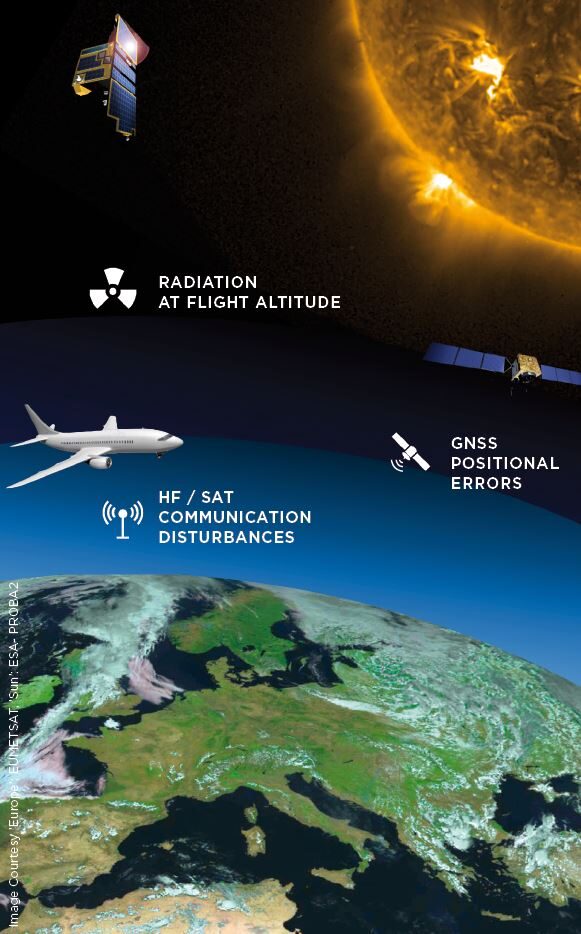
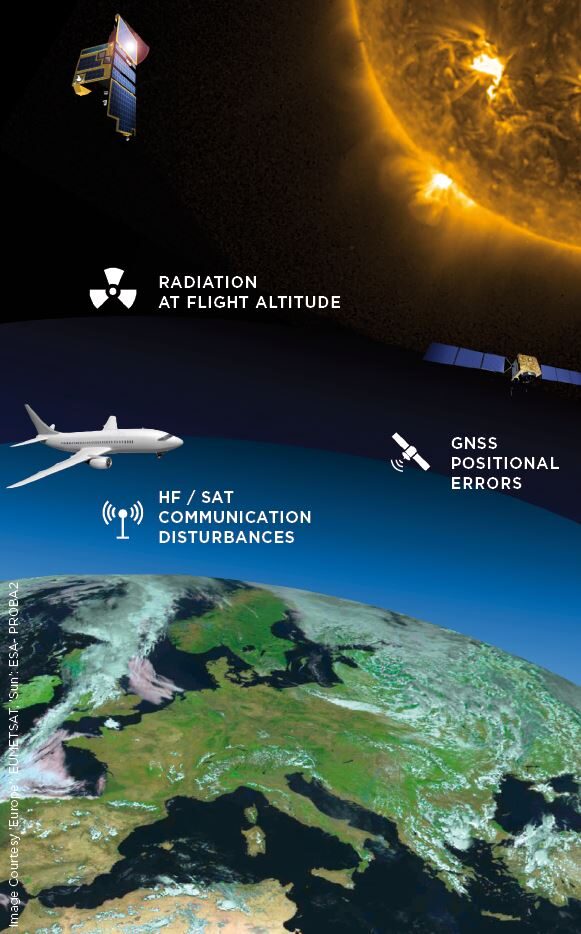
The PECASUS consortium (Partnership of Excellence for Civil Aviation Space Weather User Services) consists of weather services and research institutions from Finland (FMI), Belgium (STCE), the United Kingdom (Met Office), Poland (SRC), Germany (DLR), Italy (INGV), the Netherlands (KNMI), Austria (Seibersdorf Labor GmbH) and Cyprus (CDM). Together, they meet the ICAO requirements for providing a global space weather service for civil aviation.
The DLR contributes to the consortium with its ionosphere service IMPC (Ionosphere Monitoring and Prediction Centre). This includes the provision of ionosphere data and products as well as further developments in the field of GNSS user services.
In addition to DLR-SO, DLR-DFD is also involved in the project. The Ionosphere Monitoring and Prediction Centre (IMPC) at DLR provides global and European nowcasts of total electron content (TEC). The GNSS data required for this is collected and processed in real time from several global and regional GNSS receiver networks. To improve spatial coverage and data availability, DLR's activities are supported by INGV and STCE. In addition to the nowcasts, the IMPC also generates TEC forecasts for the global and European regions.
S4 and Sigma Phi nowcasts are also provided to estimate possible scintillation events at the receiver caused by small-scale ionospheric disturbances. These are based on the globally distributed high-rate GNSS receivers of the DLR and INGV. In addition, the DLR contributes to the further development of GNSS user services and develops products that are specifically tailored to the requirements of aviation.
The data and products generated are transmitted to the operational facilities STCE and the Finnish Meteorological Institute (FMI). FMI, which heads the PECASUS consortium, then processes the information in a timely manner into formats relevant to aviation.