Virtual Product House in ECOMAT 2.0
Virtual Product Development for climate-friendly aircraft
In the VPH 2.0 project, work continued on developing a completely digital (end-to-end) simulation process for virtual product development.
This included areas of virtual design, virtual manufacturing, virtual testing and certification. In addition to methodological developments and the integration of simulation models, physical tests and demonstrations as well as applications to specific use cases were also in focus, here with a emphasis on innovative wing and control surface components as well as hydrogen tanks as central components on the way to the "Zero-Emission" aircraft.
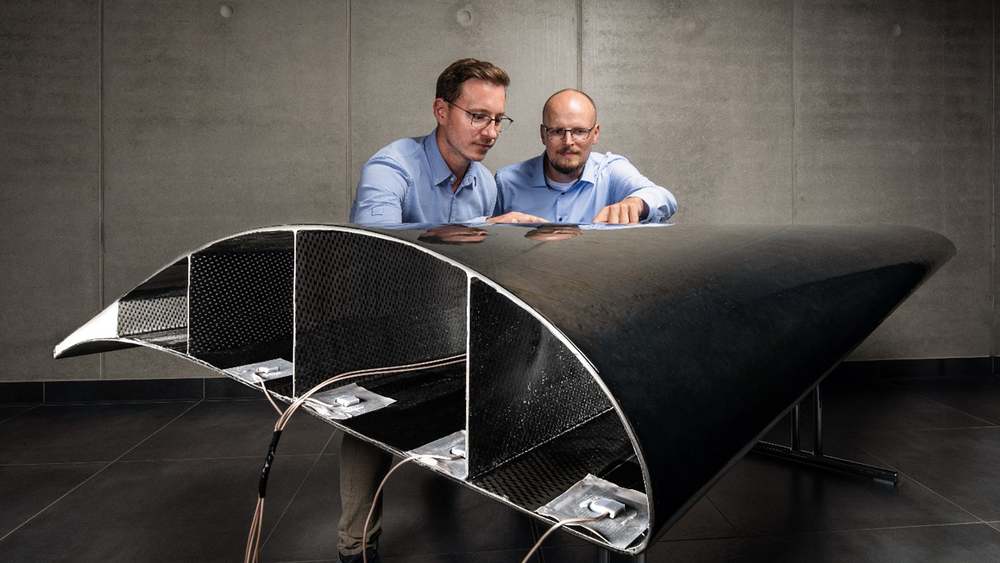
To be able to quantify the prediction capability of simulation-based design and test methods, a central part of the project was the validation of models using data from conducted tests as well as the manufacturing of a carbon fiber flap. In the latter case, the production process was precisely monitored using a variety of sensors. The manufactured control surface was also used for further testing to evaluate the predictive accuracy of simulations for analyzing residual strength after impact damage.
Institutes involved
- DLR Institute of Aeroelasticity
- DLR Institute of Aerodynamics and Flow Technology
- DLR Institute of Flight Systems
- DLR Institute of Software Technology
- DLR Institute of Software Methods for Product Virtualization
- DLR Institute of Lightweight Systems
Lead
DLR Programme Directorate Aviation
Partners involved
AKKA Germany GmbH, ExxpertSystems GmbH, FFT Produktionssysteme GmbH, TESTIA GmbH, Airbus Operations GmbH (associated)
Funding programme