VPH-DRIVE


How can key aircraft components be tested and certified more quickly, more efficiently and with less effort in future? This is the question addressed by the VPH-DRIVE research project, which is being carried out by the DLR in collaboration with its partners FFT, TECHNIA and ExxpertSystems, and with the support of Airbus.
The aim of the project is to further develop digital methods, virtual testing procedures and hybrid test bed concepts, and to demonstrate their industrial relevance – with a focus on the development of energy-efficient and safe next-generation aircraft.
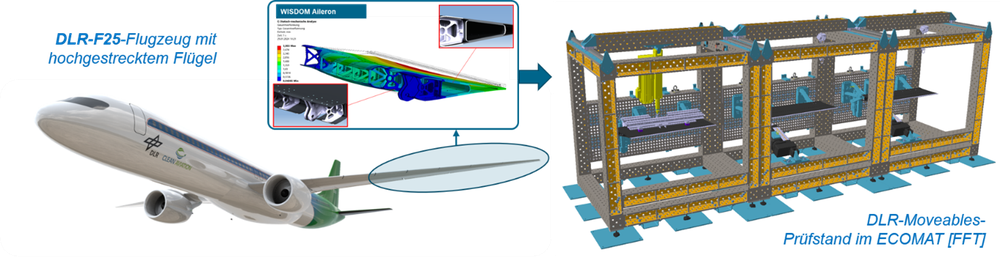
A key area of focus is so-called ‘moveables’, i.e. movable control surfaces such as flaps, ailerons or spoilers. These components are crucial for modern aircraft configurations, such as highly efficient wings with a high aspect ratio. In the project, moveables are not only designed and simulated virtually, but also tested on a new, specialised test rig. This creates a close link between the digital model and the physical experiment. With the help of these hybrid tests, simulation models are to be validated and methods further developed which can also be used in the future for the certification of relevant aircraft components.
The project’s digital approach encompasses an end-to-end process chain: from digital design through virtual manufacturing to virtual and physical testing. In the process, new methods for data acquisition, processing and analysis are being investigated. Particular emphasis is placed on improving the comparison of measurement data from test bench trials with simulation results, evaluating them automatically and utilising them for the further development of models. This is intended to make the development of complex aircraft systems more precise, traceable and efficient.
Another key aspect of VPH-DRIVE is the extension of digital development processes to include practical issues such as the repair and damage assessment of components. In collaboration with industrial partners, specific use cases are being examined to make digital methods applicable to the subsequent maintenance and repair of aircraft components. This will align digital product development more closely with the real-world conditions of aircraft operations.
Furthermore, the project looks beyond the field of moveables: prospects for other future-relevant topics, such as issues relating to fire protection, are being examined and linked to existing research activities. The aim is to make digital methods applicable beyond individual components to various fields of application in future aviation.
Through VPH-DRIVE, the consortium is working to bridge the gap between research, digital tools and industrial application. The project demonstrates how modern simulation technology, hybrid testing methods and intelligent data analysis can help to develop complex aircraft components more quickly and efficiently – an important step towards more efficient and climate-friendly aircraft.
DLR-Institutes involved
- DLR Institute of Aerodynamics and Flow Technology
- DLR Institute of Aeroelasticity
- DLR Institute of Flight Systems
- DLR Institute of Lightweight Systems
- DLR Institute of Software Technology
- DLR Institute of Software Methods for Product Virtualization
- DLR Institute of System Architectures in Aeronautics
Partners involved
FFT Produktionssysteme GmbH & Co. KG, TECHNIA GmbH, Exxpert Systems
Funded by
BAB, LuRaFo 6