VPH-Tank
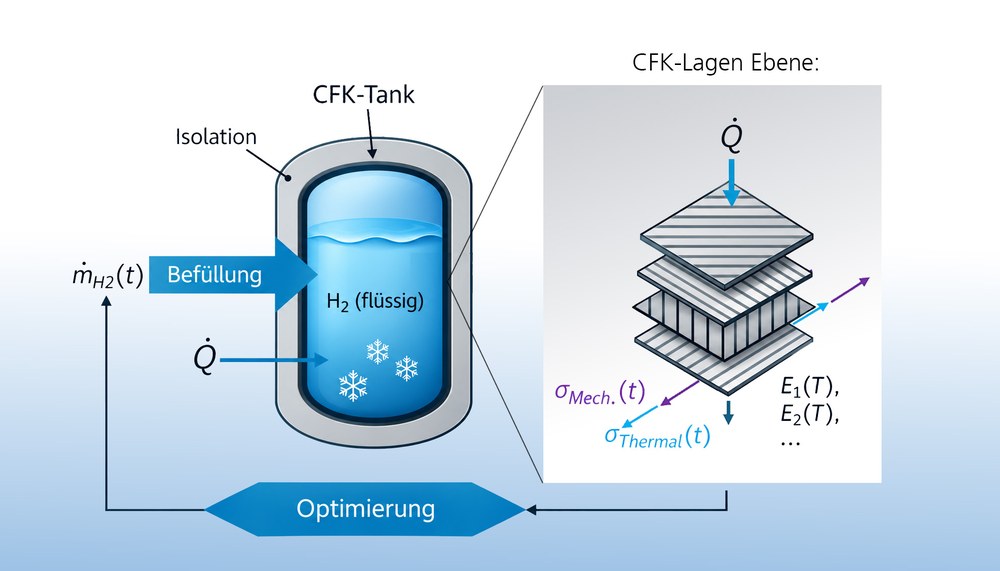

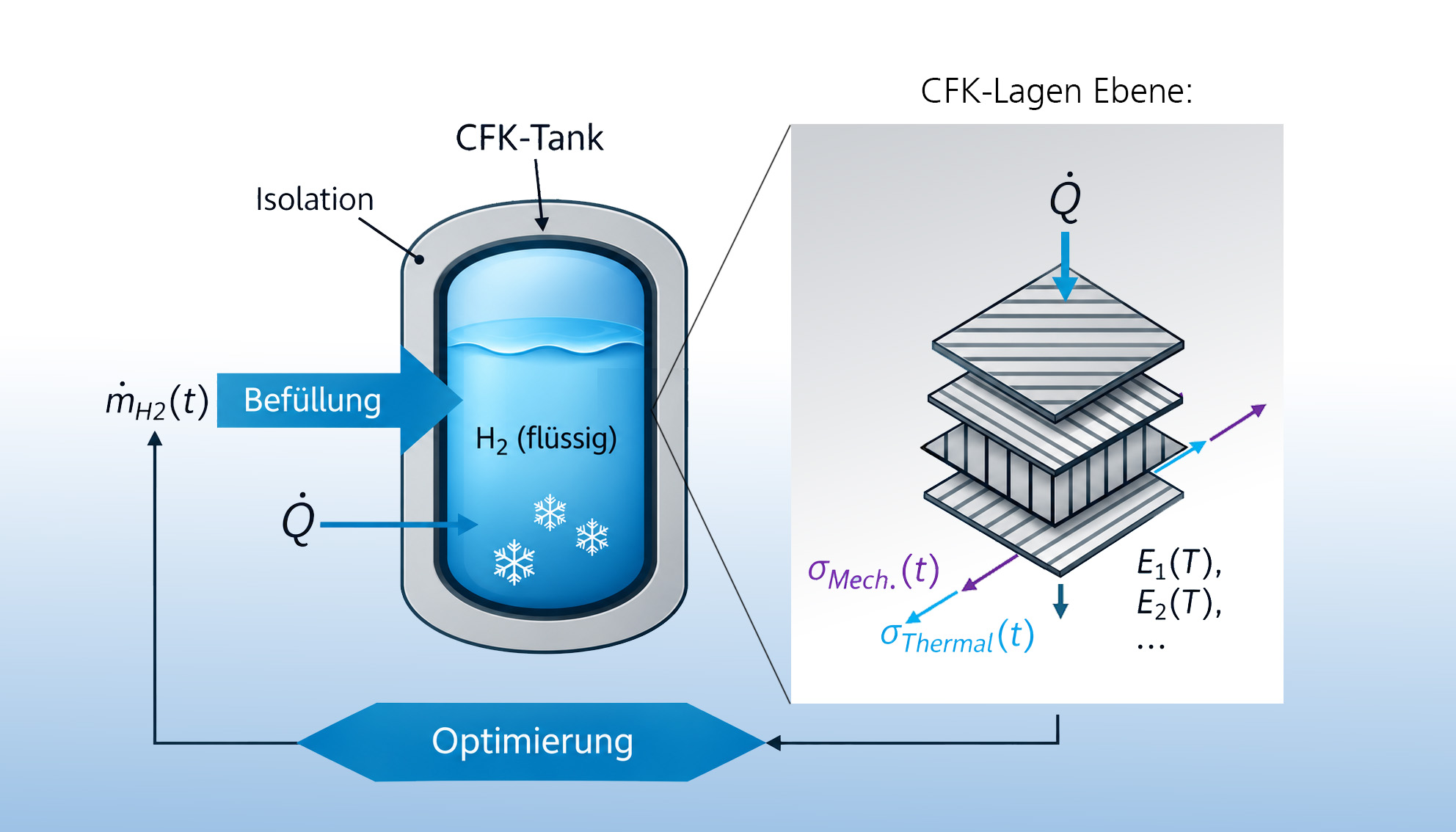
The VPH-Tank project is dedicated to developing a simulation chain to couple thermodynamic and thermomechanical effects during the filling of cryogenic liquid hydrogen tanks. The aim is to assess the structural effects of filling at the level of the CFRP plies. In addition, optimised refuelling strategies for hydrogen-powered aircraft and rockets are being identified.
The project is being carried out as a hydrogen use case under the umbrella of the Virtual Product House (VPH) at the ECOMAT Research and Technology Centre in Bremen. The VPH follows a holistic end-to-end approach by considering the digital design, manufacturing, testing and certification of the component in the hydrogen use case.
The project is funded by the Bremer Aufbau Bank (BAB) and co-financed by the European Union. It runs from 1 November 2025 to 31 October 2027. Participants include Technia (ECOMAT Bremen), TOPAS Industrial Mathematics, the DLR Institute of Space Systems and the DLR Institute of Lightweight Systems.
The project focuses on developing a simulation chain to assess structural effects during the filling of cryogenic CFRP tanks for hydrogen-powered aircraft and rockets. The investigation centres on CFRP tanks manufactured using the ‘Automated Fibre Placement’ (AFP) method, which is relatively new for tank production. During filling, the material cools down relatively quickly. The CFRP material contracts as a result of the cooling, giving rise to thermomechanical stresses.
The simulation chain essentially consists of a thermodynamic model and a thermomechanical model, which are coupled together. The thermodynamic model enables the simulation of processes during filling, such as the evaporation and condensation of hydrogen. A key result is the locally discretised heat flux density through the tank wall.
The heat flux density serves as an input parameter for the thermomechanical model. There, a temperature distribution at the ply level is calculated based on the heat flux, from which the resulting stress state at the ply level can be derived. As the simulation chain is designed to be transient (time-dependent), stress states are calculated continuously throughout the refuelling process. The stress states enable an optimiser to specifically adjust the mass flow rate during refuelling. A typical objective is to fill the tank as quickly as possible – subject to the constraint that the tank structure must not suffer any long-term damage. This is relevant for optimising the refuelling time between the arrival and departure of a hydrogen-powered aircraft.
The DLR’s contribution lies, on the one hand, in providing the thermomechanical structural model of an AFP-manufactured tank. Preliminary work has already been carried out in this area: a model generator was developed to automatically create structural models of AFP-manufactured tanks. These models are now being adapted and extended for VPH-Tank. A key extension involves the capability for transient heat conduction at the ply level.
The DLR is also developing the model for the thermodynamic simulation of tank filling. In this regard, it can draw on extensive experience in the field of cryogenic rocket tanks. Based on this expertise, thermodynamic filling models specifically for hydrogen aircraft tanks are being developed as part of the project. In addition to its technical tasks, the DLR is also responsible for project management.
Duration
01.11.2025 – 31.10.2027
DLR-Institutes involved
- DLR Institute of Space Systems
- DLR Institute of Lightweight Systems
Partners involved
Technia, TOPAS Industrial Mathematics
Funded by