
GAIA
A framework to study the thermo-chemical evolution of rocky and icy bodies (planets, moons, and planetoids) on a global scale in the solar system and beyond.
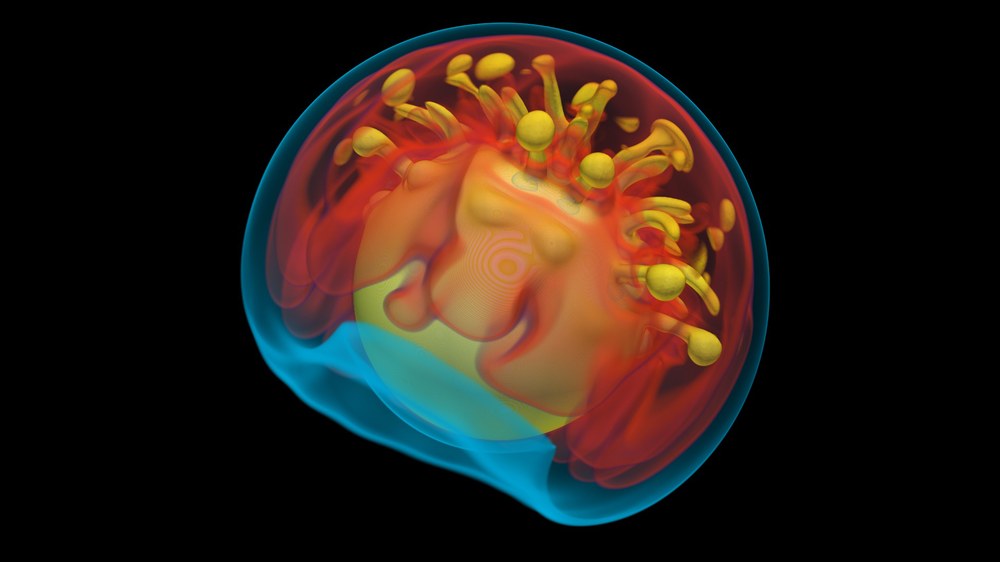

GAIA Code
Visualisation of the GAIA code
Credit:
DLR
GAIA is a comprehensive framework designed to study the thermo-chemical evolution of rocky and icy bodies (planets, moons, and planetoids) on a global scale within the solar system and beyond. The core part consists of a fluid-dynamics solver for creeping flows under highly spatially varying viscosities with an additional energy solver for natural convection.
Natural convection is a type of heat transfer that occurs due to the movement of a fluid (such as air, water, or in much larger time-scales even rocks) caused by differences in density. When a fluid is heated, it becomes less dense and rises, while cooler, denser fluid sinks. This creates a natural circulation pattern that transfers heat from one area to another without the need for external forces like pumps or fans.
In the context of planetary bodies, natural convection plays a crucial role in the thermal and thermo-chemical evolution of rocky and icy bodies. It drives processes such as mantle convection, which can influence plate tectonics, vulcanism, magnetic field development, and the differentiation of materials within the planet's interior.
Why use GAIA?
- Study the thermal and thermo-chemical evolution of planetary bodies
- Examine the influence of plate tectonics, magnetic field development, magma oceans, partial melting, and mantle differentiation
- Investigate the effects of varying viscosities on materials and fluids under natural convection
- Explore the phenomena of natural convection in rocky and icy bodies
How GAIA works
- Solves Magneto-Hydro-Dynamics (MHD) equations
- Utilizes Finite-Volume discretization for Voronoi cells
- Offers many available linear iterative solvers on CSR matrices (e.g., BiCGS(l), IDRS, GMRES, etc.)
- Supports irregular grids for arbitrary geometries (2D + 3D)
- Massively parallel via domain-decomposition for HPC systems (MPI Interface)
- GPU-ready CUDA / hybrid (GPU+CPU) solver
- No third-party libraries or dependencies, DLR-developed C++ code
- Optional interface to MUMPS solver for 2D applications
- Paraview and Python plugins for visualization and data analysis
- Includes a Particle / Tracer system to track chemical species
Highlights
- Natural convection of water-like substance under an extreme heat gradient: Video (upper part: velocity, lower part: temperature)
- Natural convection of water-like substance under a less extreme heat gradient in 3D: Video (left: temperature, right: strain rate)
- A heavy DLR Logo with a low viscosity and brittle material sinking in a fluid: Video (left: material, right upper: strain rate, right lower: viscosity)
- Hot liquid in a full-sphere (core-convection) under self-gravity cooled at the boundary under a rotating reference frame: Video (left: temperature side-view, right: temperature top view onto rotation axis)
- Combination: A 3D DLR Logo wants to move to the surface of a sphere that rotates. (Reversed) Reversed Video
Online Demo
A JS compiled (older) version can be found here . Just click Run in the Run tab and switch to Temperature or Velocity tab.
Reference papers
Journal articles
- An improved formulation of the incompressible Navier–Stokes equations with variable viscosity
Author(s): Christian Hüttig, Nicola Tosi, William B. Moore
Published in Physics of the Earth and Planetary Interiors by Elsevier BV in 2013, page: 11-18
DOI: 10.1016/j.pepi.2013.04.002
- The spiral grid: A new approach to discretize the sphere and its application to mantle convection
Author(s): Christian Hüttig, Kai Stemmer
Published in Geochemistry, Geophysics, Geosystems by American Geophysical Union (AGU) in 2008
DOI: 10.1029/2007gc001581
- Finite volume discretization for dynamic viscosities on Voronoi grids
Author(s): Christian Hüttig, Kai Stemmer
Published in Physics of the Earth and Planetary Interiors by Elsevier BV in 2008, page: 137-146
DOI: 10.1016/j.pepi.2008.07.007