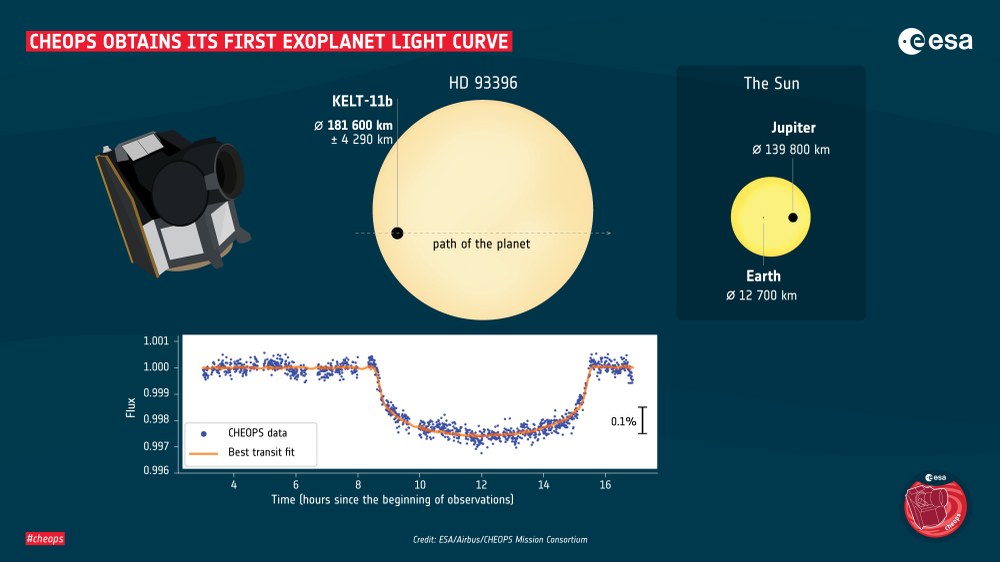
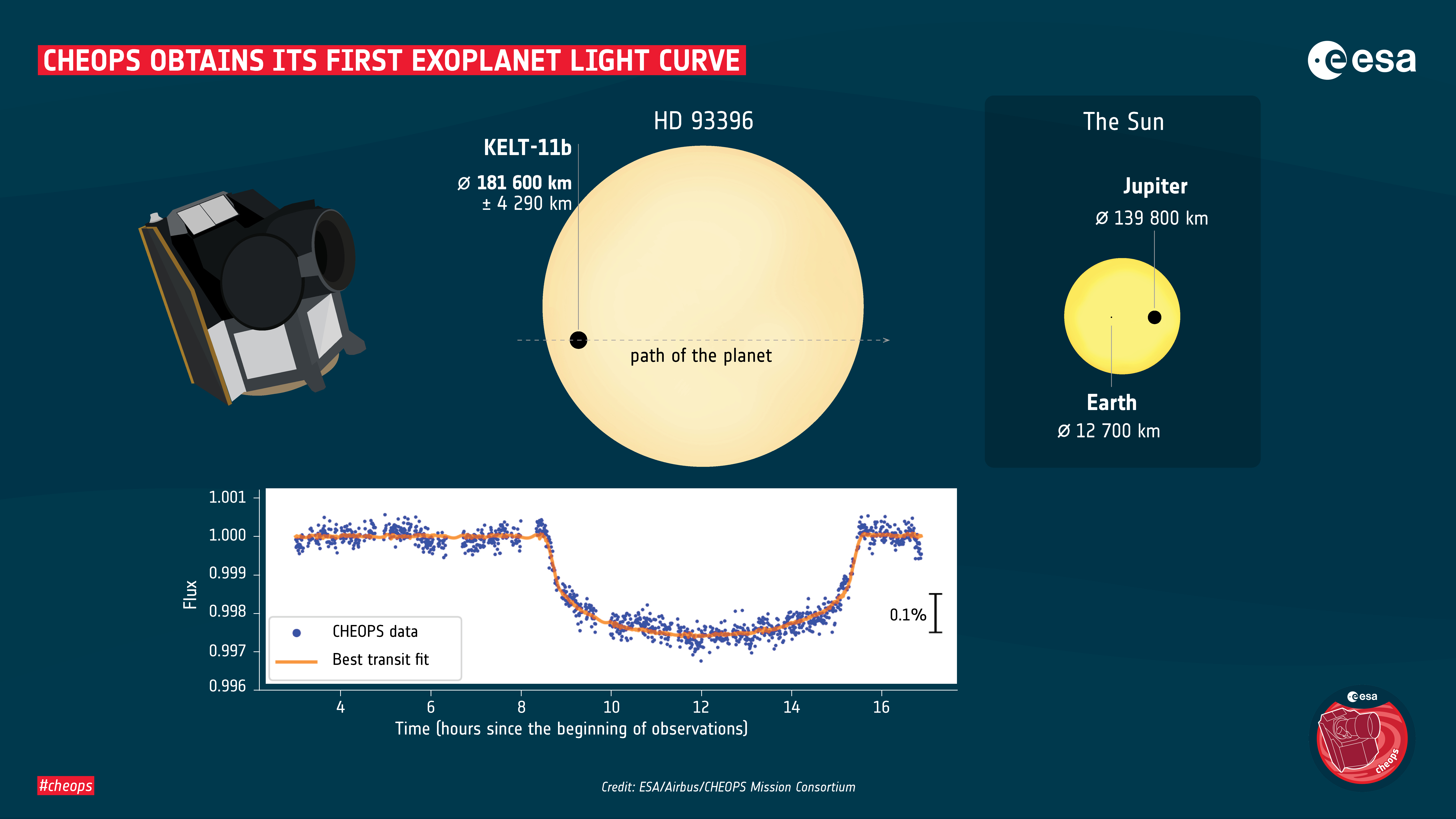
The first star whose light curve was recorded by CHEOPS was HD 93386, a yellow subgiant, roughly three times the size of the Sun. The dip in the star’s brightness is caused by the planet KELT-11b, which is 30% larger than Jupiter.
KELT-11b was the first exoplanet for which CHEOPS observed a transit curve when it was still in the commissioning phase.
This planet was already discovered using a ground-based telescope back in 2014. Further ground-based follow-up observations, transit and spectroscopic measurements were carried out, the results of which were published in 2017. These indicate that the planet's radius is approximately 1.4 times that of Jupiter, with an error margin of around 10%. Measurements taken with CHEOPS were able to determine the radius with an error margin of around 2.5%.
The star HD 93396 is a subgiant yellow star located 320 light-years away, slightly cooler and three times larger than our Sun. It hosts a puffy gaseous planet, KELT-11b, about 30% larger in size than Jupiter, in an orbit that is much closer to the star than Mercury is to the Sun.
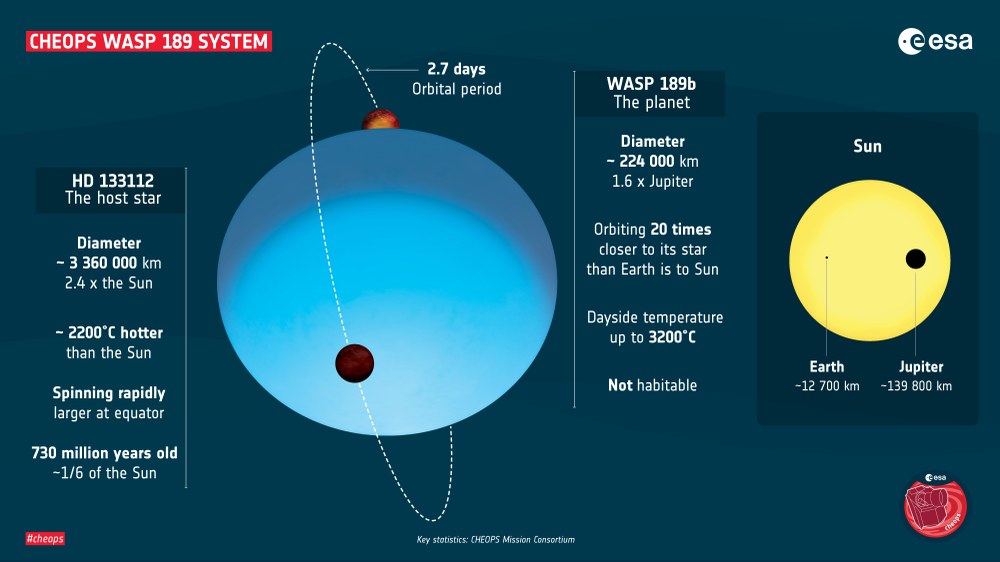
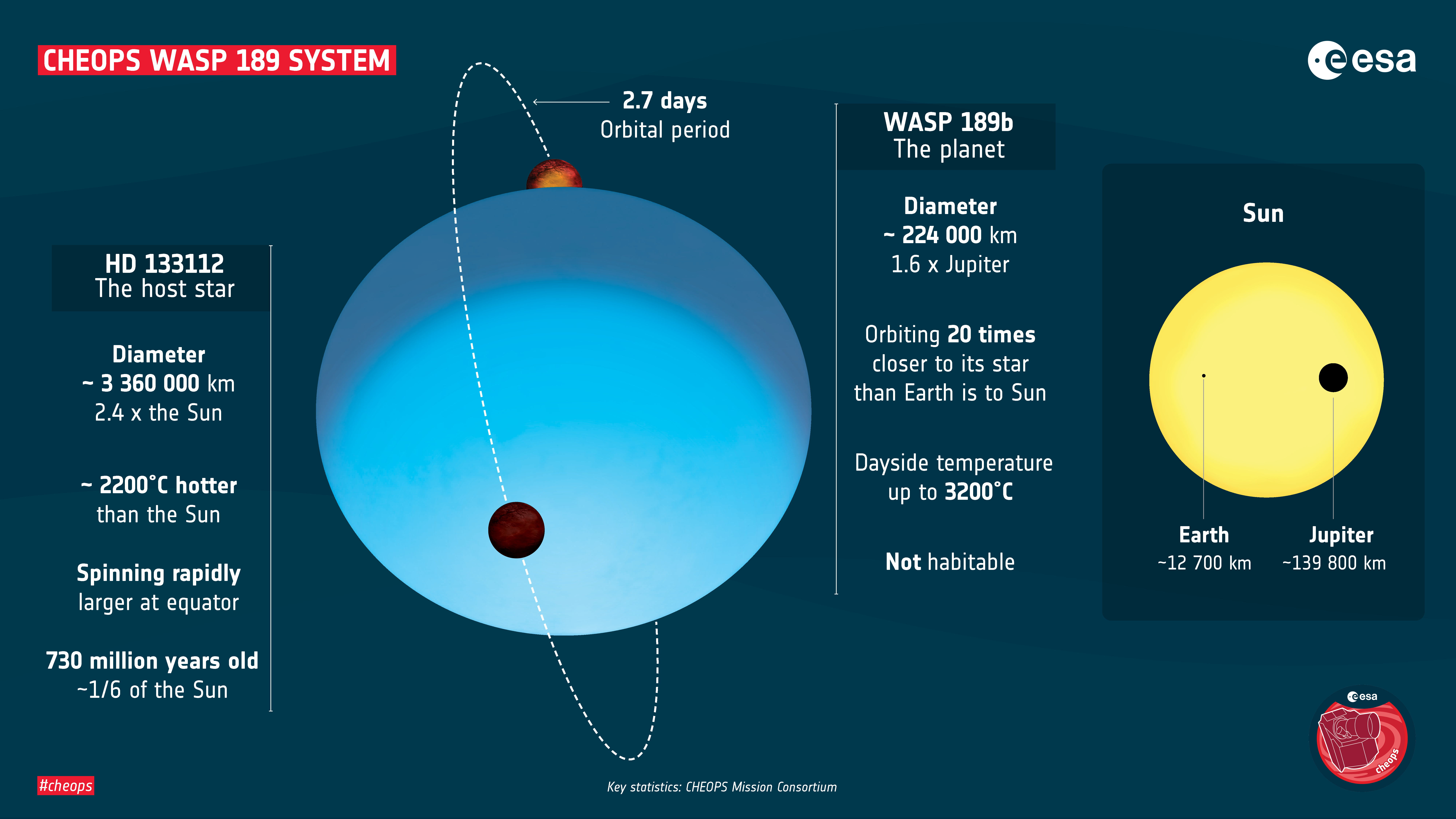
Infographic on the WASP 189 planetary system
In just 2.7 days, the planet orbits its star in an unusal orbit, namely around the stellar poles, and not in the equatorial planet.
WASP-189b had been discovered 2018 and was already in the spotlight because of its proximity to the star and its unusual orbit around the star's poles. WASP-189 is a very hot star, about 2000 times hotter than the Sun, and its companion, WASP-186b, takes only 2.7 days to orbit the star. This means that the planet orbits very close to the star and is therefore exposed to intense radiation and becomes extremely hot. It is considered one of the brightest hot Jupiter-sized planets and CHEOPS was able to determine its radius to 224,000 km (1.6 times the radius of Jupiter), with an accuracy of 1%.
The star also has surprising properties. It is not a perfect sphere, but rotates so fast that it becomes deformed and the equatorial radius is larger than the polar radius. This means that it is cooler at the equator and hotter at the poles. In addition to this unusual asymmetry, the planet's orbit runs over the star's poles, not in the star's equatorial plane. This is what one would actually expect, since the star and planet develop from a common gas and dust disc that ‘passes on’ its direction of rotation to its planets, as is also the case in the solar system. How such an unusual arrangement came about in WASP-189 has not yet been clarified.
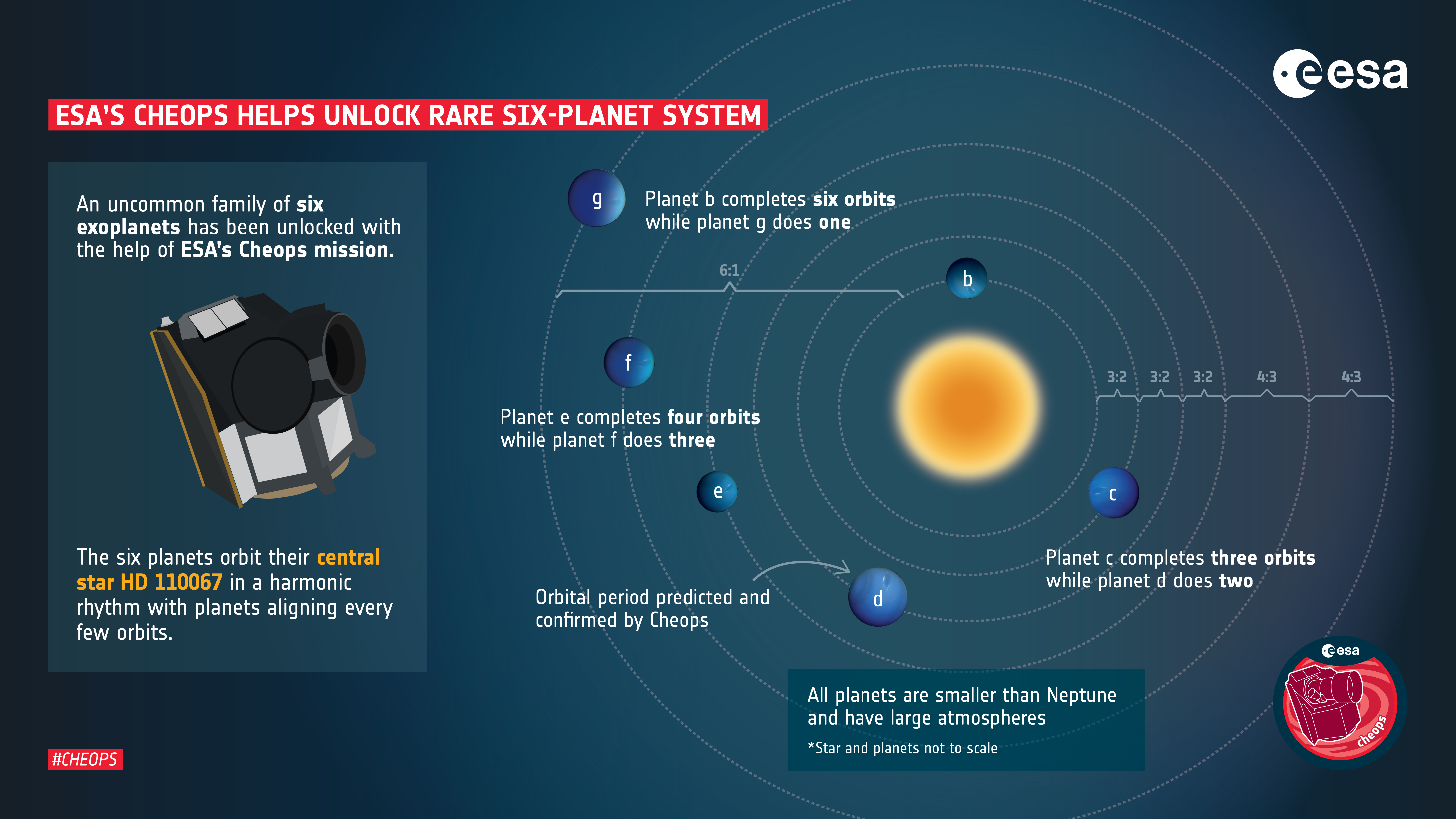
A harmonic planetary system around HD 110067
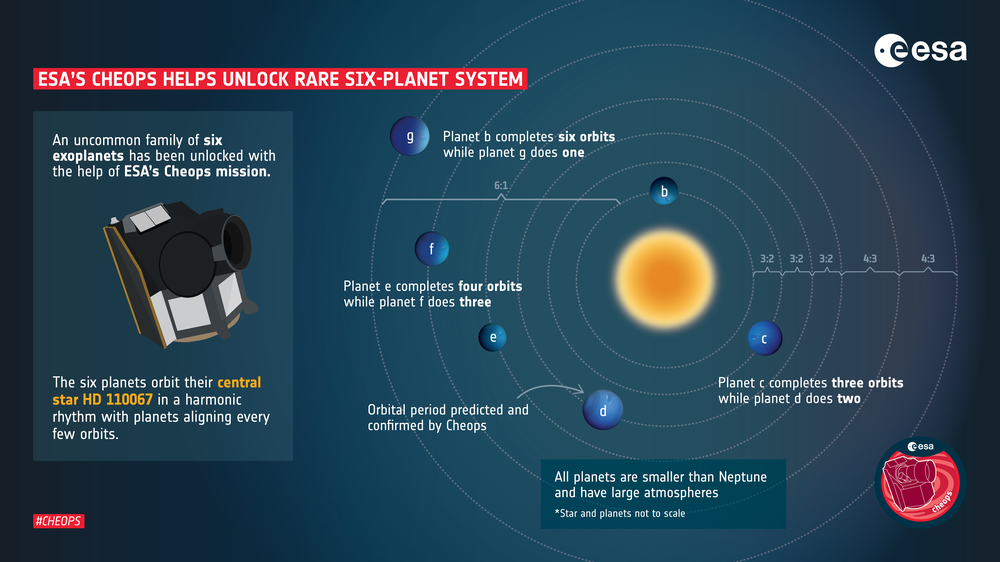
Using CHEOPS, the architecture of a system containing six planets has been deciphered: they orbit in orbits whose periods are in harmonic ratios to one another.
TESS first noticed the planetary system HD 110067 in spring 2020. Two planets were suspected, but this was only confirmed two years later with further TESS measurements. The first planet, HD 110067 b, has an orbital period of 9.1 days. The second planet, HD 110067 c, takes 13.7 days to orbit its star. However, the star's light curve showed transit events that could not be interpreted. At least two events are needed to obtain an indication of the planet's period.
Observations with CHEOPS shed light on this mystery, as they allowed the star to be observed specifically at the times when transit events were suspected. This proved to be the key to interpreting the system. The CHEOPS data revealed a third planet, HD 110067 d, which takes 20.5 days to orbit its star.
The orbital periods are in harmonic relation to each other: 9.1 to 13.7 corresponds to a ratio of 3:2 and 13.7 to 20.5 corresponds to a ratio of 3:4. In music, this would be referred to as a fifth or a fourth.
But even this was not a complete description of the system, because there were still dips that could not be attributed to any of the three planets. Based on the harmonic ratios of the orbital periods of other planets, three more planets were then found. It is believed that such harmonic conditions originated in the first phase of planetary formation and have been preserved because the system was not disturbed.
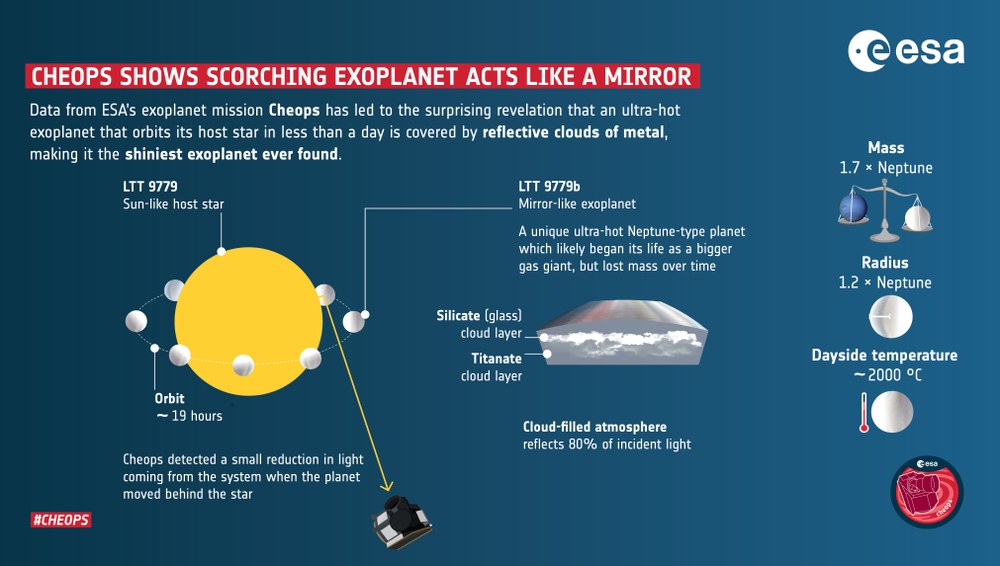
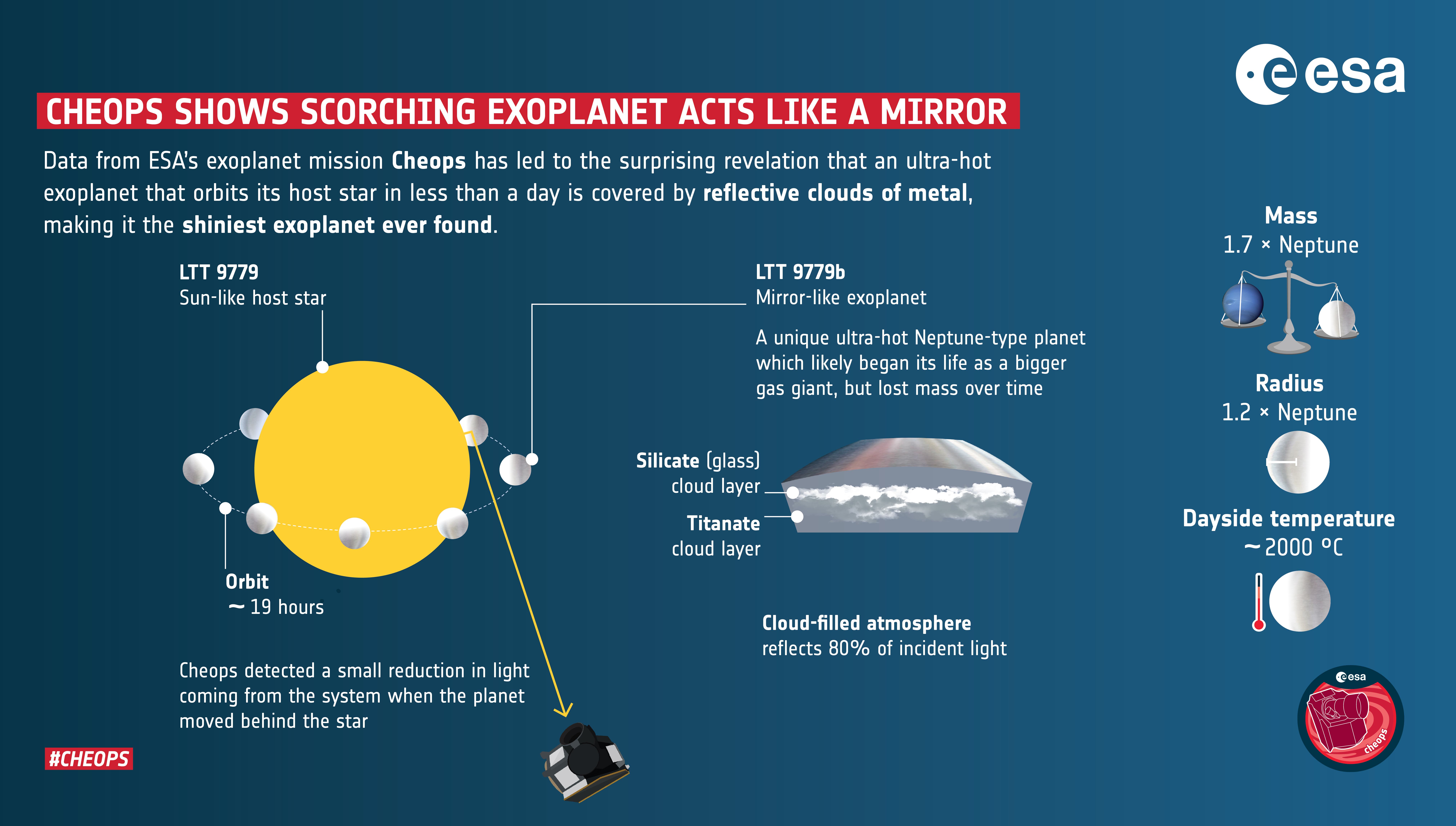
A scorching-hot exoplanet that acts like a mirror
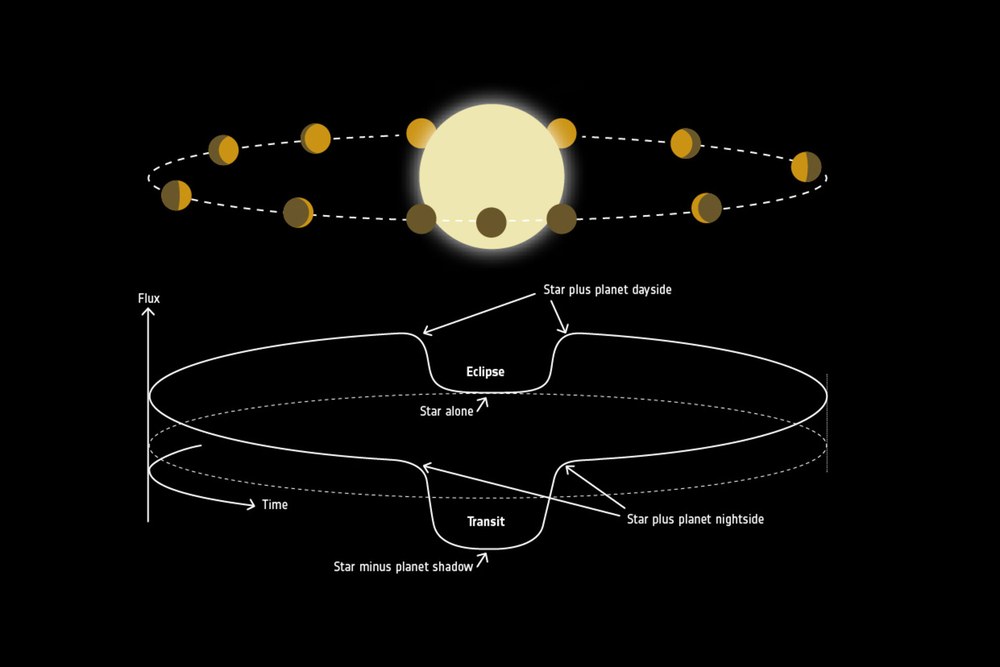
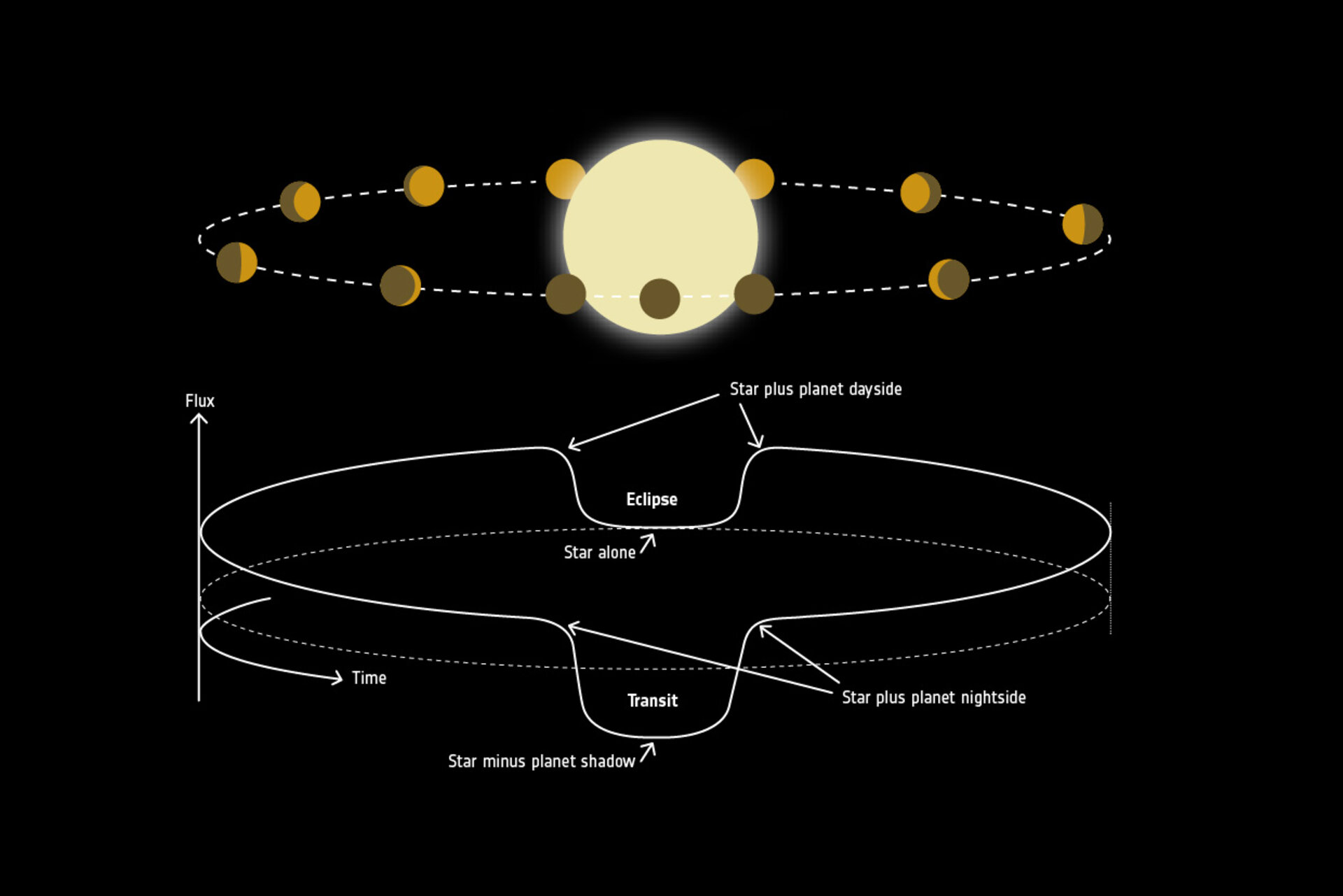
The brightness of the planetary system changes over the course of a complete orbital period. The nature of this change suggests a planet with a high albedo.
Credit:
ESA (Acknowledgement: work performed by ATG under contract for ESA)
LTT-9779 b is an exoplanet the size of Neptune. CHEOPS has now been able to determine its reflective properties, known technically as its albedo: the planet reflects more than 80% of the light it receives from its star. Its albedo is very high compared to Earth (30%) and even higher than Venus (75%), the planet with the highest albedo in our solar system. This planet may be enveloped in clouds of silicates and metals, making it a kind of giant mirror.
Similar to other planets, LTT 9776 b was first discovered with NASA's TESS space telescope and then the system was spectroscopically investigated with ESA's HARPS instrument in Chile. Finally, CHEOPS carried out further photometric measurements. But what exactly did CHEOPS contribute?
Since the orbital period was known, it was possible to calculate exactly when the planet passes in front of its star (transit) and when it disappears behind its star (eclipse). Shortly before the planet appears to disappear, a telescope receives maximum radiation, namely the light from the star and the reflected light from the maximally illuminated planetary disc. The more light the planet reflects, the greater the change in intensity when it disappears.
Changes in the brightness of a planetary system over the course of a complete orbit
Just as there are phases of the moon, there are also changes in the brightness of the entire planetary system, depending on the size of the planet and its reflectivity.
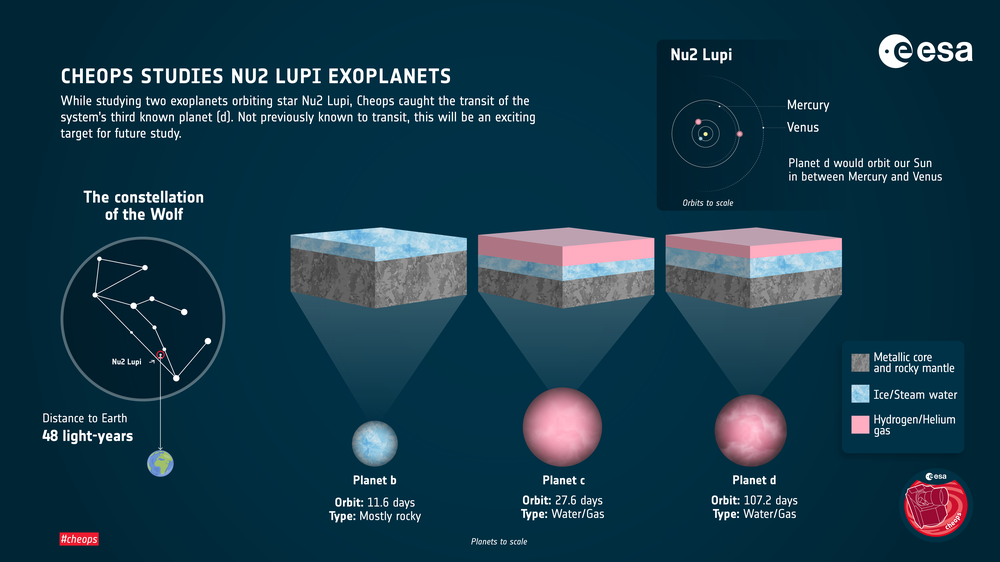
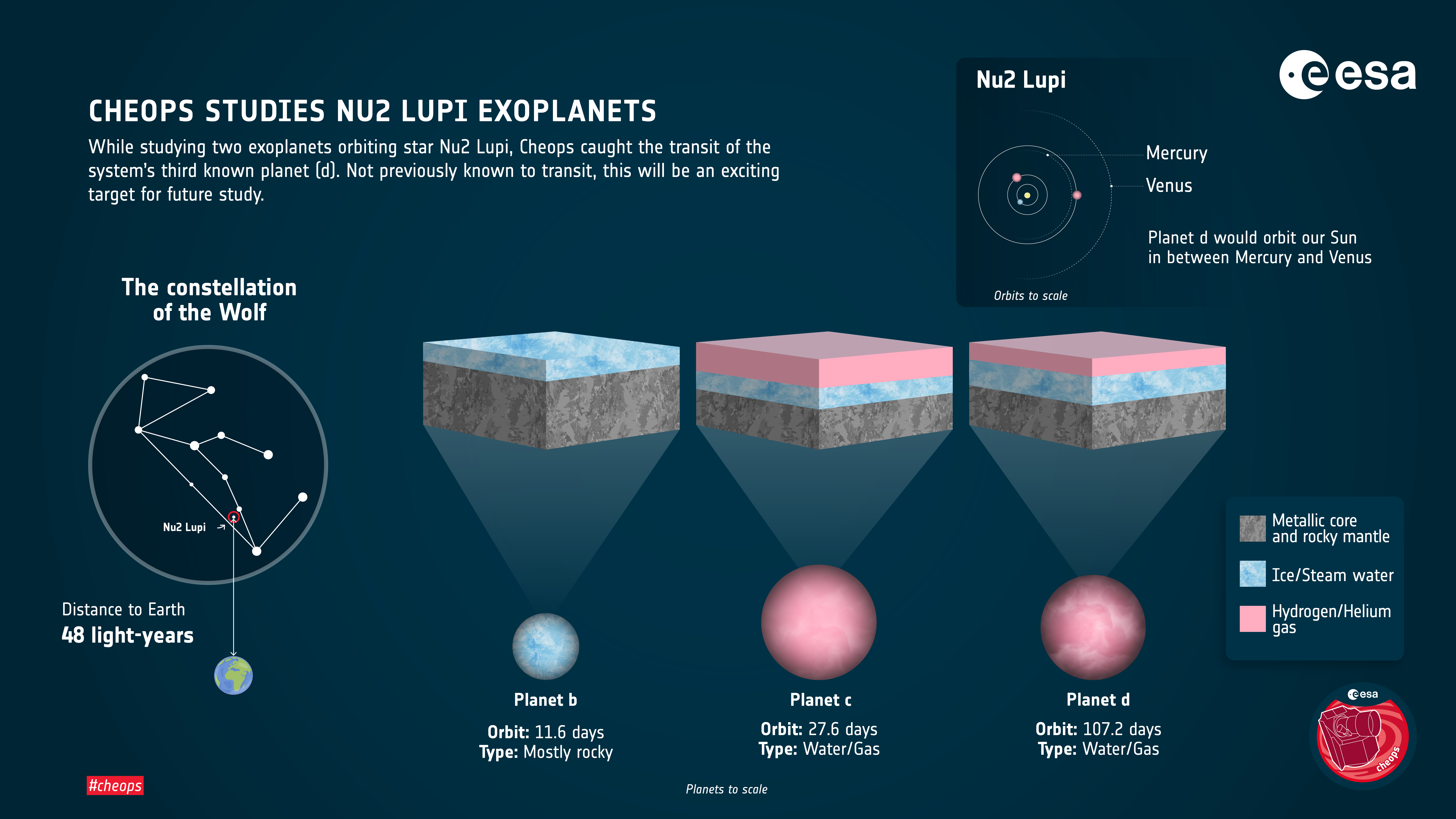
Illustration of the possible structure of the three planets orbiting the Sun-like star Nu2 Lupi. All the planets have an iron core and a rocky mantle, but planets c and d have a higher water content and an atmosphere consisting of a mixture of hydrogen and helium. Planet d orbits in a zone that, in our solar system, would lie between Mercury and Venus, and therefore receives only moderate radiation from the central star.
It has been known since 2019 that the star Nu 2 Lupi – a bright, orange-reddish-yellow star with a mass roughly equivalent to that of our Sun – is home to three planets. This star in the constellation Lupus (Wolf) is only 48 light-years away from Earth and is visible to the naked eye. It was measured using the HARPS (High Accuracy Radial velocity Planet Searcher) instrument on the 3.6-metre telescope at the European Southern Observatory (ESO) in Chile. Using the radial velocity method, three planets were discovered in this data, and their orbital periods were determined to be 12 days, 28 days and 108 days. The NASA satellite TESS (Transiting Exoplanet Search Satellite) then targeted this planetary system and was able to identify the two inner planets, Nu2 Lupi b and Nu2 Lupi c, with transit events. However, since TESS only measures in observation units of 28 days, no transit of the third planet could be detected. Perhaps the orbit of this outer planet was so inclined that no transit event was possible. It was not until 2021 that a dip in the CHEOPS data that a dip in the light curve could be attributed to this planet. The interpretation of all data sources revealed a planet with two and a half times the radius of Earth and 8.8 times the mass of Earth. Its long orbital period implies a distance between Mercury and Venus, and thus moderate radiation from the star; in short, it is a super-Earth.
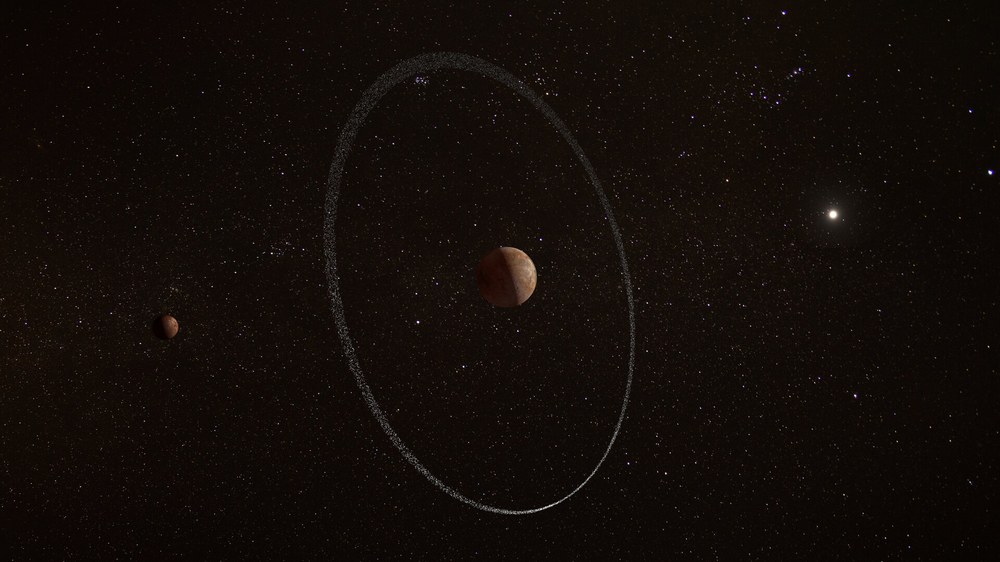
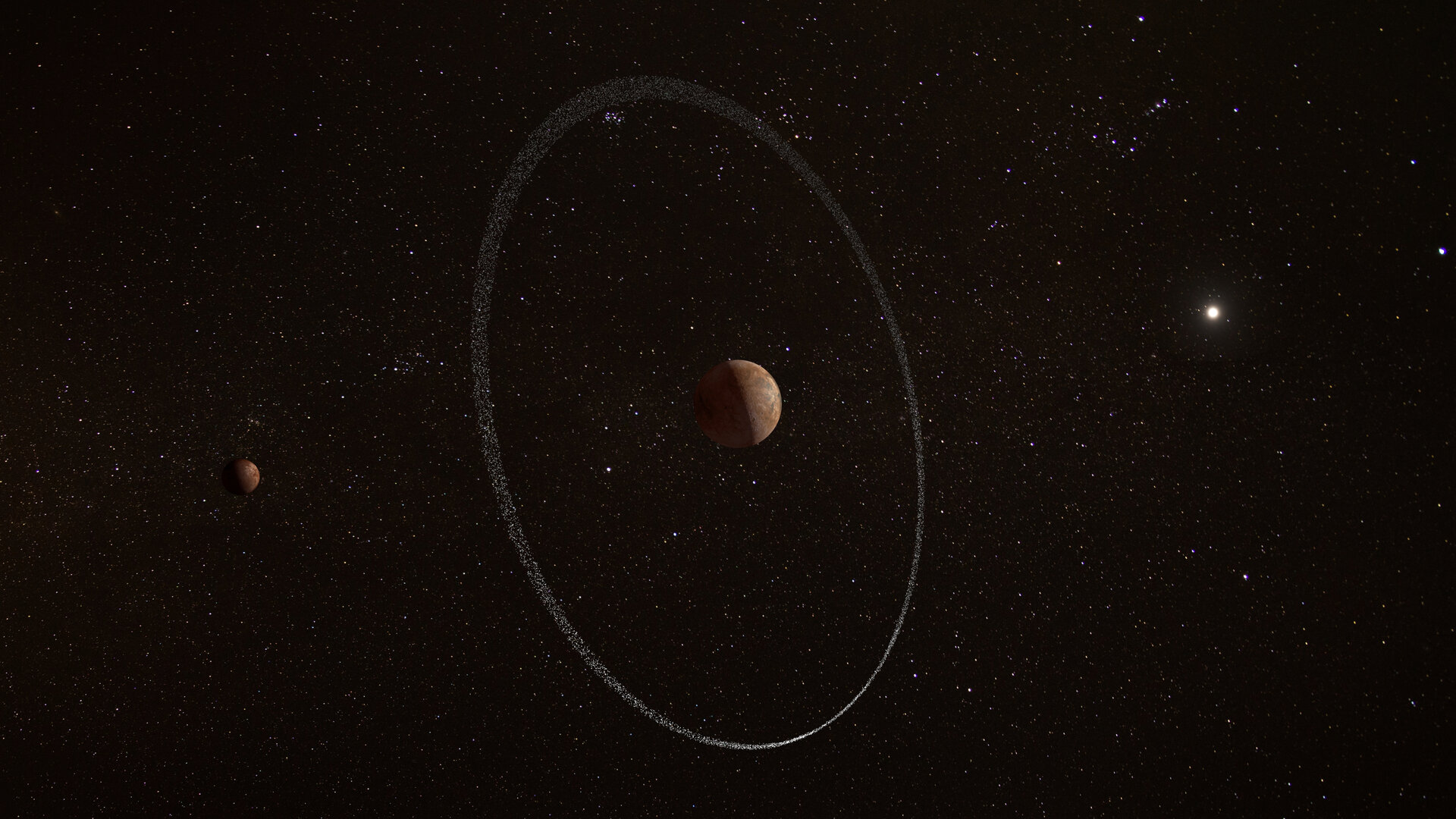
Artist’s impression of the dwarf planet Quoaor
Using CHEOPS, a ring has been discovered around this dwarf planet, that is far more distant than previously possible. In theory, this material should actually have formed a moon.
It is not only exoplanets that can be observed in transit; asteroids or dwarf planets in our own solar system can also be observed when they pass between a star and the telescope. Unlike exoplanet transits, however, these events do not occur regularly. The dwarf planet Quaoar, a trans-Neptunian object, was discovered in 2002 using a ground-based telescope at the Palomar Observatory. From 2018 to 2023, CHEOPS and several ground-based telescopes observed this object as it passed in front of a star. In addition to the expected transit signal from the dwarf planet, further dips were observed, which originate from a ring system. Of particular interest is the distance between the ring and the planet, which is significantly greater than the Roche limit, which is actually considered to be the furthest distance at which a ring can exist.