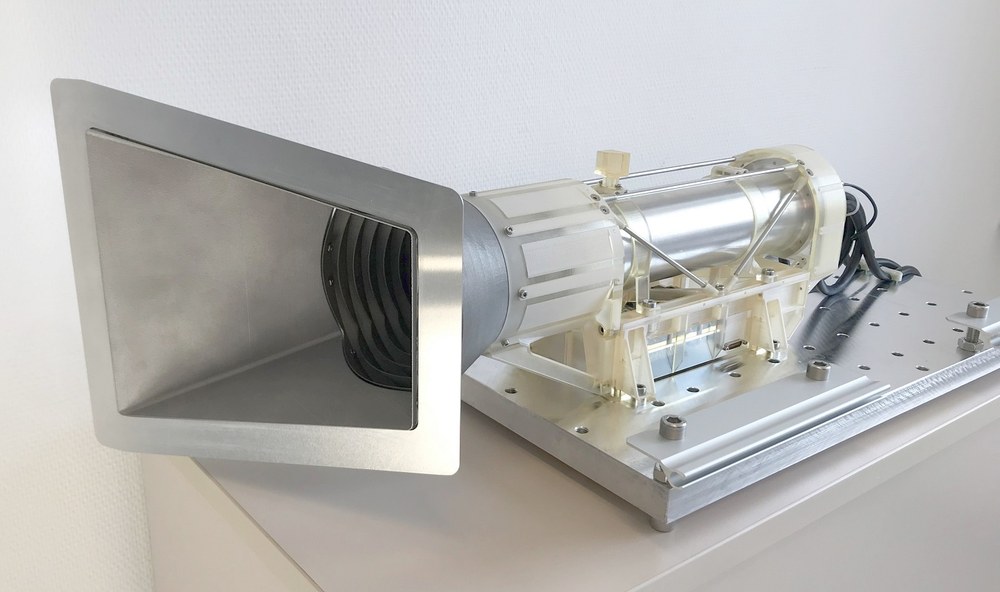
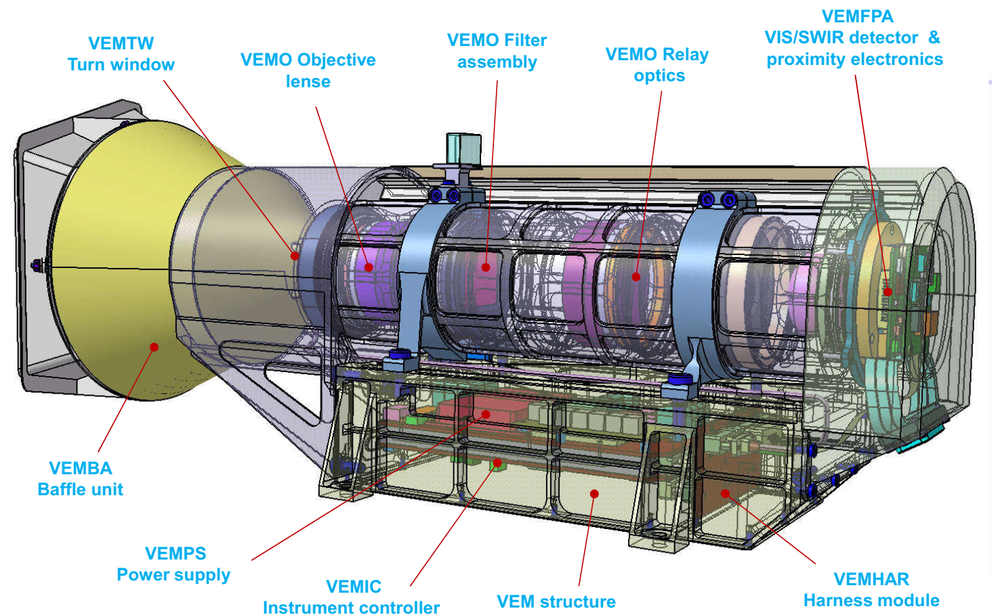
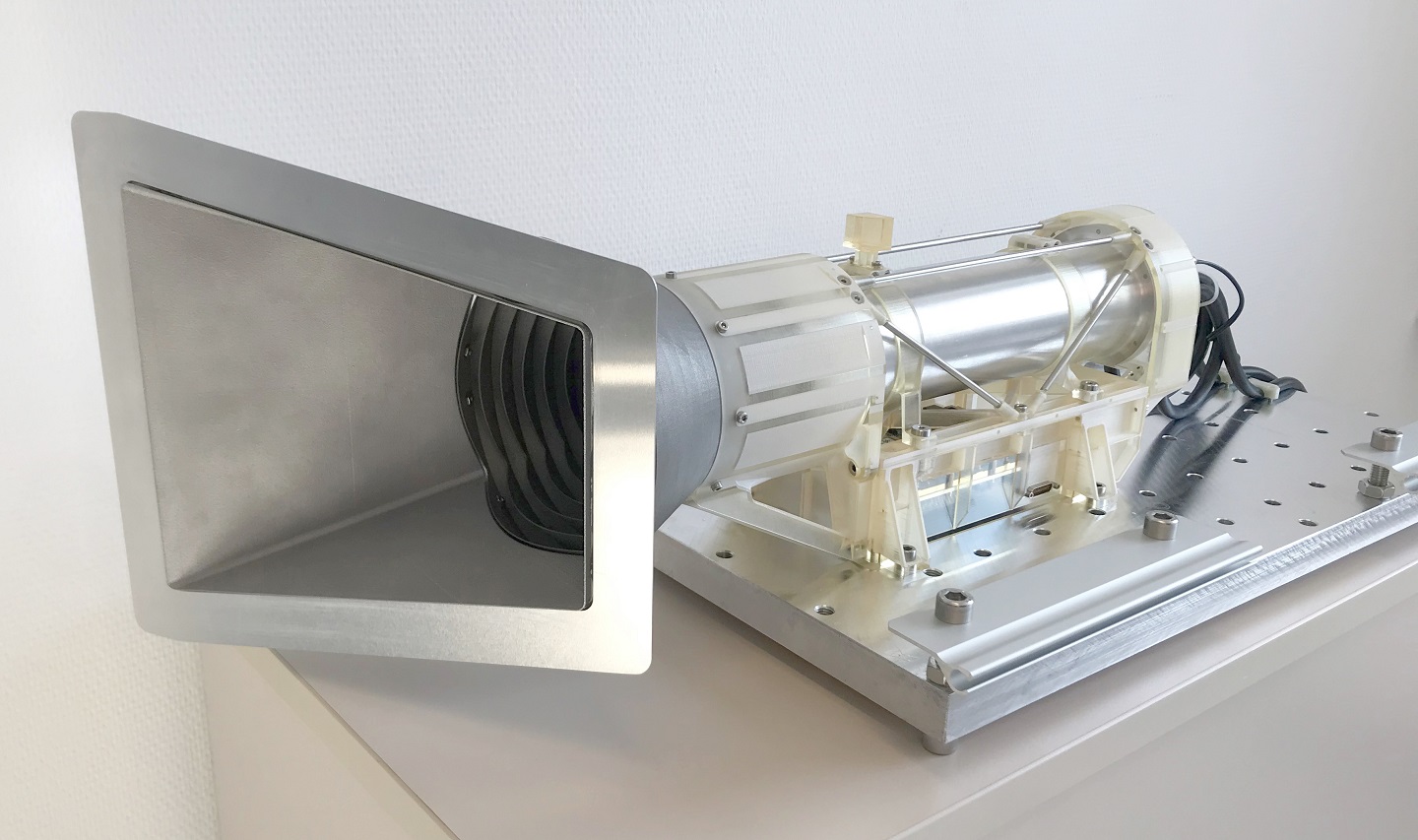
A complete, representative mock-up of the VEM instrument for use on the VERITAS mission, to aid understanding of its design. The upper section comprises a two-part 3D-printed baffle, a protective rotating window between the baffle and the optics, the optics (owned by CNRS LATMOS / LESIA) and a camera head (commercial component, RAPTOR Photonics). The lower part of the housing currently houses the placeholder electronics (the actual electronics are under development); nevertheless, the camera is operational in the configuration shown.
The Venus Emissivity Mapper (VEM) is the first flight instrument designed to focus on mapping the surface of Venus using several atmospheric windows around 1 µm. Its main objective is achieving an instrument SNR of well above 1000, as well as predicted error in retrieval of relative emissivity of better than 1%, assuming the availability of improved Venus topography.
VEM is one of the two core scientific instruments on VERITAS, a NASA mission to observe Venus. The development of the VEM is being led by the DLR Institute of Space Research in Berlin. This encompasses not only the scientific definition and implementation, validation and operation, but also the design, manufacture, assembly and verification of the instrument. A French contribution, the optics including spectral filter assembly, is provided by the Centre National d'Etudes Spatiales (CNES) and the Laboratoire d'études spatiales et d'instrumentation en astrophysique (LESIA).
In June 2021 NASA has selected two missions (VERITAS and DAVINCI+) to Venus, the Earth’s nearest planetary neighbor. Part of NASA’s Discovery Program 2019, the missions aim to understand how Venus became an inferno-like world when it has so many other characteristics similar to ours – and may have been the first habitable world in the solar system, complete with an ocean and Earthlike climate. Suzanne Smrekar of NASA’s Jet Propulsion Laboratory in Southern California is the principal investigator. JPL provides project management for the mission, the German Aerospace Center the infrared mapper VEM, the Italian Space Agency (ISA) and France’s Centre National d'Etudes Spatiales (CNES) contributing to the radar and other parts of the mission. The launch of VERITAS is planned in 2031.
VEM is designed as a multispectral push broom imager to map the surface emissivity using six spectral bands in five atmospheric windows of the atmosphere and eight spectral bands for calibration and detection of near- surface water vapor. It leverages a proven measurement technique pioneered by VIRTIS on Venus Express (VEX). It also incorporates lessons learned from VIRTIS to achieve greatly improved sensitivity and spectral and spatial coverage.
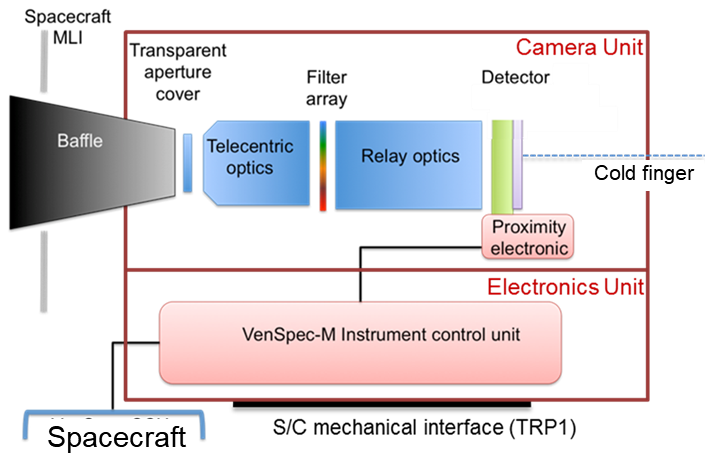
A filter array (rather than a grating) provides wavelength stability (band-center and widthscatter) about 5 times more stable and maximizes signal to the focal-plane array (FPA). A two-stage baffle decreases scattered light and improves sensitivity. Use of an highly integrated InGaAs detector with 1280 x 768 pixels including an thermal electric cooler (TEC) eliminates the need for cryogenic cooling. The thermal stabilization ensures the high Signal to Noise Ratio for measurements in the wavelength range between 0,8µm and 1,6µm. A turntable window protects the optical entrance against contamination during the aerobreaking phase when VERITAS enters the atmosphere of VENUS. The telecentric optics image the spectral lines on the detector which is thermally stabilized to ensure a high signal to noise ratio. Electronics drives and supply the system. An onboard processing unit installed with on-board software controls the components and provides data processing and compression.