SmartBlades2 - Construction, testing and further development of intelligent rotor blades
SmartBlades2
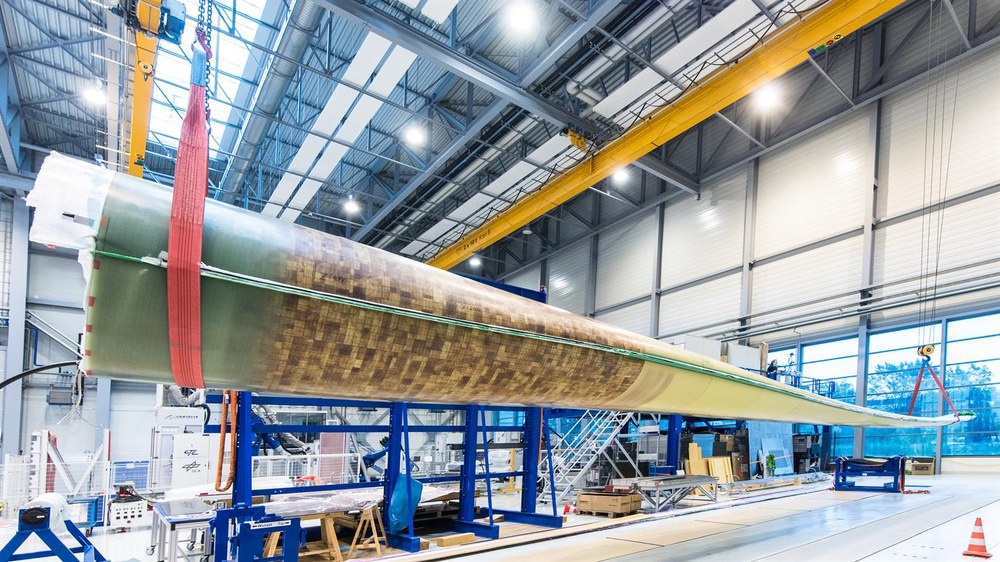
Within the SmartBlades1 project, three technologies for the design and construction of larger rotor blades were investigated.
The rotor blades equipped with these technologies are intended to have the ability to adapt optimally to variable wind conditions, withstand gust loads better, and be capable of achieving higher energy yields. At the same time, the blades must remain light enough to be cost-effective to manufacture, transport, and install. The SmartBlades1 project demonstrated the potential of three different technologies. On one hand, blades were designed to passively adapt to the load situation through a bend-twist coupling (BTC). Additionally, the application of leading and trailing edge flaps to control and influence the aerodynamic behavior of the blade system was studied. These systems function similarly to aircraft high-lift systems and control surfaces.
The results of SmartBlades1 illustrate the potential of innovative blade technologies and have sparked increased interest from the industry for such applications. This led to the follow-up project: SmartBlades2. In this project, the Wind Energy Research Consortium and a consortium of industry partners jointly leverage their expertise to test and evaluate the developed concepts for a new generation of rotor blades.
Type of project
Third-party funded project
Other partners
Carl von Ossietzky Universität Oldenburg (ForWind), Leibniz Universität Hannover (ForWind), Fraunhofer-Institut für Windenergiesysteme IWES, WRD Wobben Research and Development GmbH, SSB Wind Systems GmbH & Co. KG, Suzlon Energy Limited, GE Global Research, Henkel AG & Co. KGaA, Nordex Acciona Windpower, Senvion
Funding organisations
Bundesministerium für Wirtschaft und Klimaschutz (BMWK) over Projektträger Jülich (PTJ)