With its 26 cameras, the European space telescope PLATO has a wide field of view – about fifty times wider than the full Moon. Or, to put it another way, PLATO can see five percent of the celestial sphere. Its images are captured using cameras whose fields of view are slightly offset from one another.
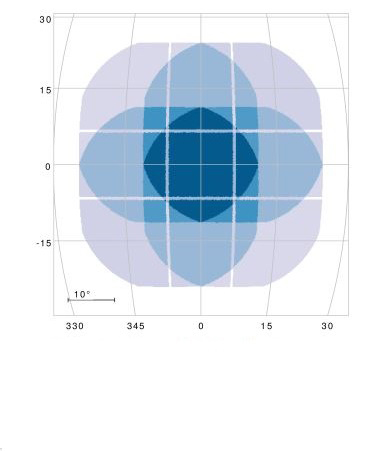
Field of view of PLATO's 24 standard cameras
The colours indicate the number of cameras pointing at the field of view: 24 cameras observe the centre, followed by 18, 12 and, at the outer edge, six. The entire field of view covers approximately 49 by 49 degrees, with the central field (dark blue) spanning approximately 18 by 18 degrees.
Credit:
Nascimbeni et al., A&A, 658, A31 (2022)
Twenty-four standard cameras, which are read out every 25 seconds, do the heavy lifting. Two fast cameras, with a readout rate of just 2.5 seconds, are used to fine-tune the spacecraft's position so that it remains constantly aligned with a selected patch of the sky.
From the start of its mission in 2027, PLATO will search for Earth-sized planets orbiting Sun-like stars by observing a single selected region of the sky continuously for at least two years.
The reason for this long-term observation is easy to understand using Earth as an example. Detecting a transit of our planet from a distant vantage point in space would mean observing the Sun continuously for at least 365 days – and then maintaining that watch for the same length of time again to detect and confirm a second transit, thus determining the planet’s orbital period around the Sun.
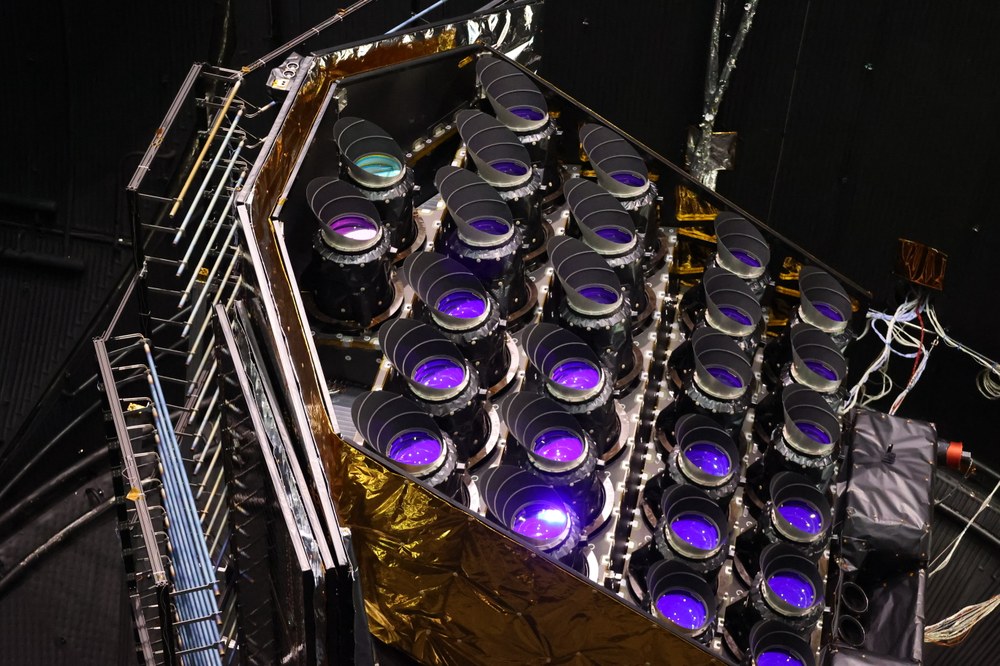
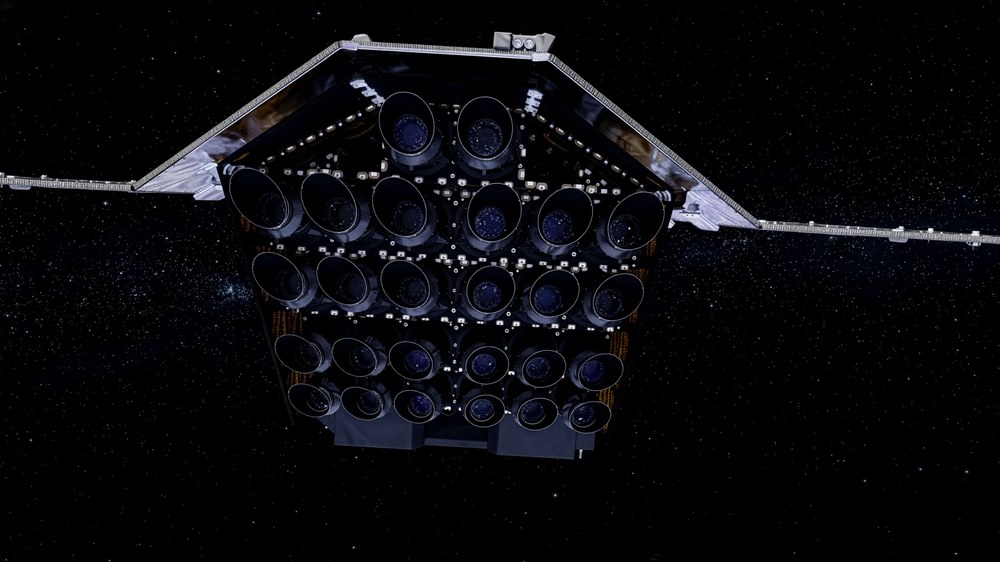
PLATO in the space simulation chamber
The image shows the PLATO spacecraft with its 26 highly sensitive cameras, following testing in ESA's space simulation chamber (Large Space Simulator). The comprehensive tests were completed in April 2026 and demonstrated that the instrument functions under the harsh conditions of space.
Credit:
ESA
How to select an observation field
The observation field should not be too densely populated with stars, so that their light can be clearly attributed to the correct source. To ensure this, the PLATO Input Catalogue (PIC) was consulted; it lists the properties of stars such as their spectral type, luminosity, brightness and – most importantly – the expected 'noise' in the star's signal, which describes how consistently a star shines. If the brightness varies significantly, this noise can mask a transit signal. Yet it is precisely these signals that PLATO is looking for, because they occur when a planet passes in front of a star and causes it to dim.
Projection of the possible PLATO fields of view onto the celestial sphere
The PLATO fields are shown in shades of blue, with the number of cameras decreasing from 24, 18 and 12 to six as the shading lightens from dark to light blue. The Kepler mission's field of view is shown in magenta, the K2 mission's in green and the TESS mission's in yellow. The grey shading represents stellar density.
Credit:
Nascimbeni et al., A&A, 658, A31 (2022)
An important source of this data comes from the results of the European Space Agency's (ESA) Gaia mission. Between 2013 and 2025, the Gaia spacecraft observed nearly two billion stars and other celestial bodies, measuring their position, distance and motion.
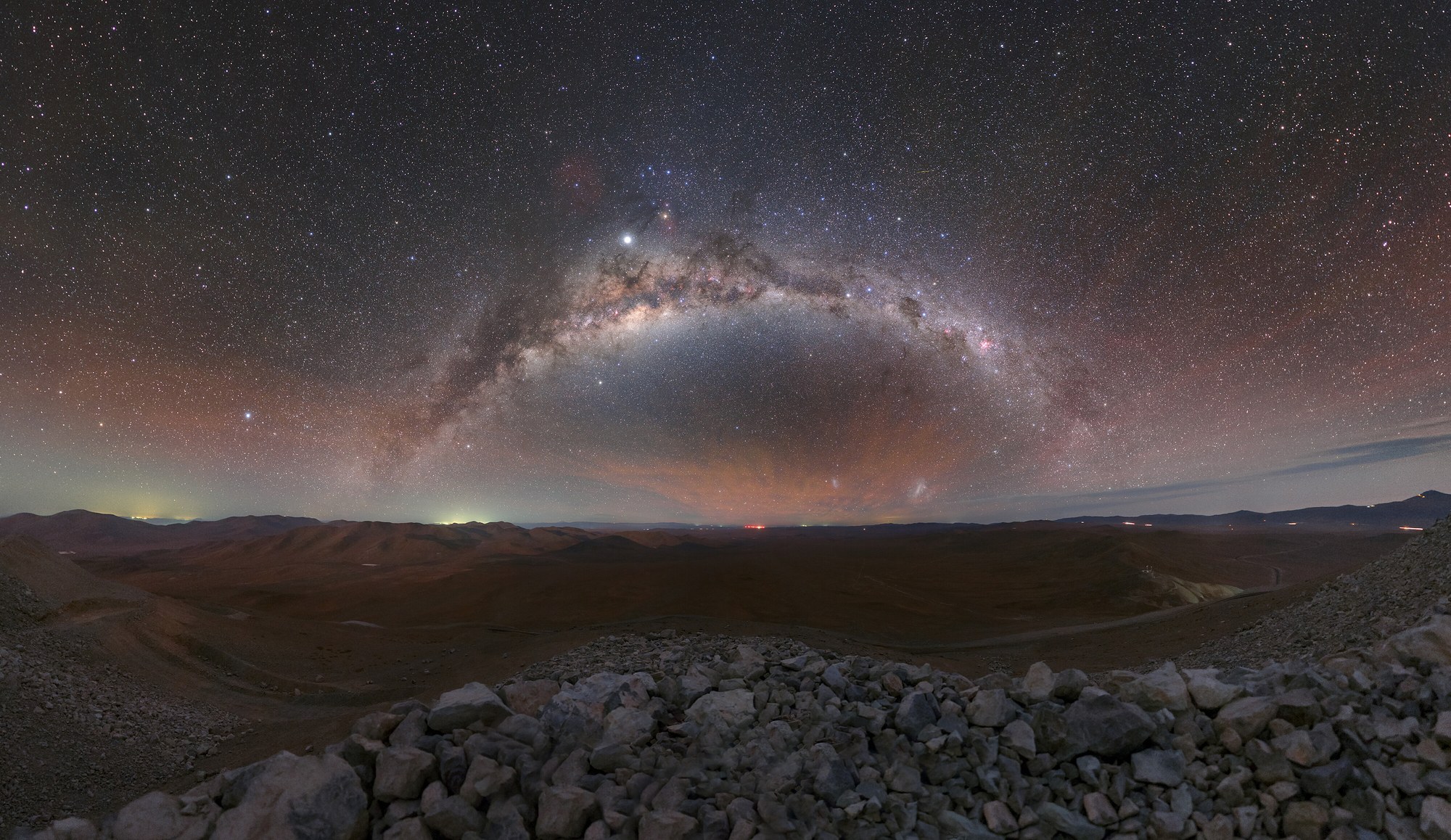
A first look towards Canopus
Two fields have been identified as possible candidates for this first campaign – one in the northern hemisphere and one in the southern hemisphere. In 2023, the field in the southern hemisphere was selected. A strong argument in its favour was that there are more telescopes in the southern hemisphere offering opportunities for follow-up observations. The now precisely defined field, named Long-Pointing Field South 2 (LOPS2), contains roughly 250,000 stars, of which approximately 215,000 will be measured. This field contains the second-brightest star in the night sky, Canopus, and the massive binary star system Eta Carinae, as well as non-stellar objects such as the Large Magellanic Cloud.
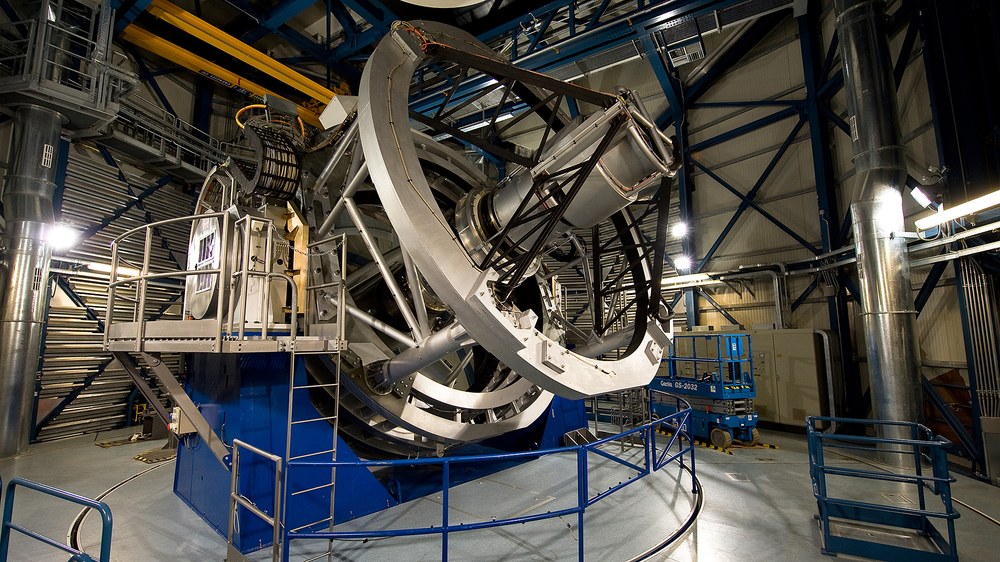
The VISTA telescope in Chile
The VISTA telescope, operated by the European Southern Observatory (ESO), is involved in the ground-based measurements for the PLATO mission.
Credit:
ESO
It is important to realise that while PLATO is searching for exoplanets, initially only planet candidates will be identified from the data. In any case, further measurements using ground-based telescopes and specialised instruments – such as a spectrometer – are necessary.
The 4MOST instrument on the European Southern Observatory's (ESO) VISTA telescope at the Paranal Observatory in Chile is well-suited for this purpose. These follow-up ground-based measurements are combined in the Ground-based Observational Programme of the PLATO Mission Consortium.
Thorough preparation is essential
It is worth knowing the field of view as precisely as possible. More accurate descriptions of the stars in the field lead to better analysis of PLATO data. In the LOPS2 field, 789 stars are already known to host planets, along with a great many planet candidates awaiting confirmatory follow-up measurements. Many of these were identified by NASA's TESS mission, which is reflected in the name TOI (TESS Objects of Interest).
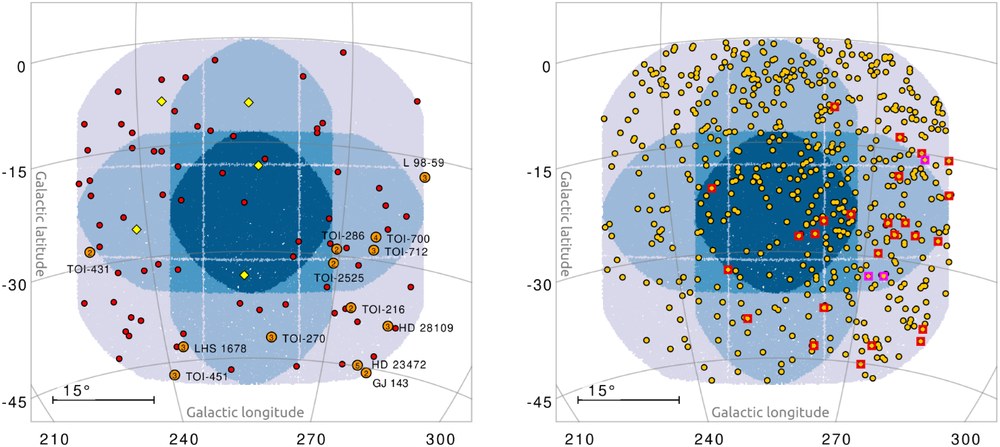
The LOPS2 survey area, with planets and planet candidates
Planets have already been found in PLATO's first observation field, LOPS2. Left: the field showing all the planetary systems discovered so far. Stars with more than one planet are marked with 2, 3 and 4 respectively. Right: stars where a planet is suspected but has not yet been confirmed. These planet candidates are derived from data collected by the TESS mission.
Credit:
Nascimbeni et al., A&A, 694, A313 (2025), The PLATO field selection process, II. Characterization of LOPS2, the first long-pointing field
PLATO's success will depend not only on technical implementation and data processing, but also on thorough scientific preparation involving a precise analysis of the field. The main-sequence stars are of particular interest. Their hydrogen is fusing into helium inside these stars, resulting in a stable state. In this state, a star can exist for many billions of years, depending on its mass. Such stars include F-, G- and K-type stars. Our Sun is a G star; on the main sequence, neighbouring F-type stars have larger masses and radii, while K-type stars are slightly smaller.
Hundreds of thousands of stars and one problem
The vast size of the field of view results in enormous quantities of measurement data. If the information from all the cameras was sent back to Earth, this would quickly reach terabit levels. This volume of data is simply too large to be transmitted to the ground station without restrictions. After all, with 24 standard cameras, the volume of data is immense – each camera has four light-sensitive detectors, known as charge-coupled devices (CCDs). Each detector comprises 4,510 by 4,510 pixels, amounting to 1.95 billion pixels, which are read out every 25 seconds. This alone results in a data volume of 100 terabits. However, the capacity of PLATO's transmission antenna is limited to 435 gigabits per day.
Artist's impression of the PLATO spacecraft in space
The cameras on the PLATO mission will generate a huge amount of data. It is therefore necessary to pre-select the information to be sent back to Earth.
Credit:
ESA
We are all familiar with the solution to this challenge from our everyday use of computers: the data is compressed before being sent. Here, this is achieved by pre-selecting the information to be transmitted. For the vast majority of stars, a light curve – that is, a record of the star’s brightness over time – is already generated on board the PLATO telescope. Only these significantly smaller datasets are then sent to the ground station. For the stars of greatest scientific interest – those in the Prime Sample – all measurement values from a 6 by 6-pixel field, known as an 'imagette', are retained and sent to Earth unprocessed.
The launch of the mission in early 2027 will mark the beginning of a very interesting era in astronomy.