
ARCADIA – Assessment of passenger safety in aircraft design
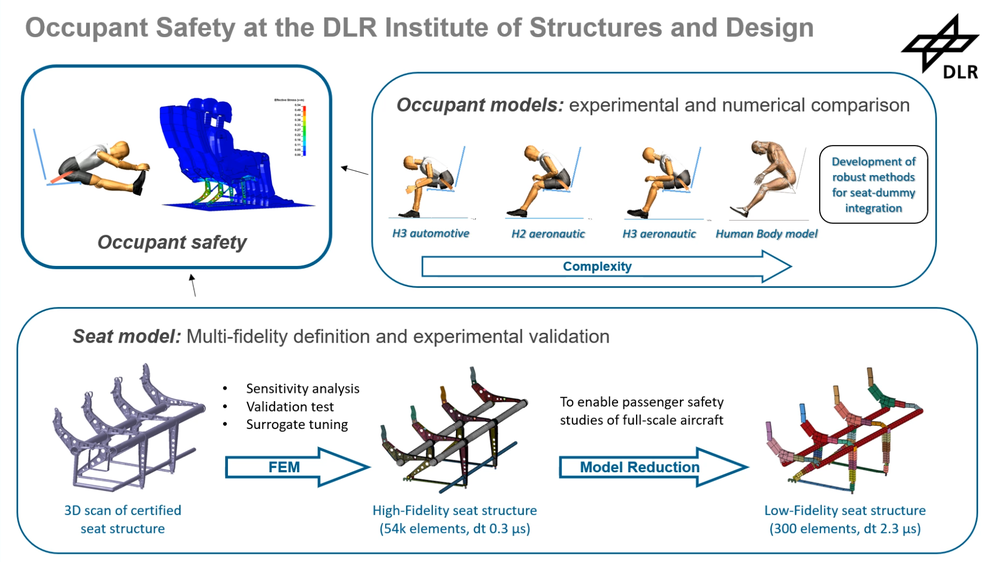
Overview of the research area of occupant safety at our institute
Your consent to the storage of data ('cookies') is required for the playback of this video on Youtube.com. You can view and change your current data storage settings at any time under privacy.
Overview of the research area of occupant safety at our institute
Credit:
Project Duration: 2023 - 2028
Designing a new aircraft is a complex multidisciplinary process. The German Aerospace Center (DLR) has established a process chain for aircraft design, combining the expertise of its various institutes. DLR established the ARCADIA project to integrate the expertise of the DLR institutes working on innovative cabin configurations. In particular, the initiative includes the development of disruptive cabin designs, ventilation concepts, occupant safety methodologies, electrical systems frameworks, and boarding strategies, through testing and in-depth virtual analysis. This collaborative aircraft and cabin development relies on the Common Parametric Aircraft Configuration Schema (CPACS) to streamline the exchange of design data and results of increasingly detailed aircraft models within different institutions focusing on diverse aspects of aeronautics.
PANDORA: Digital Environment for Crash Simulation
The Institute of Structures and Design plays a key role in the design process, contributing to crashworthiness and structural design. The internally developed Python tool PANDORA (Parametric Numerical Design and Optimization Routines for Aircraft) represents an interface with the DLR design process chain, thanks to the automatic generation of complex multi-fidelity Finite Element (FE) models based on the aircraft CPACS definition. Within ARCADIA, the PANDORA environment is extended with the integration of cabin environment and occupant models, to investigate novel safety challenges emerging with non-conventional cabins. For such configurations, the passenger safety requirements may directly affect the structural design, urging a comprehensive crashworthiness evaluation already in the preliminary design phase.
The methodology to generate the fuselage structure is numerically validated, and a detailed seat model is developed, based on a certified seat geometry, to guarantee a reliable occupant safety assessment even beyond the certification requirements. The seat leg structure model is experimentally validated, while small elements (e.g. floor joints, backrest release mechanism) are simulated via numerical joints, tuned though dedicated experiments, to minimize the computational cost of the seat model. The resulting virtual seat can be assembled by PANDORA to form any cabin layout, thanks to its modular design.
The methodology to generate the fuselage structure is numerically validated, and a detailed seat model is developed, based on a certified seat geometry, to guarantee a reliable occupant safety assessment even beyond the certification requirements. The seat leg structure model is experimentally validated, while small elements (e.g. floor joints, backrest release mechanism) are simulated via numerical joints, tuned though dedicated experiments, to minimize the computational cost of the seat model. The resulting virtual seat can be assembled by PANDORA to form any cabin layout, thanks to its modular design.
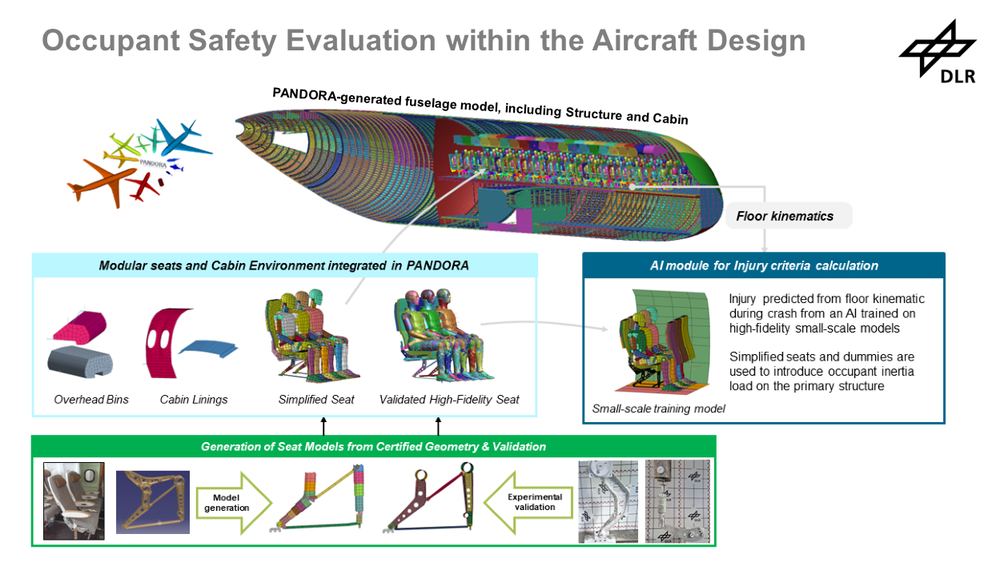

Occupant safety PANDORA process-chain
Credit:
Occupant safety assessment in large-scale aircraft models
Although the seat model is conceived to minimize its computational weight, the high level of detail required to accurately capture the physics of seats and passengers necessitates a fine space and time discretization. This poses a significant challenge in large-scale aircraft simulations, where hundreds of high-fidelity seat and dummy models are required. The resulting increase in elements and iterations can quickly drive the analysis time beyond practical limits, considering the intended use in preliminary design. On the other hand, the numerical representation of occupants and seats have a primary influence on the safety assessment, being responsible for: The transmission of the crash load to the passenger, the passenger kinematics and the computation of the safety indexes itself. Detailed numerical models are therefore necessary to assess the survivability in an emergency landing event.
AI-Based Multi-Fidelity Approach
A multi-fidelity approach, based on an AI surrogate model, is under development to provide an optimal balance between computational cost and high-quality results, in simulations involving large fuselage models. The methodology addresses three key challenges: the need for cost-effective simulations of the fuselage primary structure, the significantly higher level of detail required for dummy and seat models, and ensuring the numerical stability of finely discretized dummy and seat models under extreme crash loads. The multi-fidelity approach involves the use of a Reduced Order Model for seat and dummies in the PANDORA-generate full-scale aircraft simulation to efficiently determine the kinematics of the passenger floor below each seat, in terms of local rotations and accelerations. The simplified seat model replicates the key mass and stiffness properties of the validated seat, at a fraction of its computational cost. The simplified seat is integrated with coarse stiffened dummies, providing a numerically robust and efficient solution to introduce the inertial load due to the passengers into the aircraft primary structure. Finally, the occupant injury criteria are evaluated by an AI algorithm based on the kinematics of the fuselage passenger’s floor. The algorithm is trained through a small-scale FE model using high-fidelity seat and aerospace dummy models, to correlate the kinematics at the seat leg attachment points with the resulting occupant injury levels or seat structural failures.
The AI-driven methodology is being designed to provide a reliable occupant safety assessment by accounting for model and load case uncertainties, offering crucial insights for the robust design of novel non-conventional cabin and seat configurations.
Involved DLR Institutes

Kontakt
Dieter Kohlgrüber
German Aerospace Center (DLR)
Institute of Structures and Design
Pfaffenwaldring 38-40, 70569 Stuttgart