Research project Coole Wärme
Real-world experiment for highly transferable PVT-based heat pump systems in residential buildings
Decarbonising heat supply is one of the central tasks in transforming the energy system. In Germany, more than 75 per cent of building heating is still supplied by fossil fuels. This causes around 30 per cent of nationwide CO₂ emissions. Air-source heat pumps are a plannable, flexible solution that can be used almost anywhere, but they achieve lower efficiency than other heat pump systems. The Coole Wärme research project, funded by the German Federal Environmental Foundation (DBU), therefore investigates how heat pumps in residential buildings can be used more efficiently by combining them with photovoltaic-thermal (PVT) or solar thermal collectors.
Research project Coole Wärme | |
|---|
Duration | March 2025 to February 2027 |
Funded by | German Federal Environmental Foundation (DBU) |
Project participants | - DLR Institute of Networked Energy Systems
- Carl von Ossietzky University of Oldenburg
- Olegeno – Oldenburger Energie-Genossenschaft eG (Oldenburg Energy Cooperative)
|
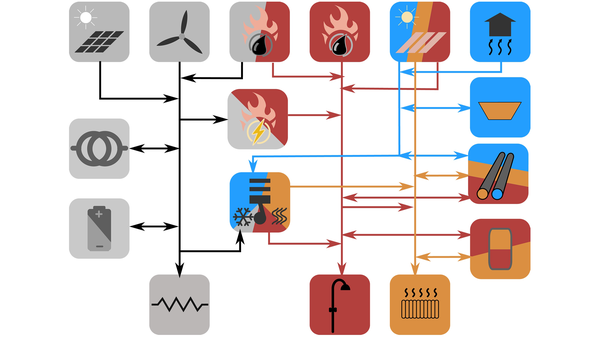
The project aims to develop initial general design guidelines for efficient systems comprising air-to-water and brine-to-water heat pumps combined with PVT or solar thermal collectors. The focus is on applications in contexts with limited spatial or financial resources, such as urban areas, existing buildings or locations where near-surface geothermal energy cannot be used. Simulation results will be used to investigate the technical and economic potential of such systems. As planning involves a wide range of system combinations, exchange with practice participants in a planning laboratory is designed as a central element of the real-world experiment.
In the Coole Wärme project, the Institute of Networked Energy Systems focuses on identifying application areas and barriers for innovative, easily transferable and highly efficient heat supply systems and on promoting their implementation. The concepts examined include single-family homes, for example without the option of using geothermal heat, as well as multi-family buildings. In methodological terms, the researchers are further developing and adapting existing open-source models in order to calculate technical and economic potential as well as optimisation options. In addition, they examine and reflect on the practical relevance of the developed system concepts and draw up design guidelines for efficient heat pump systems in contexts with limited resources.
More information