Sector Integration – Gas Technology
The Sector Integration – Gas Technology research group is dedicated to the question of how certain infrastructures can be operated with hydrogen from a technical and economic point of view.
H2 Cavern Storage Transition –Testing and validation of new operating modes for storing hydrogen in salt caverns
Hydrogen has a key role to play in the transformation of our energy system. It is easy to produce, does not cause any CO2 emissions as an energy source and can be used in a variety of ways, for example as a raw material in the chemical industry, for reconversion in power plants or as a fuel. However, practical solutions are needed for large-volume storage. Underground salt caverns offer the possibility of storing large quantities of hydrogen safely and efficiently. Against this background, the H2CAST-Prove project, which is funded by the German Federal Ministry for Economic Affairs and Energy, aims to test and validate the safety of innovative operating modes for the underground storage of green hydrogen in salt caverns. Two real caverns converted from natural gas to hydrogen storage and the above-ground facility designed for H2 are being tested on an industrial scale.
Research project H2CAST-Prove | |
|---|---|
Duration | November 2022 to October 2026 |
Funded by | German Federal Ministry for Economic Affairs and Energy |
Project participants |
|
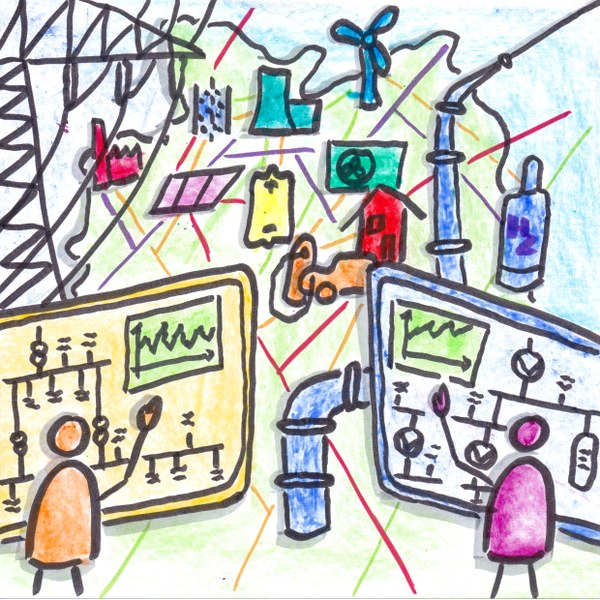
The H2CAST-Prove research project plans to use an innovative brine shuttle operation between the existing facilities at the Etzel cavern site in north-west Germany to simulate realistic operation in a closed cycle without the actual consumption of hydrogen. Storage volumes, pressure and flow rate regimes can be adapted, and highly flexible and multi-cyclical injection and withdrawal rates are possible. Test runs and long-term demonstration operation provide the basis for evaluating and optimising operating modes, gas purification, cavern integrity, testing and maintenance strategies and plant safety.
The Institute of Networked Energy Systems determines the necessary design parameters and operating parameters for test operation by developing and subsequently applying a dynamic overall system model. In addition, the potential of cavern storage as a sector integrating interface between the gas and electricity grids is being evaluated and concepts for potential CO2 savings are being developed.