Research project HyNRGCube
Hy-energy-cube for commercial and industrial applications based on a passenger car fuel cell
Green hydrogen provides a clean, cross‑sectoral and efficient energy source for power supply, but one that is only limitedly available. This gives rise to key economic and technological challenges: on the one hand, re‑electrification requires solutions with high efficiencies; on the other hand, investment and operating costs must be economically viable. Fuel‑cell systems have so far met efficiency targets but have not yet achieved the required cost targets, primarily because serial production in the required power classes has been lacking. The research project HyNRGCube, funded by the Federal Ministry for Economic Affairs and Energy, addresses this gap by adapting a fuel‑cell module already proven in the automotive sector for commercial and industrial applications, with the aim of optimising efficiency, lifespan and cost‑effectiveness simultaneously.
Research project HyNRGCube | |
|---|
Duration | July 2024 to November 2027 |
Funded by | Federal Ministry for Economic Affairs and Energy |
Project participants | - DLR Institute of Networked Energy Systems
- H2 POWERCELL GmbH
- DBI – Gas TechnoIogy Institute gGmbH
- HS-Drives GmbH
associated: - Honda R&D Europe (Germany) GmbH
|
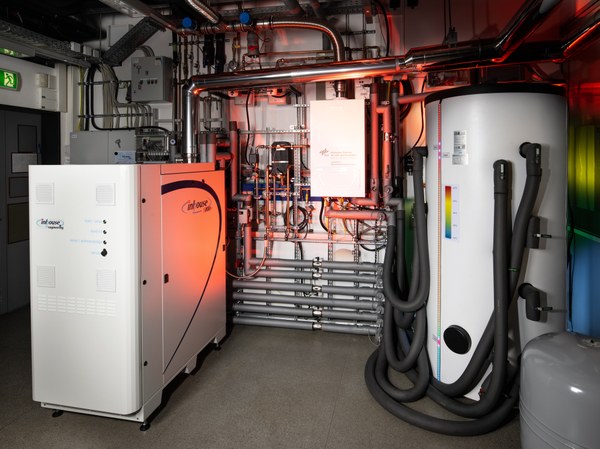
The project focuses on the development and deployment of mobile, stationary and flexible fuel‑cell energy supply systems (the so‑called Hy‑Energy Cubes) based on a technically mature fuel‑cell system delivering 80 kWel from Honda. Using a module from the transport sector for other domains is intended to lower costs and development times. The specific requirements and differing boundary conditions of the new application fields – for example with respect to hydrogen infrastructure – present challenges that the project will address. The aim is to demonstrate a functional Hy‑Energy‑Cube system in several power ratings capable of meeting both electricity and heat demand, thereby opening new application areas.
The Institute of Networked Energy Systems, within a sub‑task, will carry out validation of the system module and its model‑based assessment. As the first and to date only research organisation to evaluate a truck‑fuel cell on a test rig for stationary applications, the Institute provides robust measurements of the thermal component that has so far been neglected in the mobility context. By modelling efficiency and heat‑delivery profiles, the study will examine how the module can serve as a grid‑independent emergency‑power and base‑load solution, contributing to the resilience of the future energy system based on renewable sources. The insights gained will form the basis for an economic assessment and technology transfer from the transport sector to the energy sector.
The modules could be deployed, for example, in neighbourhoods or industrial sites, as well as in safety‑critical facilities and public buildings such as hospitals. Here they could, in addition to grid supply, provide a portion of the base load efficiently and, in the event of large‑scale outages, deliver power independently of the grid.
More information