Research project Opti-VNL

Optimised procedures for vertical grid load forecasting using machine learning

The reliable operation of power grids is complex, as the loading of individual power lines is hard to predict due to the fluctuating nature of renewable energy sources. This can lead to renewable energy plants being curtailed more than necessary, or expensive power plant capacities having to be brought online on short notice to keep the grid stable (so-called redispatch, i.e., system-stabilizing adjustments of the generator’s unit commitment). Against this background, the research project Opti-VNL, which is funded by the Federal Ministry for Economic Affairs and Energy, aims at improving the forecast of the vertical grid load (Germ.: Vertikale Netzlast; VNL), i.e., the loading of the transformers that connect the different voltage levels of the electricity grid. The project contributes to a more efficient use of renewable energy and to keeping the power grid stable.

Research project Opti-VNL


Duration

April 2025 to March 2028

Funded by

Federal Ministry for Economic Affairs and Energy

Project participants

  • Institute of Networked Energy Systems
  • Institute of Solar Research
  • EWE Netz GmbH
  • Siemens Energy Global GmbH & Co. KG
  • University of Oldenburg
  • Westnetz GmbH (associated)

Specifically, Opti-VNL involves the development of novel machine learning methods for short-term forecasting of the VNL with integrated uncertainty modeling. The goal is to be able to react quickly not only upon feed-in fluctuations, but also upon network reconfiguration (switching) and fault conditions, thereby avoiding unnecessary curtailment of renewable generation. At the beginning of the project, reference models will be built that serve as the baseline for a comparative assessment of the developed approaches for modeling and forecasting the VNL. The next steps are to examine existing forecasting methods for their ability to incorporate uncertainty models and to implement new methods for quantifying uncertainties, particularly those arising from weather scenarios.

Real-world data provided by the industrial project participants will be considered in the grid state evaluation, taking into account the assessment and propagation of uncertainties. The study will investigate how the injection of fluctuating renewable energy in the considered grid area could affect the VNL forecast. In a case study, the added value of the enhanced VNL forecast for the congestion prediction will be demonstrated. Finally, the developed methods will be packaged into a toolbox that is supposed to assist grid operators in their grid management and redispatch processes.

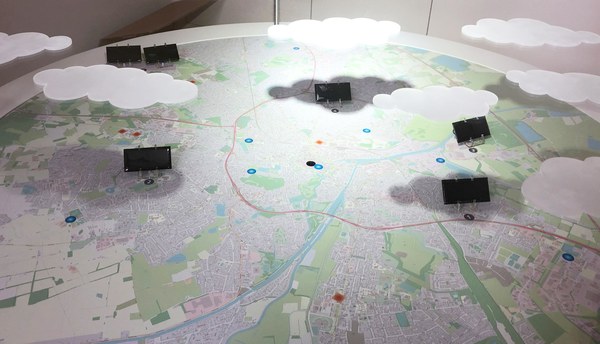
Grid operation will be modeled and evaluated primarily by the Institute of Networked Energy Systems. Their tasks include modeling and simulation to predict congestion in upstream 110-kV grids as well as the optimized curtailment of renewable energy plants. Additionally, they will process meteorological data, refine methodologies and analyze simulation results for use in VNL forecasting. In collaboration with the industrial project participants, the institute will also develop a monitoring system for VNL forecasting under changing weather situations. To this end, the project team will optimize camera-based methods and satellite image-based methods and compare them with conventional forecasts based on weather models. The comparison will focus on weather situations initially identified as relevant for redispatch. Finally, the Institute of Networked Energy Systems will define suitable metrics to assess the technical and economic benefits of the new forecasts from which the impact of ultra-short-term PV generation predictions on the derived VNL forecasts can be quantified.

Contact

Flexibilities and Ancillary Services

Research Group
Institute of Networked Energy Systems

Power Grid Technologies

Research Group
Institute of Networked Energy Systems

Energy Meteorology

Research Group
Institute of Networked Energy Systems