Research project PV-Reserve

Balancing power from PV systems without storage through innovative short-term forecasts

The growing feed-in of renewable energy presents operators and marketers of conventional as well as renewable power plants with the challenge of ensuring grid stability, even with fluctuating generation. Especially photovoltaic systems can so far only contribute limited balancing power, as precise short-term forecasts of solar power production are missing – particularly when energy storage is dispensed with. The research project "PV-Reserve" (funded by the Federal Ministry for Economic Affairs and Energy) addresses this challenge by creating the technical and economical conditions for providing balancing energy from commercial PV systems without storage based on innovative forecasting methods.

Research project PV-Reserve


Duration

September 2025 to August 2028

Funded by

Federal Ministry for Economic Affairs and Energy

Project participants

  • Institute of Networked Energy Systems
  • Institute of Solar Research
  • Energy and Meteo Systems GmbH
  • CSP Services GmbH
  • BayWa r.e. AG

As part of the project, the participants will for the first time develop a comprehensive concept for providing balancing energy from PV systems without storage and demonstrate this within the scope of prequalification for several facilities. These include the development of state-of-the-art forecasting models both for PV performance and for retrievable balancing power potential, the adaptation of trading strategies for power plant operators and direct marketers, as well as the development of real-time identification methods for balancing energy retrieval. In the project consortium, different participants assume specialised tasks: from installing intelligent metering systems to the development of scalable forecasting models to practical demonstration and integration into the market.

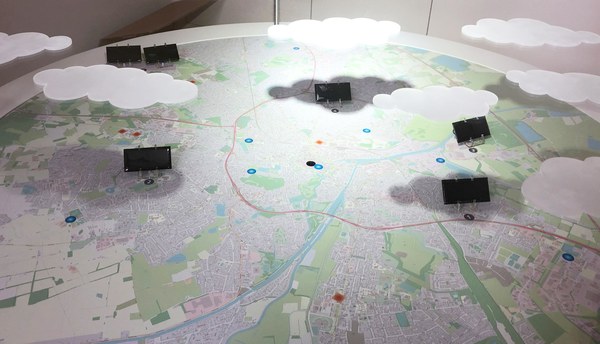
The DLR Institute of Networked Energy Systems works on central tasks of the PV-Reserve project in close cooperation with the DLR Institute for Solar Research, in the area of developing and validating novel forecasting models for solar irradiation. Special attention is given to multimodal approaches that combine different data sources – such as high-resolution satellite measurements (MTG), the Eye2Sky network, and individual SkyCams. Deep learning techniques are used to develop forecasting models that achieve a spatial resolution of at least 50 metres and a temporal resolution of at least 30 seconds with a lead time of up to one hour. Not only PV performance is precisely forecasted, but also critical ramp events are identified, making balancing energy potential quantifiable precisely. The research advances achieved in this way are a crucial cornerstone for the integration of renewable energies and ensuring grid stability. 

Contact

Energy Meteorology

Research Group
Institute of Networked Energy Systems