A current example of this is the planetary system around the star LHS 1903, a red dwarf star 116 light years away that is about half the size of the Sun. Four planets orbit this star. This was not clear at first, and even in astronomy, the saying ‘Rome wasn’t built in a day’ applies, and planets are not detected and characterised by a single measurement with a single telescope. Several telescopes have contributed to this discovery. Since 2019, a planetary system with three planets has been suspected. This assumption was confirmed by the highly accurate measurements made with CHEOPS. The planetary radii could be characterised more precisely and a fourth planet was found, which poses a mystery.
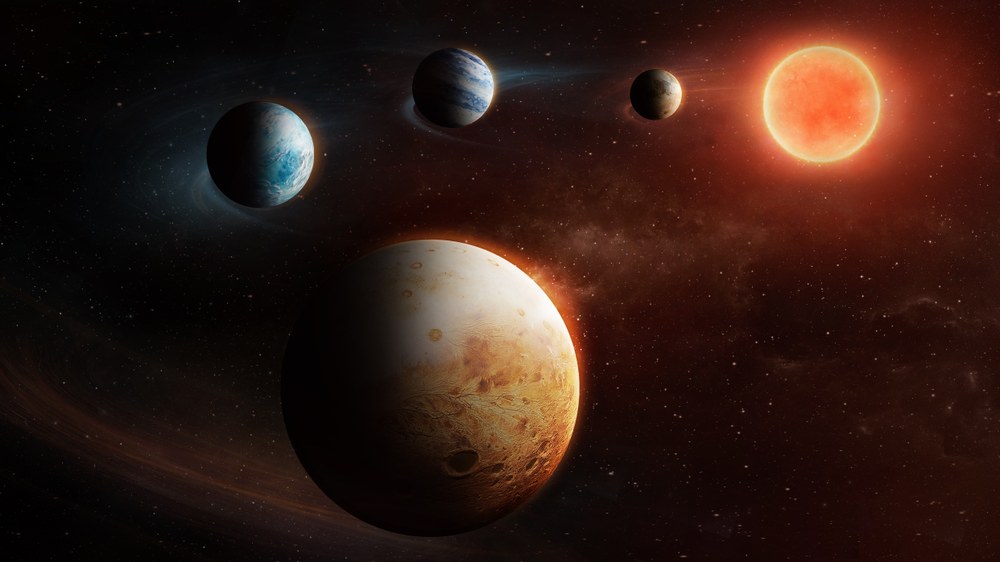
Artist view of the plaentary system around LHS 1903
LHS 1903 is a small red M-dwarf star that is cooler and shines less brightly than our Sun. Scientists used telescopes in space and on Earth to discover four planets orbiting LHS 1903. With those telescopes, they classified the three closest planets to the star as the innermost being rocky, and the two that follow it gas giants.
In a recent study, scientists used ESA’s Cheops satellite to investigate the fourth planet in this system. They noted that it is much smaller and further away from its star than the other planets and discovered that it might be rocky, like Venus. This is surprising because a planet order of rocky-gaseous-gaseous-rocky in a planetary system is unusual and rarely observed in the Universe.
What is unusual is the arrangement of these four planets, which breaks with previous assumptions. The rocky planets should orbit closest to the star, with the gas planets further out – that is what we know from our solar system. But the planets around the star LHS 1903 behave quite differently. The innermost planet is a rocky planet and the next two planets are gas planets, but the outermost planet is again a rocky planet. This challenges the theory of planetary formation. As described in the publication, the planets in this system may not have formed at the same time, but one after the other. This would make this planet a kind of latecomer for which there was no longer enough gas available.
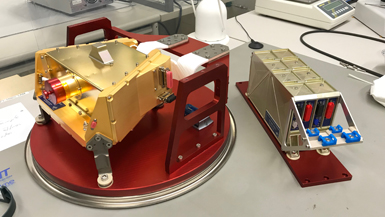
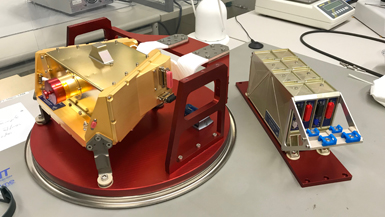
Focal Plane Module (FPM) for CHEOPS
Mid-2013 DLR has been selected to contribute the Focal Plane Module where the single CCD detector is integrated. The Institute of Optical Sensor Systems develops this major sub-system together with the Institute of Planetary Research. Both institutes merged in the Institute for Space Research in 2025.
The ESO space telescope CHEOPS – CHaracterizing ExOPlanet Satellite – has now been in successful operation for six years. Its high-precision photometric measurements are used to measure the brightness of individual stars in order to record expected transit events with the utmost accuracy. Two electronic modules that make these high-precision measurements possible in the first place and are still working successfully were developed here at the DLR site in Adlershof. The fruits of this outstanding engineering work are the scientific data, in the evaluation of which the DLR plays a key role. In the process, there are always surprising findings that cannot be expected or planned for – and this is precisely what research is all about.