The PLATO satellite underwent several weeks of testing at the ESA test centre in Noordwijk to ensure it was fit for space. On 10 April, the hatches of the Large Space Simulator (LSS) opened once more and PLATO was lifted out. Once these demanding tests under space conditions have been completed and the data analysed, PLATO - PLAnetary Transits and Oscillations of stars - will be ready to launch into space in early 2027 and begin the search for Earth-like planets.
Together with ESA the PLATO Mission consortium at DLR in Berlin provides the overall consortium management and has been responsible for mission and payload design.
PLATO in the Large Space Simulator (LSS)
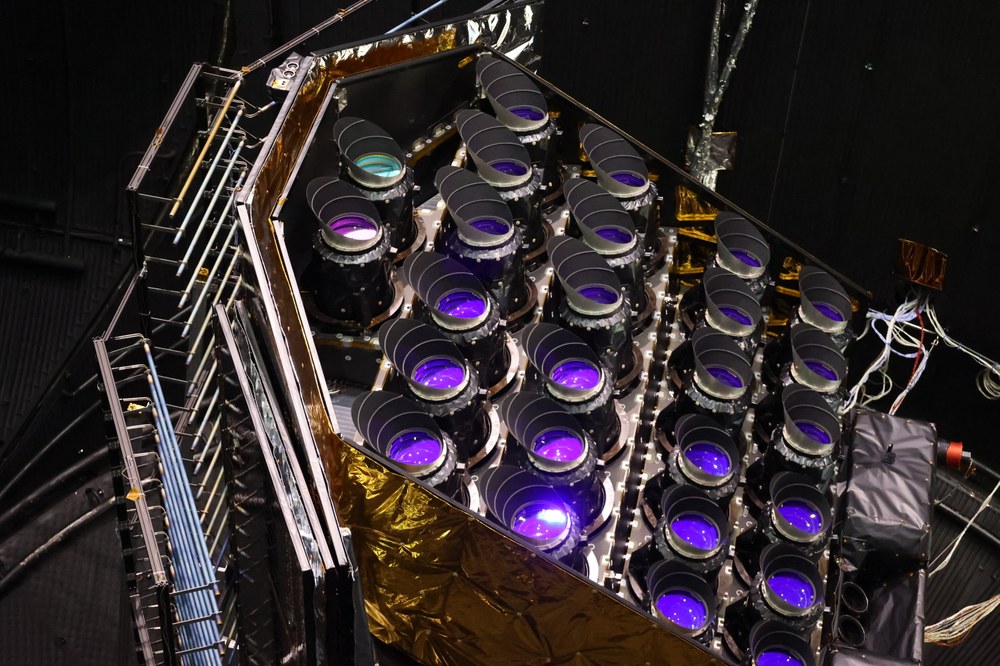
A direct view to the 26 cameras through the upper hatch of the space simulator chamber at ESA's test centre in Nordwijk (ESTEC)
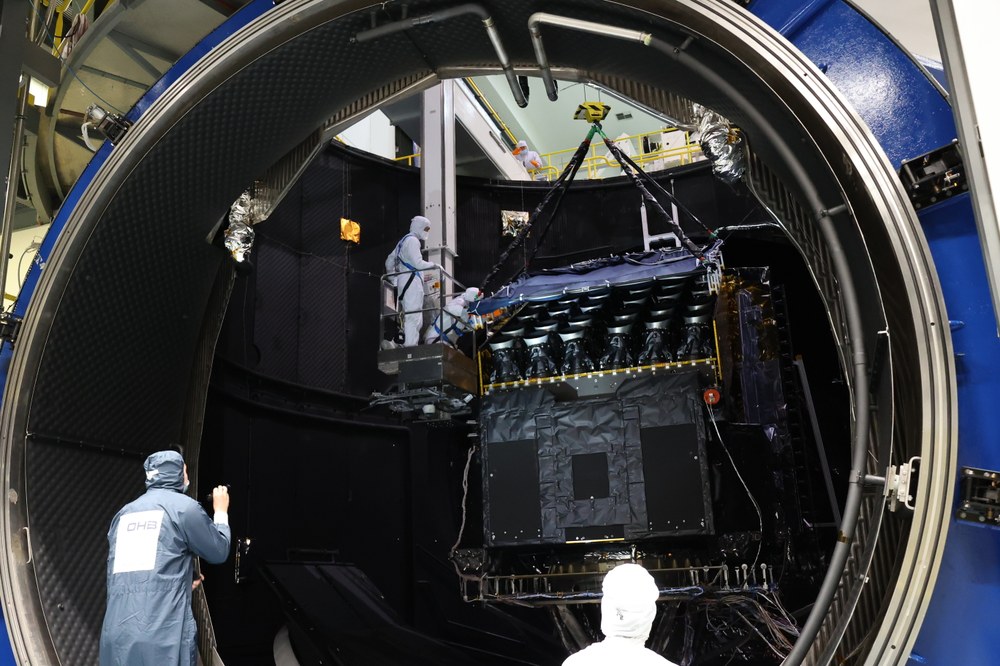
The picture is taken looking into the enclosure through a wide circular opening. Lifting straps are attached to the spacecraft and connected to a yellow overhead crane hook, holding the spacecraft suspended in mid-air.
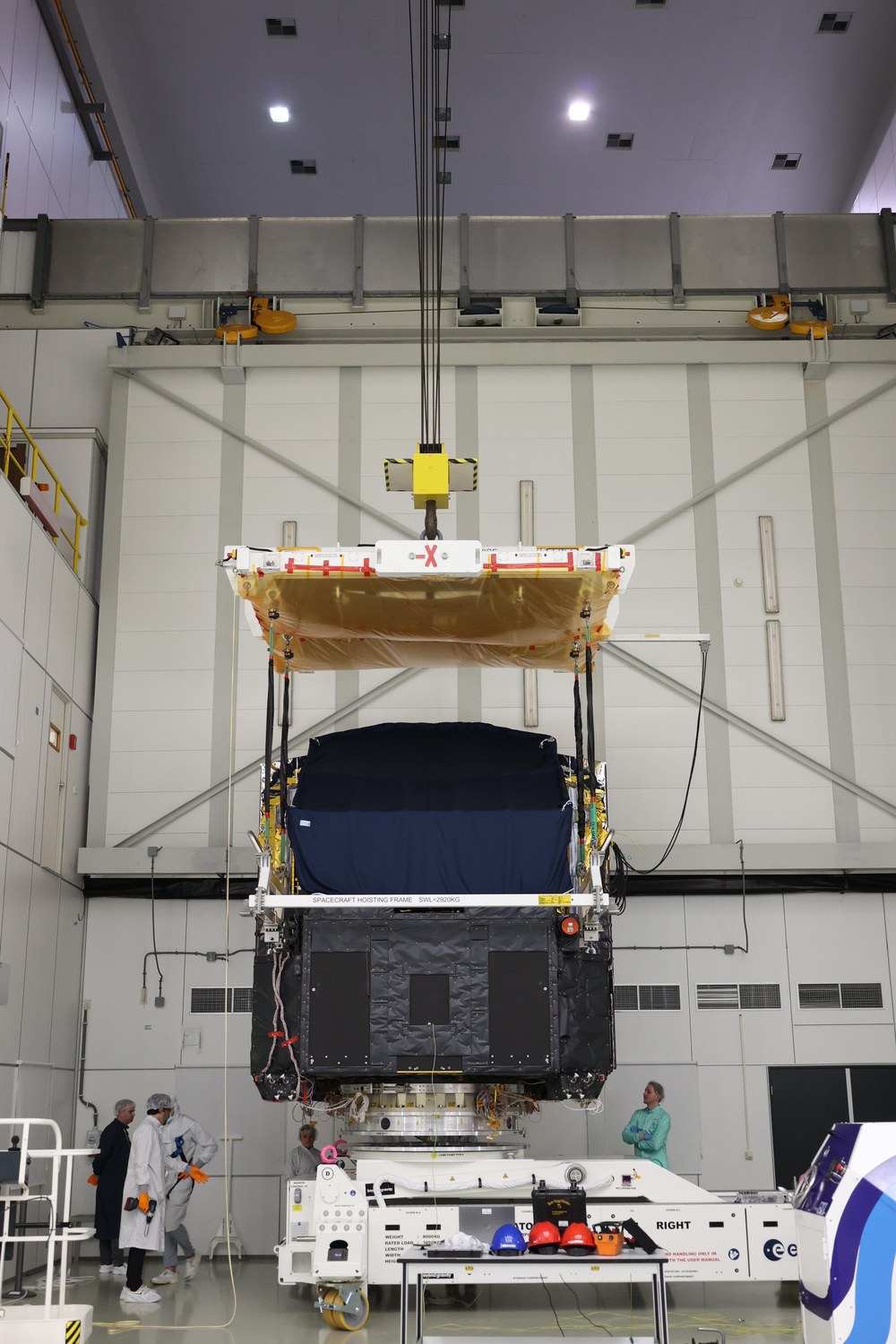
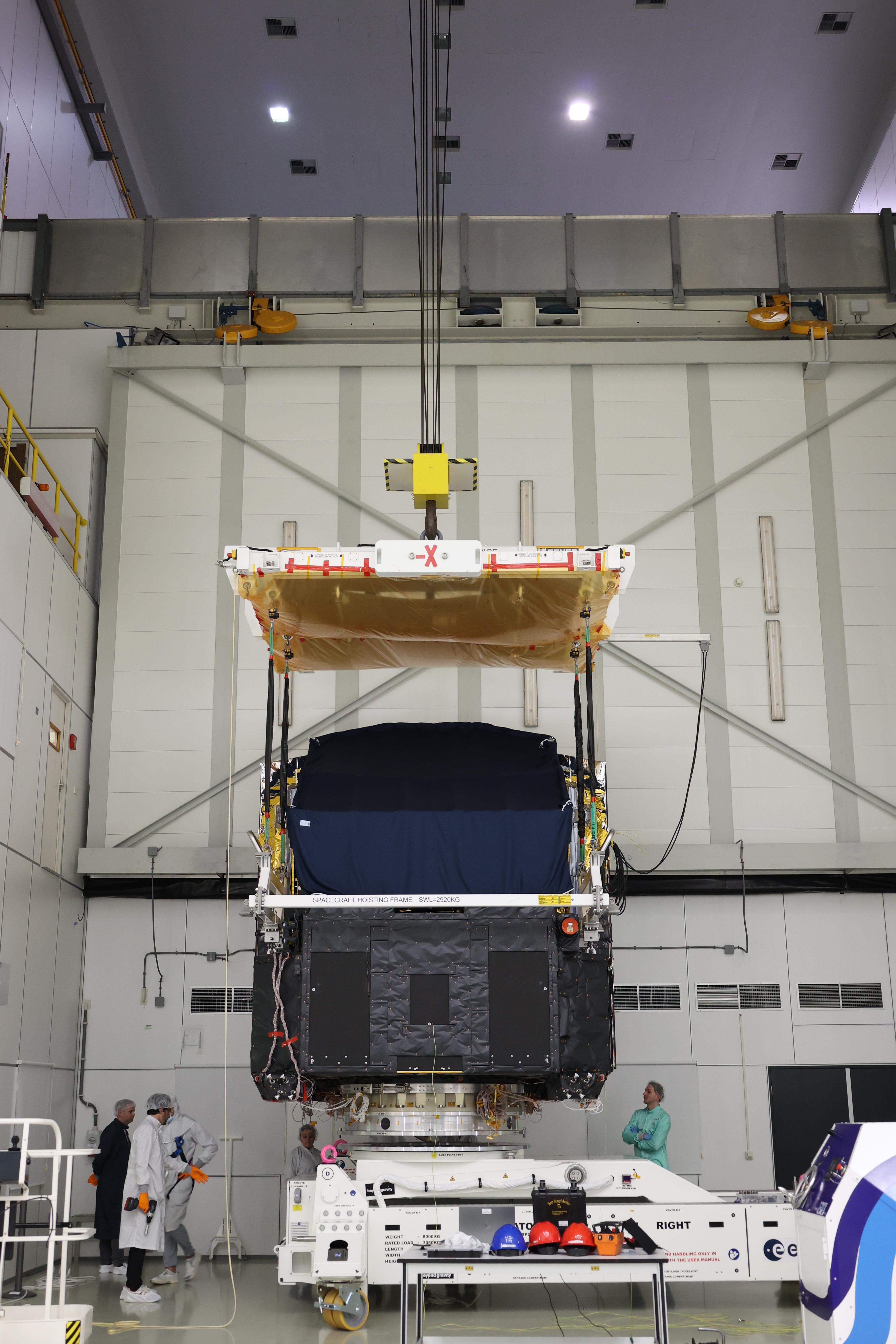
In the LSS chamber, Plato successfully completed a series of tough tests in space-like conditions. Engineers used a special crane to lift the spacecraft out of the LSS chamber, move it over the open ceiling of a cleanroom, and then gently lower it onto a mobile supporting platform. In the following days, engineers will perform further measurements and checks of the spacecraft.
In the Large Space Simulator (LSS) chamber at ESA’s Test Centre, PLATO made its first acquaintance with the rigours of space. Within space projects, ‘test as you fly’ is every engineer’s mantra. So before launching a spacecraft, it is crucial to check all its functionalities in the same conditions it will meet in orbit. To this end, PLATO was placed inside the LSS.
Once the LSS chamber’s top and side hatches were sealed, in early March, powerful pumps sucked air out of the enclosure, creating a vacuum a billion times sparser than standard atmospheric pressure. Meanwhile, liquid nitrogen pumped through the walls to reproduce the cold of space. A grid of powerful heating elements, specially placed inside the LSS, were switched on to mimic the heat of the Sun hitting Plato’s solar panels and sunshield. Then, testing began.
To find and characterise Earth-like planets orbiting Sun-like stars,the variations in a star’s luminosity smaller than 80 parts per million would need to be detected. Such a level of precision is extremely demanding, and tests under space‑like conditions are essential. These tests are necessary to ensure that the response of the cameras and the spacecraft systems could be controlled to the degree required for detecting small planets.
Dedicated tests had been carried out to assess the correct functioning of the cameras and the entire spacecraft under the thermal conditions expected in its final orbit. As the focus of the cameras is fine‑tuned by adjusting the temperature of their optical tubes, a series of tests had been conducted to confirm that the cameras’ optimal focus could be maintained through highly accurate temperature control.
Engineers tested the entire spacecraft in a typical space environment, as well as in so‑called hot and cold phases. In the LSS, the team had stress‑tested Plato by exposing it to more extreme conditions than it would normally encounter in orbit. The aim was to verify whether the spacecraft could perform as expected under both harsh and nominal space conditions.
During the hot phase, engineers operated all spacecraft elements at full power, while the solar‑panel side heated up to 150 °C. At the same time, they ensured that the cameras, protected by the sunshield and facing the cold part of the chamber, remained between –70 and –90 °C.For the cold phase, temperatures across the spacecraft were lowered, requiring the heaters to be powered up to prevent the cameras from becoming too cold.
The tests in a space‑like environment have been completed, but the analysis of the data collected while Plato was inside the LSS will continue in the coming months. Engineers and scientists will study the gathered information to better understand the spacecraft’s behaviour and the detailed performance of its instruments. They will use the data to refine thermal models that will be essential for predicting the cameras’ responses once Plato is in flight.
The moment of launch is approaching: Plato is expected to be ready by the end of this year, and lift‑off on an Ariane 6 is planned by Arianespace for January 2027.