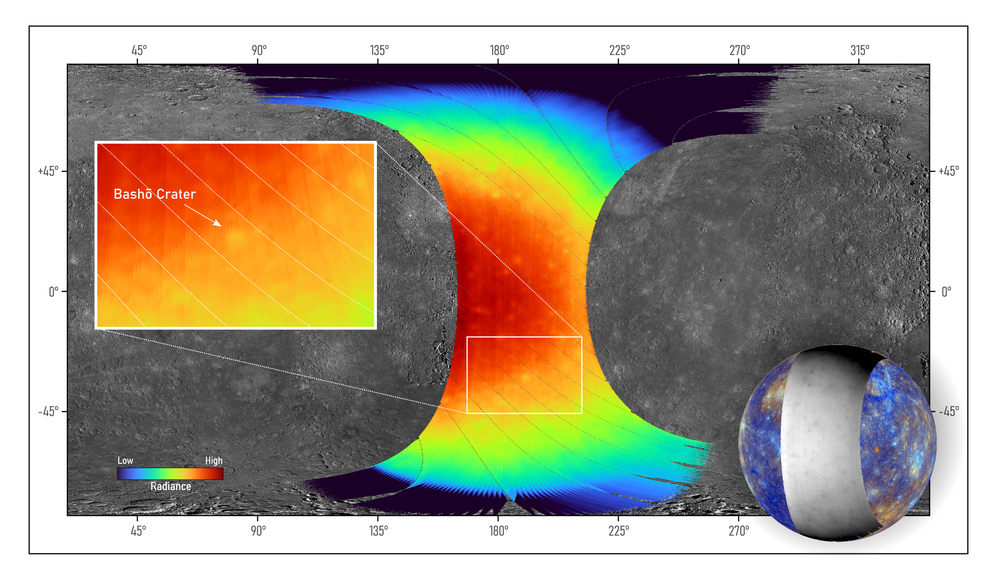
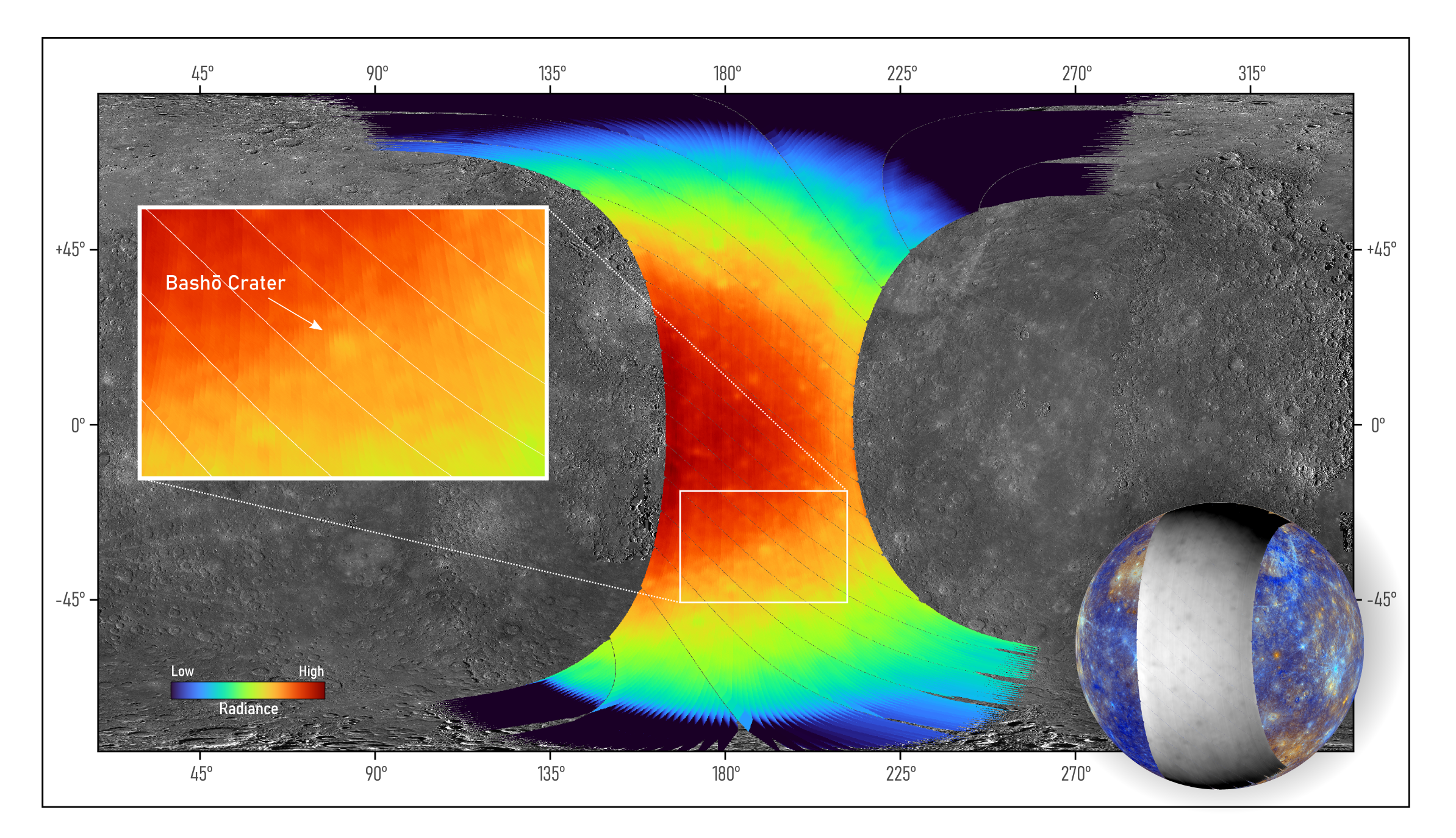
First mid-infrared observation of Mercury: MERTIS measurements (8.45 µm channel) from the fifth flyby, projected onto a MESSENGER mosaic. The Bashō crater (inset) shows a distinct thermal anomaly.
Image: 4/4, Credit:
MERTIS/DLR/University of Münster & NASA/Johns Hopkins University Applied Physics Laboratory/Carnegie Institution of Washington
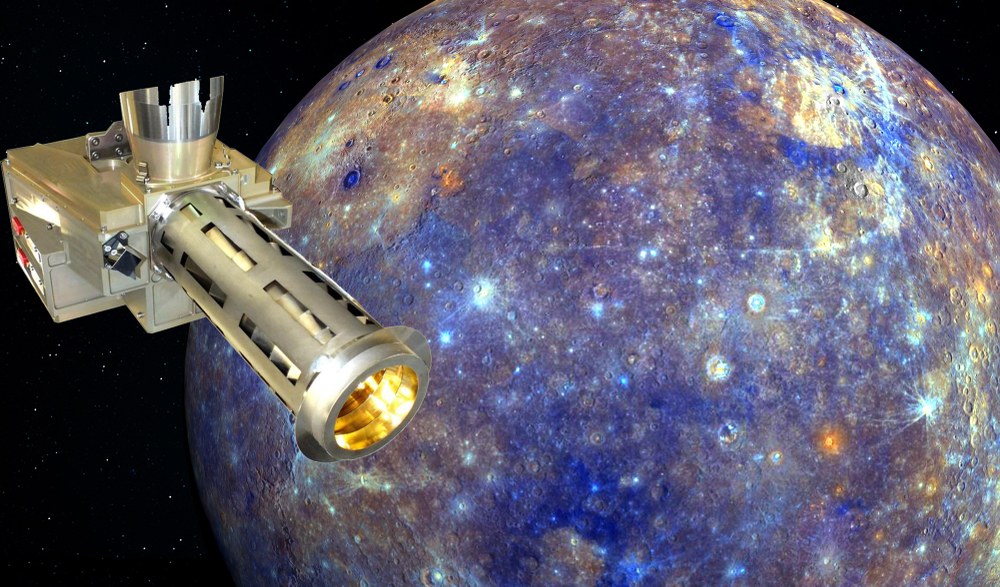
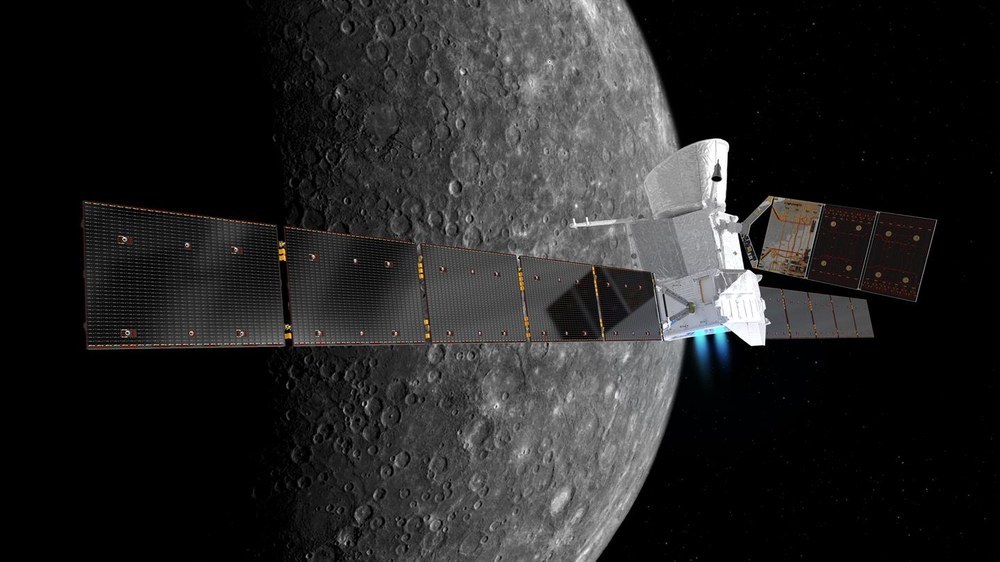
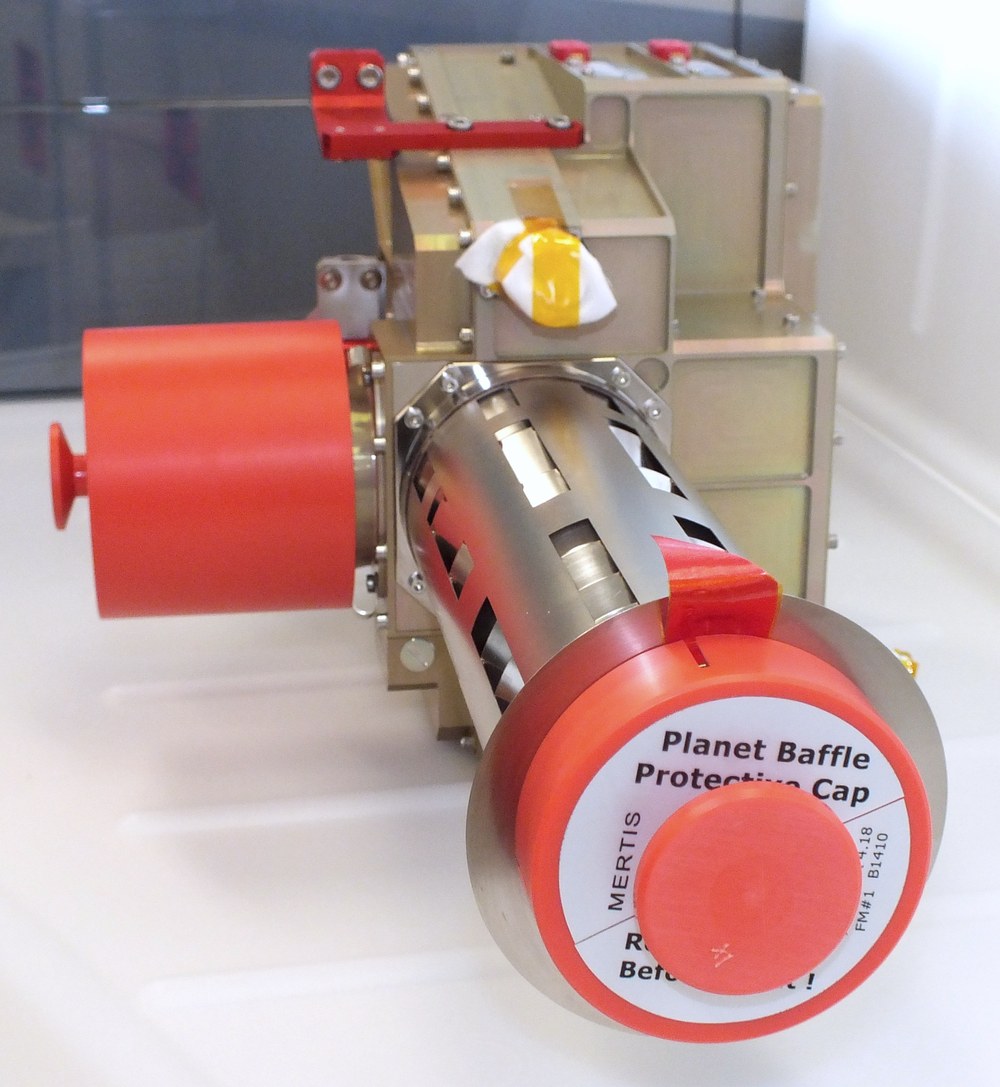
MERTIS is one of the scientific instruments on board the ESA/JAXA BepiColombo [BepiColombo – exploring the planet Mercury] mission and will study the mineralogy and temperature distribution of Mercury’s surface in unprecedented detail. The instrument's scientific objectives are the study of Mercury’s surface composition, the identification of rock-forming minerals, the mapping of surface mineralogy and the study of surface temperature and thermal inertia.
Instrument Description
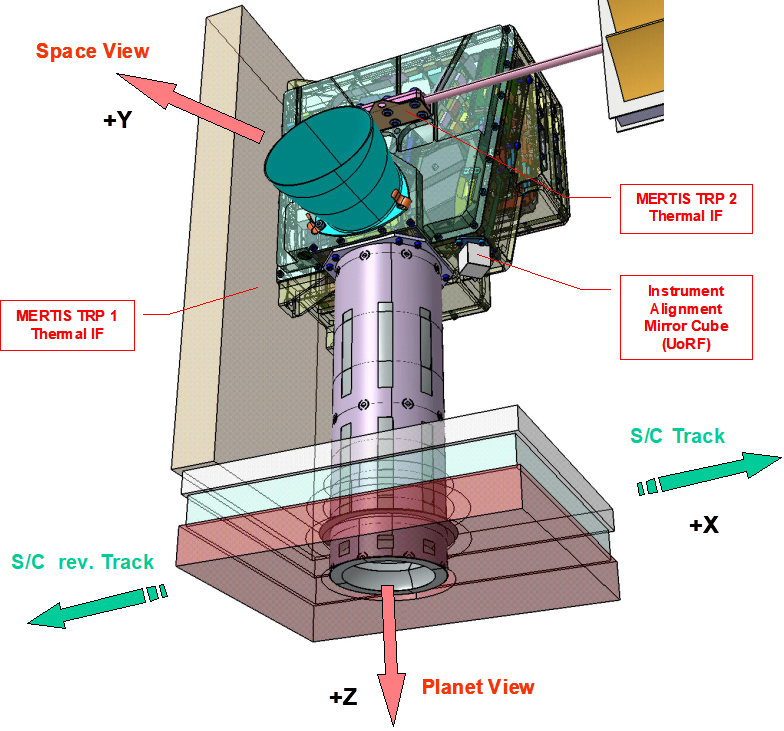
MERTIS is an imaging spectrometer that operates near room temperature and provides hyperspectral data in the thermal infrared (7–14 µm). At its core is an uncooled, temperature-stabilised bolometer detector array that delivers two-dimensional data at medium spectral and spatial resolution. In addition to the spectrometer, a micro-radiometer with two channels (8–14 µm and 7–40 µm) is located in the same optical path, at the slit of the spectrometer optics, which enables measurements of surface temperature and thermal conductivity. The instrument was designed with a very low mass of about three kilogram and low power consumption.
Calibration System
The operating concept is characterized by a permanent on-board calibration in which data is cyclically recorded from 3 calibration sources (cold space and two blackbody sources of different temperatures) and the Mercury surface.
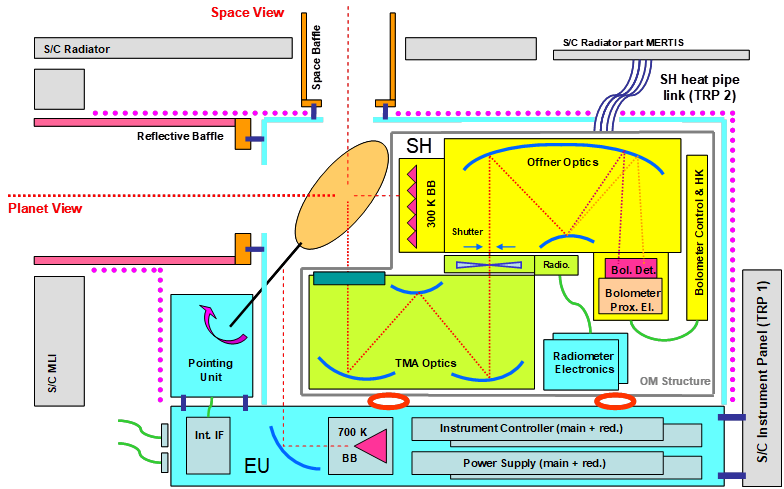
This calibration is necessary because the uncooled bolometer detector array is sensitive to the thermal environment of the instrument itself: the measured signal depends both on the radiation emitted by the observed surface and on the thermal state of the instrument. The two blackbodies of known temperature (300 K and 700 K) define two reference points of the measurement range, while the deep-space view provides a zero-radiance reference. These three reference measurements allow the raw signal to be converted into absolute radiance values and any drift in instrument sensitivity to be tracked and corrected over the course of the mission.
Observation History
MERTIS operated successfully during several test flybys:
Earth-Moon system (10 April 2020): 1.2 million spectra obtained from distances exceeding 700,000 km
Venus first flyby (15 October 2020): Measurements began at distances over 1.3 million km, 3 million spectra collected
Venus second flyby (10 August 2021): Data collected at closest approach (800–1,000 km)
Mercury fifth flyby (1 December 2024): First mid-infrared observation of Mercury by any spacecraft
During the fifth Mercury flyby, MERTIS observed the surface from a distance of about 37,000 km with a spatial resolution of 26–30 km per pixel; the TIS channel recorded about 1.4 million pixels on the surface of Mercury. The images cover parts of the Caloris Basin and of the northern volcanic plains and reveal variations in surface temperature, composition and roughness; the radiometer measured temperatures of up to 420 °C. The Bashō impact crater, which shows both very dark and very bright material in visible-light images, also stands out as a clear anomaly in the thermal infrared. For reference, Mercury observations from orbit will occur at distances between 400 and 1,500 km. The combined flyby data demonstrate that MERTIS performance exceeds requirements; regular checkouts during the cruise phase continue to verify the instrument performance ahead of the start of science operations in early 2027.
Instrument Architecture
The integrated measurement system consists of two thermally decoupled units:
Sensor Module: Contains optics, detectors, readout electronics, and a shutter for on-board calibration
Main Electronics Unit: Houses redundant instrument control and power supply, plus the calibration sources
A pointing/scanning unit orients the optical path either to Mercury or to the calibration sources as required.
Development Team
DLR's Institute of Space Research in Berlin leads the system design development, integrates the instrument, verifies optical performance, and conducts calibration based on infrared laboratory investigations. The project was developed in close cooperation with science and industry partners:
Principal Investigator: Harald Hiesinger, Universität Münster
Co-Principal Investigator: Solmaz Adeli, DLR
Kayser-Threde (nowOHB) – Munich
Astrofeinwerktechnik – Berlin
Polish Institute of Cosmic Research – Warsaw
Engineering Office Ulmer – Frankfurt/Oder
MERTIS – Technische Daten
Spectral range
7 - 14 µm (Spectrometer)
7 - 40 µm (Radiometer)
Spectral resolution
80 spectral channels, 90 nm (<200 nm)
Spatial resolution
> 280 m
Swath width
> 28 km; Field Of View: 4°
Mass
3,1 kg
Power
9,9 – 12,4 Watt
Dimensions
180 x 180 x 130 mm³ (excl. Baffles)
MERTIS Block Diagramm und Design
MERTIS Block Diagram
Schematic layout illustrating the optical paths, sensor systems, electronic units, and calibration views for space and planet observations.