BepiColombo
BepiColombo
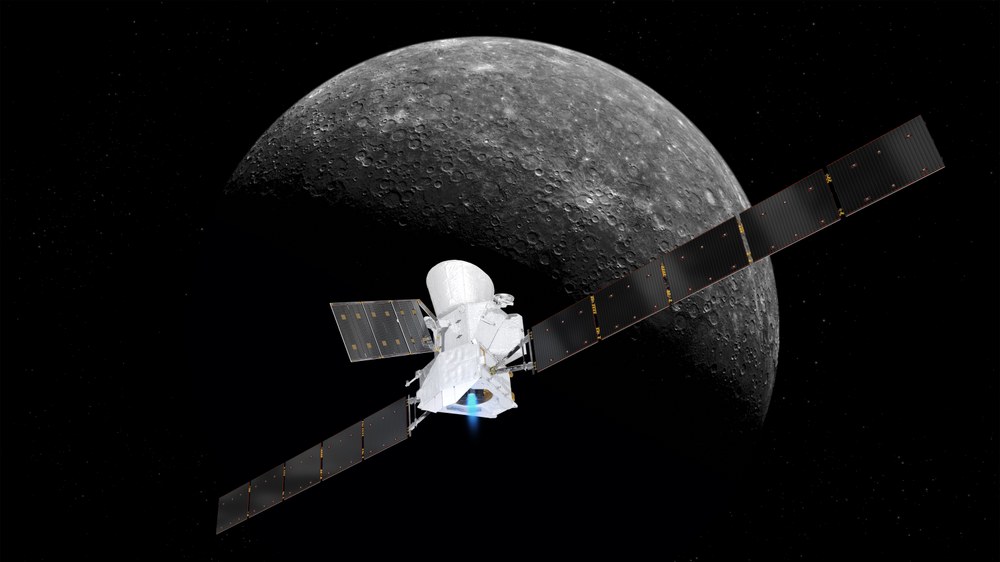
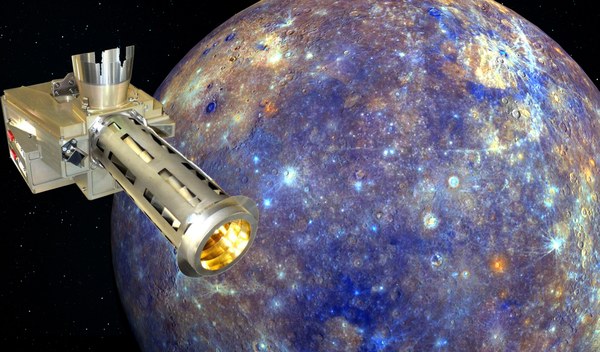
The ESA/JAXA BepiColombo mission will arrive at Mercury in late November 2026. On board: the BELA and MERTIS instruments, built and operated under the responsibility of DLR's Institute of Space Research. During the fifth Mercury flyby in December 2024, MERTIS obtained the first mid-infrared images of the planet ever taken.
After its successful launch in October 2018 from Europe's Spaceport in Kourou, French Guiana, ESA's BepiColombo mission is currently on its eight-year journey to the planet closest to the Sun. The interplanetary cruise included nine flybys for gravitational assists: one at Earth, two at Venus and six at Mercury. The Earth flyby and the first Venus flyby took place in April and October 2020, the second Venus flyby in August 2021. Six Mercury flybys followed in November 2021, June 2022, June 2023, September 2024, December 2024 and January 2025. Several instruments, including the MERTIS spectrometer contributed by DLR-WR, were able to collect data during some of the flybys; during the fifth Mercury flyby on 1 December 2024, MERTIS obtained the first mid-infrared observations of Mercury ever made. The spacecraft will enter Mercury orbit in late November 2026. Once in orbit, BepiColombo's carrier spacecraft will release two orbiters, ESA's Mercury Planetary Orbiter (MPO) and JAXA's Mercury Magnetospheric Orbiter (MMO); the one-year nominal science mission will begin in early 2027. The MPO will study the surface, interior, exosphere, and magnetosphere of the planet using a suite of 11 instruments. Two of the instruments, the BepiColombo Laser Altimeter BELA and the MErcury Radiometer and Thermal Infrared Spectrometer MERTIS, were built and will be operated under the responsibility of DLR's Institute of Space Research.
Hardware Participation of the DLR Institute of
Space Research
- BELA (BepiColombo Laser Altimeter)
- MERTIS (MErcury Radiometer and Thermal Infrared Spectrometer)
Scientific Participation of the DLR Institute of Space Research
- BELA (BepiColombo Laser Altimeter)
- MERTIS (MErcury Radiometer and Thermal Infrared Spectrometer)
- SIMBIO-SYS (Spectrometer and Imaging for MPO BepiColombo Integrated Observatory SYStem)
- MORE (Mercury Orbiter Radio-science Experiment)