
CHEOPS: Organisation and Background
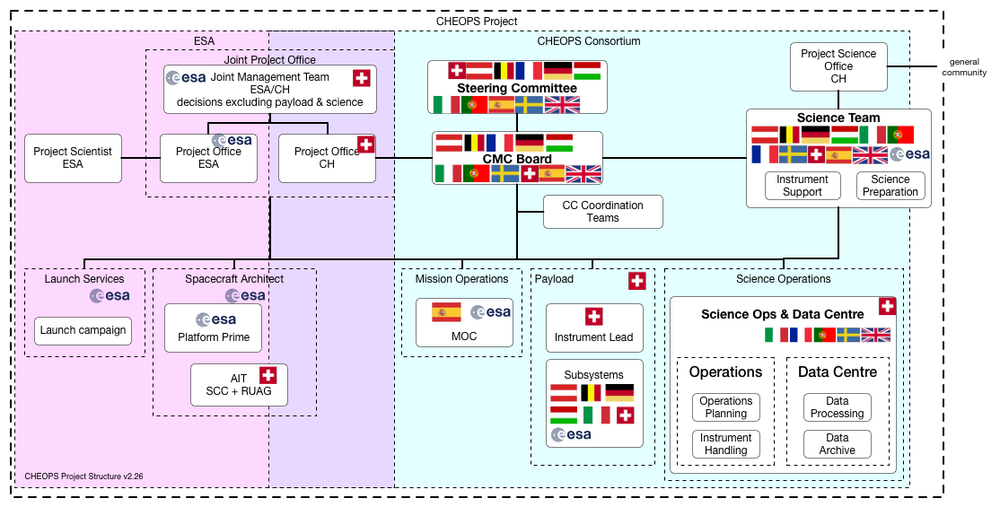

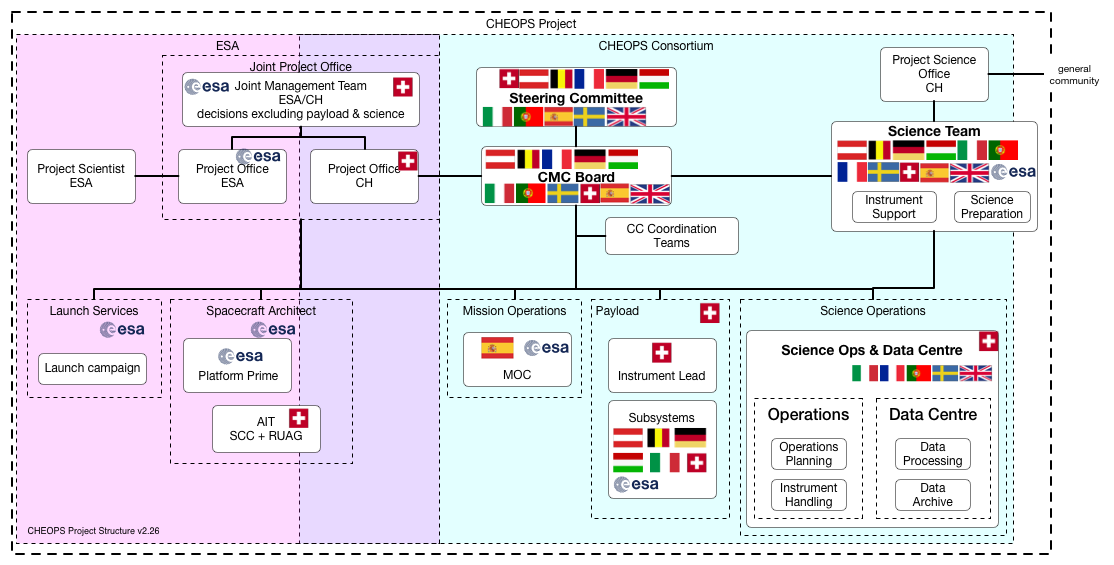
CHEOPS is an ESA S-class mission selected in 2012 and led by the University of Bern as the Principal Investigator (PI). In addition to Germany, ten other European countries are involved in this mission.
The DLR Institute of Space Research in Berlin, which emerged from the Institute of Planetary Research and the Institute of Planetary Research, serves on the CHEOPS Advisory Board and is represented on the science team, which advises the PI on scientific requirements, the core observation programme, the observation and calibration strategy, data processing and analysis, and the scientific evaluation of the data.
In mid-2013, the DLR was selected to contribute key electronic modules: the Focal Plane Module (FPM) and the Sensor Electronics Module (SEM). The then Institute of Optical Sensor Systems developed these important subsystems in collaboration with the then Institute of Planetary Research. These modules are extremely important because the control of the CCD sensor and its temperature stabilisation ensure the high quality of the measurement data.
The CHEOPS mission is based on flight-proven components, which applied to both the platform and the payload components. This made it possible to minimise costs and risks.
On 19 October 2012, CHEOPS was selected as the first S-class mission under ESA’s ‘Cosmic Vision 2015-2025’ programme. The mission was officially approved in early February 2014. On 18 December 2019, the satellite was launched on a Soyuz-Fregat rocket from the Guiana Space Centre.