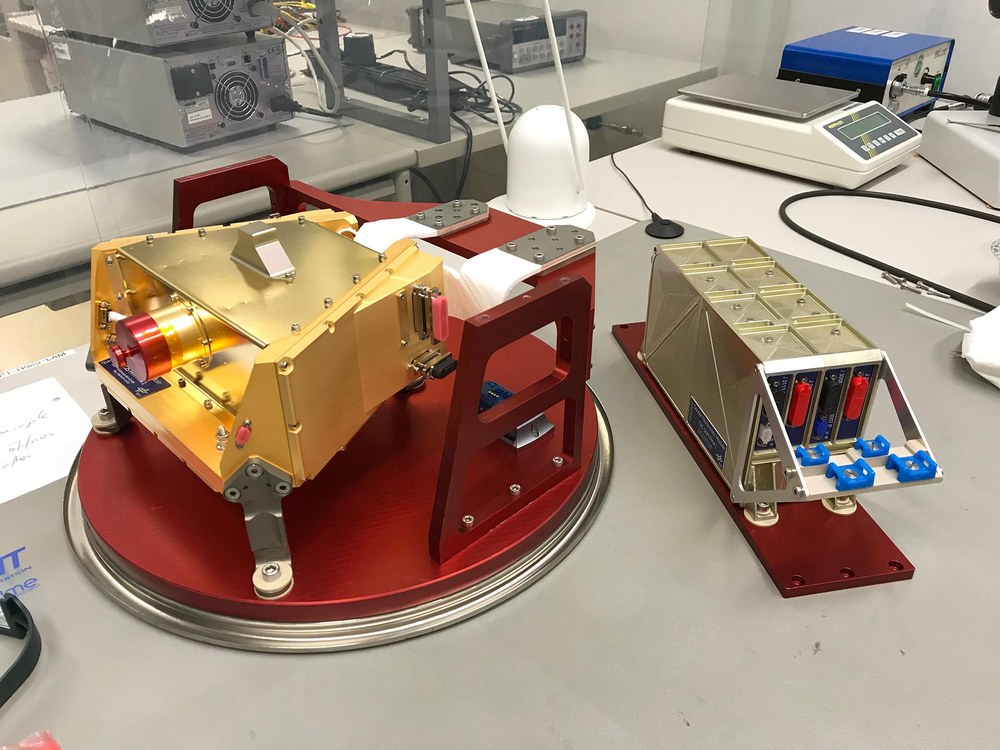
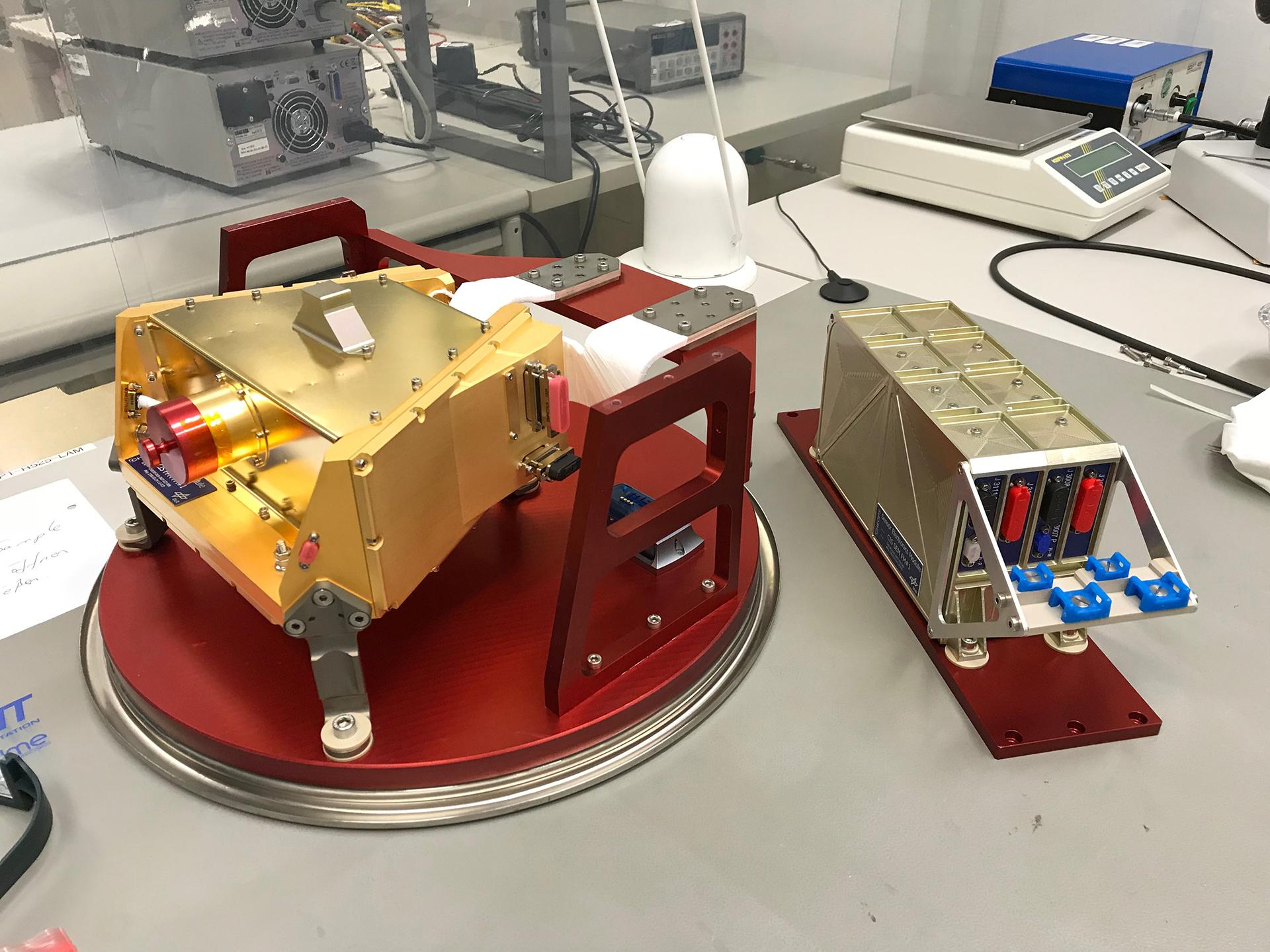
Mid-2013 DLR has been selected to contribute the Focal Plane Module (FPM) where the single CCD detector is integrated. The Institute of Optical Sensor Systems developed this major sub-system together with the Institute of Planetary Research. Both institutes merged in 2025 to form the Institute of Space Research. Furthermore the Berlin based institutes developed the detector electronics and the sensor control electronics (SEM). All these crucial components ensure the performance of the high-precision photometer of CHEOPS.
The required photometric precision is achieved with a single, frame-transfer, back-illuminated CCD detector from Teledyne e2v with 1024 × 1024 pixels and a pixel pitch of 13 µm . The CCD is mounted in the focal plane module of a Ritchey-Chrétien telescope of 32 cm diameter, f/8, on-axis. It will be passively cooled down to -40°C.
Since the depth of planetary transits is approximately 100 parts-per-million (ppm), a photometric precision of 20 ppm (goal: 10 ppm) is required for an integration time of 6 hours which corresponds to the transit duration of a planet with a revolution period of 50 days. Therefore, both the CCD detector and the low noise sensor electronics are thermally stabilized with a precision better than 10 mK.
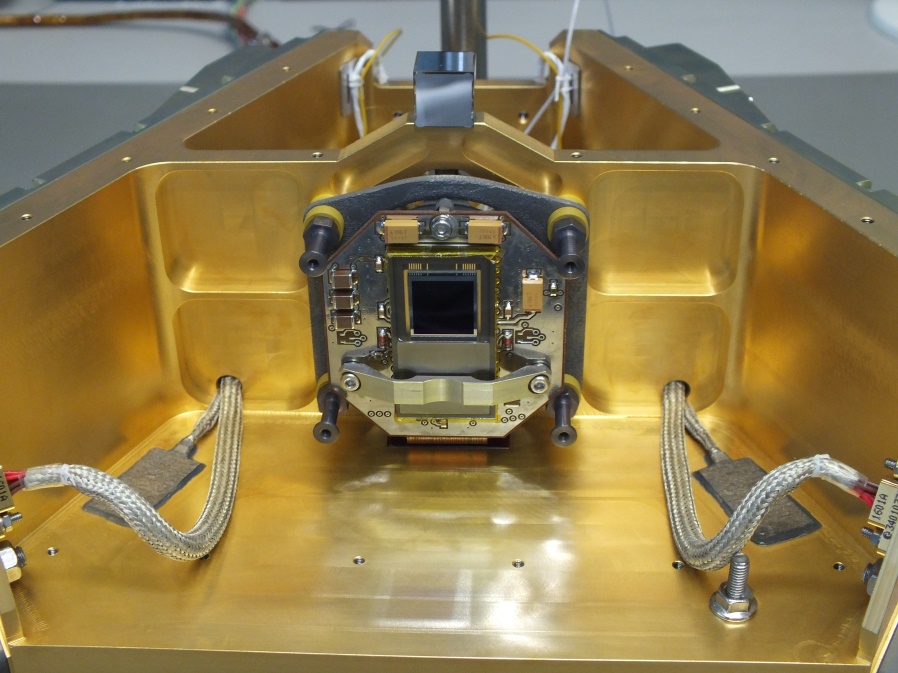
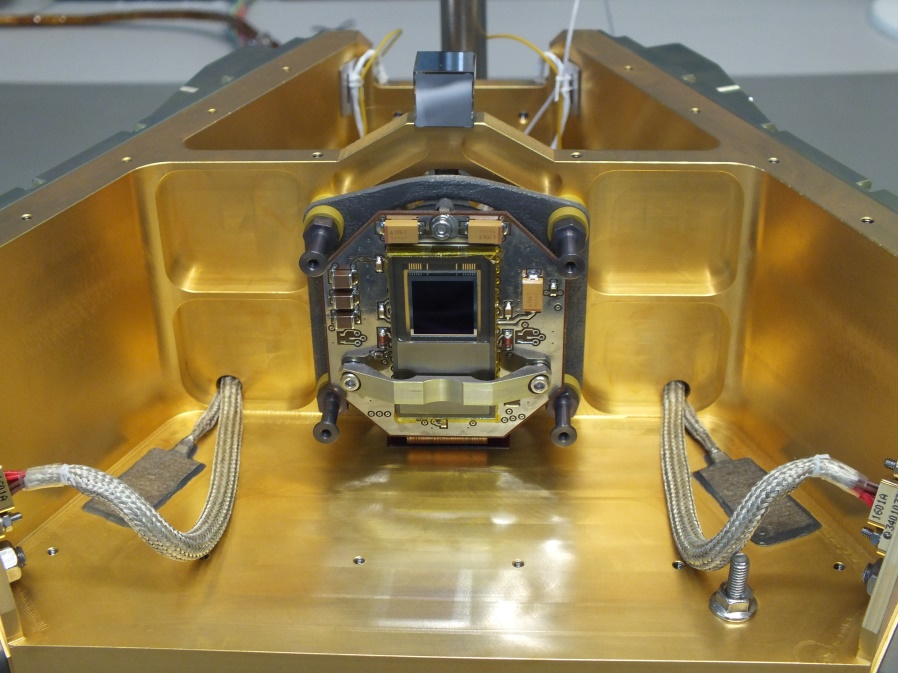
A view of the CCD detector in the focal plane
The CCD detector in the focal plane of the assembly is thermally coupled to a heat sink to dissipate heat.
The demands placed on the thermal stability of the CCD detector and the associated low-noise electronics were enormous. Everything had to be maintained at an operating temperature, with temperature fluctuations not exceeding 1/100 of a degree Celsius. Only under such conditions could CHEOPS achieve its scientific objectives: to measure the brightness of stars with high precision and thereby determine the radii of the planets orbiting them with the utmost accuracy.
The thermomechanical stability of the focal plane module is achieved through high-precision temperature control using a passive cooling element, a radiator, and an active heater. The structure of the focal plane module was manufactured from a special beryllium alloy, which is characterised by very low thermal expansion and low mass. This extremely important module was developed by the German Aerospace Centre (DLR) at its Berlin-Adlershof site.
This highly stable temperature control is not available on the CoRoT satellite, nor will it be available on the PLATO space telescope. For these missions, the temperature fluctuations of the detector are subsequently calculated out of the light curves.