The spectrometer VenSpec-M on EnVision
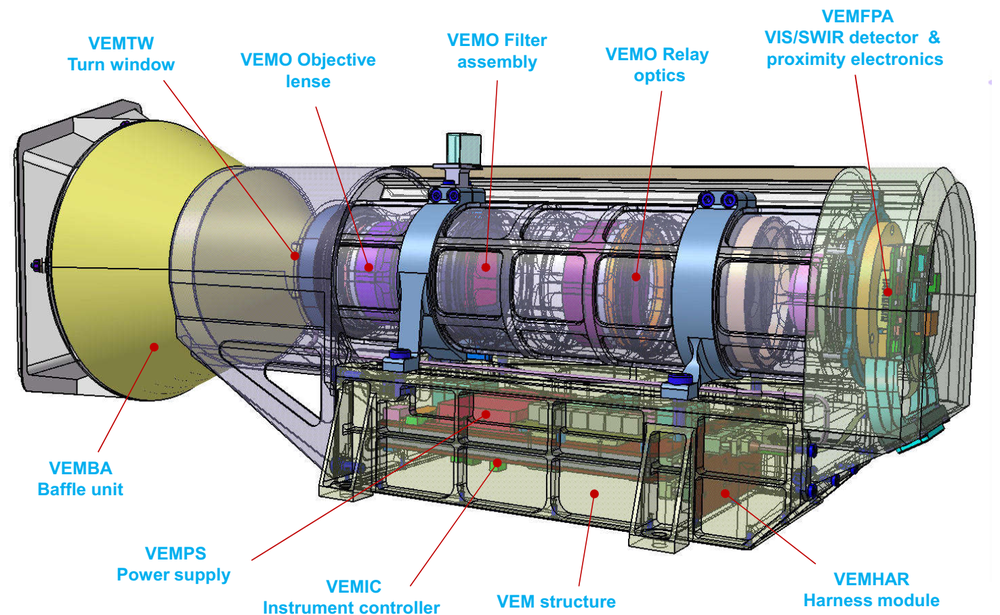

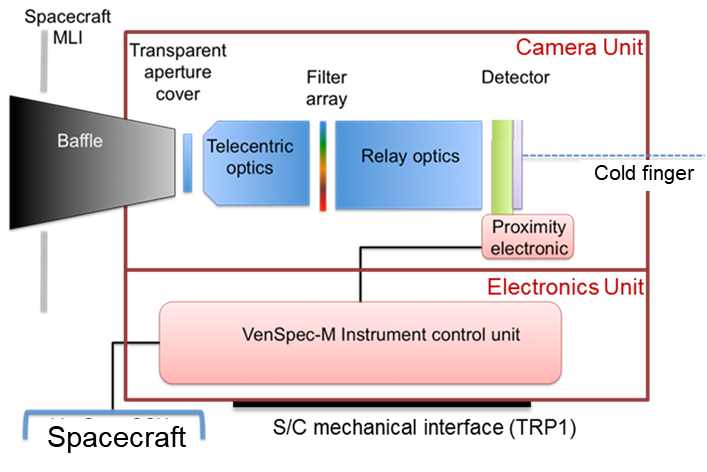
VenSpec-M is a multispectral push-broom imager that measures surface emissivity using six spectral bands across five atmospheric windows. Eight additional spectral bands are dedicated to calibration and the detection of near-surface water vapour. The instrument builds on the measurement technique pioneered by VIRTIS onboard Venus Express (VEX), incorporating improvements in sensitivity as well as spectral and spatial coverage.
Its optical and electronic design includes several features to ensure high measurement performance. A filter array, rather than a diffraction grating, provides approximately five times greater stability in wavelength calibration (band centre and bandwidth) while maximising the signal reaching the focal plane array (FPA). A two-stage baffle reduces stray light, further improving sensitivity. The highly integrated InGaAs detector, with 1280 × 768 pixels and a thermoelectric cooler (TEC), eliminates the need for cryogenic cooling. Its thermal stabilisation ensures a high signal-to-noise ratio (SNR) across the wavelength range from 0.8 to 1.6 µm. A rotating protective window shields the optical entrance from contamination during the aerobraking phase. Telecentric optics project the spectral lines onto the detector, while the instrument electronics and onboard processing unit manage the system, including instrument control, data processing and compression. The development and scientific implementation of VenSpec-M are coordinated by the DLR Institute of Space Research (WR). The institute is responsible for the scientific definition of the instrument, the development and validation of its scientific data-processing algorithms, and the preparation of scientific operations. This work is carried out in close collaboration with international partners to ensure that the instrument and its scientific data products meet the requirements of the EnVision mission.
EnVision is an ESA mission dedicated to the comprehensive investigation of Venus. Its main objective is to improve our understanding of the planet's geological evolution, internal structure, and the interactions between its surface, atmosphere, and interior. The mission is currently planned for launch in 2031.