

Loading
EnVision
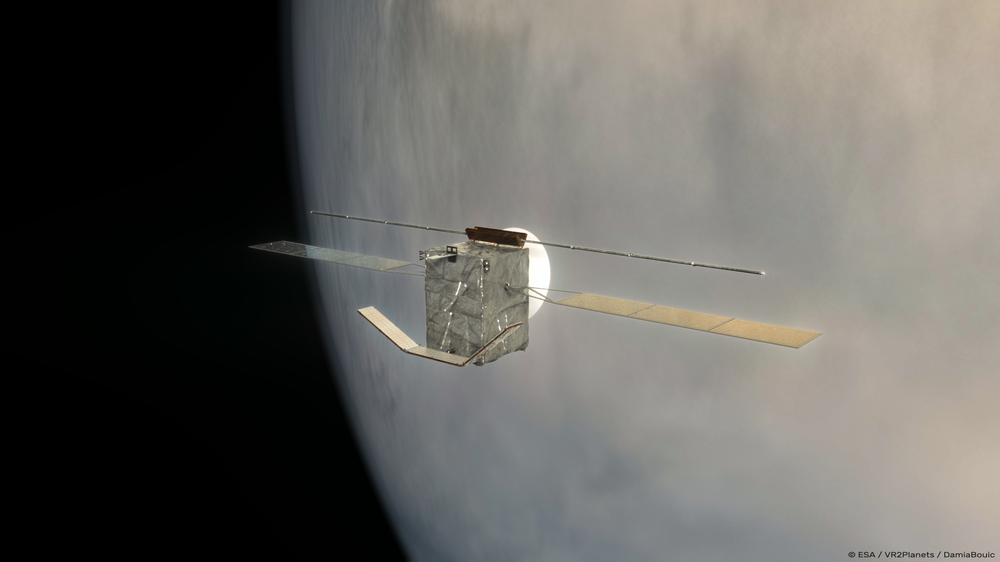
EnVision is an ESA Venus orbiter mission planned for launch in 2031 that will determine the nature and current state of Venus’ geological evolution and its relationship with the atmosphere, in order to understand how and why Venus and Earth evolved so differently. Located at the inner edge of the habitable zone, Venus may once have had abundant liquid water and potentially conditions suitable for life before developing the runaway greenhouse effect that rendered it uninhabitable today. Venus therefore provides a natural laboratory for understanding planetary evolution and the conditions that control habitability.
Geologically, Venus is Earth’s closest sibling. Similar in size and bulk composition, it appears to have remained active into the present era, unlike the smaller terrestrial planets Mars and Mercury. However, Venus today lacks mechanisms that on Earth regulate atmospheric CO₂, such as sequestration in carbonate rocks and plate tectonics, although these processes may have existed in the past. With limited sinks for volcanically emitted gases, Venus developed its present dense atmosphere, while its geological and climatic history remains poorly constrained. Studying Venus is therefore essential for understanding the links between planetary geophysical evolution and habitability—both within our Solar System and for terrestrial exoplanets.
To address these questions, EnVision carries a comprehensive suite of instruments: the VenSAR dual-polarisation S-band radar, also operating as a microwave radiometer; the Subsurface Radar Sounder (SRS) to probe the shallow subsurface; and the VenSpec spectrometer suite consisting of VenSpec-M, VenSpec-U and VenSpec-H to investigate the surface and atmosphere. These measurements are complemented by a radio science investigation that will provide gravity mapping and atmospheric profiling through radio occultations. Together, these observations will link surface geology, interior geophysics, and atmospheric processes to reveal how and why Venus evolved so differently from Earth.
The DLR Institute of Space Research contributes key hardware and scientific leadership to the mission.
VenSpec-M is designed to map the surface composition of Venus by observing thermal emission from the surface through near-infrared atmospheric windows around 1 µm.
Its development is led by the DLR Institute of Space Research responsible for the instrument design, manufacturing, assembly and verification. The Institute also leads the scientific definition, calibration, validation and future scientific operation of the instrument.
The optical system, including the spectral filter assembly, is provided through a French contribution from the Centre National d'Études Spatiales (CNES) and the Laboratoire d’Études Spatiales et d’Instrumentation en Astrophysique (LESIA).
Technically the VenSpec-M instrument bases on the VEM instrument for the NASA space mission VERITAS with almost identical technical parameters, see further information here.
News
Links
Contact
Dipl.-Ing. (FH) Gisbert Peter
Department Head
Institute of Space Research
Space Instruments
Rutherfordstraße 2, 12489 Berlin-Adlershof
Dr David Krutz
Head of Department Space Instruments
Institute of Space Research
Optical Sensors and Electronics
Rutherfordstraße 2, 12489 Berlin-Adlershof
Dr. Alessandro Maturilli
Department Head
Institute of Space Research
Planetary Laboratories
Rutherfordstr. 2, 12489 Berlin