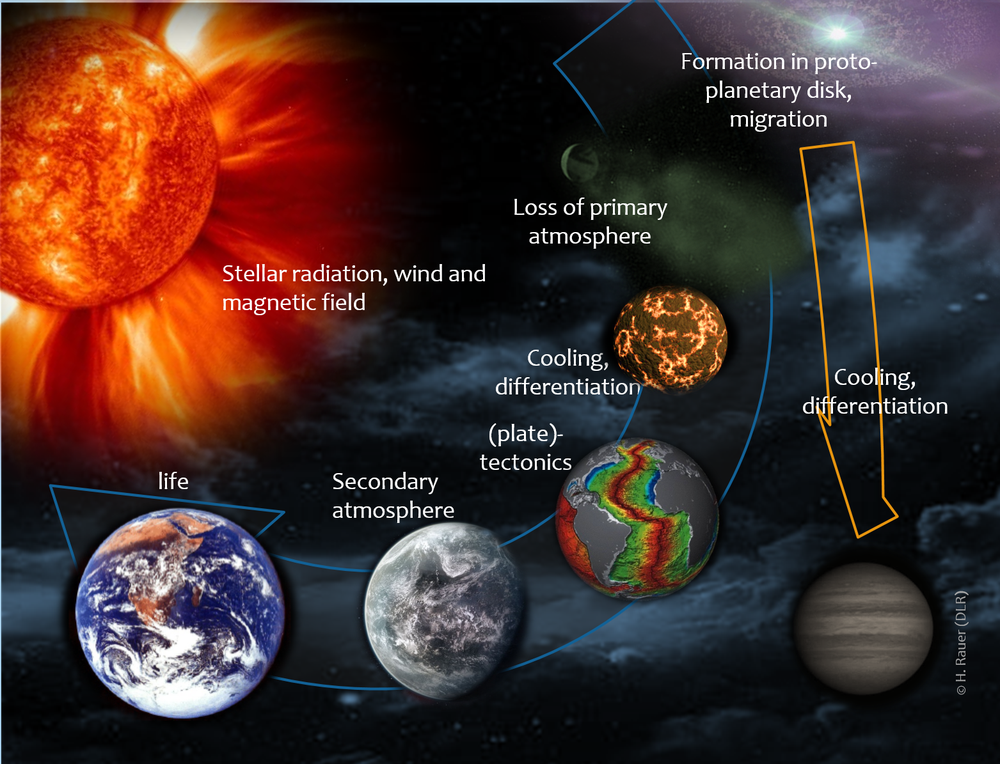
Artist’s impression of the formation and evolution of a planet
Planets also form within the cloud of gas and dust from which a star is born, and they go through various stages of development.
Credit:
DLR
PLATO will fundamentally expand our understanding of the formation and evolution of planetary systems. The stated objectives are
To discover terrestrial exoplanets in the habitable zone of Sun-like stars and characterise the properties necessary to determine their habitability.
To characterise hundreds of rocky planets, ice giants or gas giants, including the architecture of their planetary systems, in order to fundamentally improve our understanding of the formation and evolution of planetary systems.
To achieve this, both the search for planets using the space telescope and follow-up observations with ground-based telescopes are required.
Discovering planets using the transit method and determining their radius (3% accuracy)
Determining planetary masses (accuracy better than 10%) using ground-based radial velocity measurements,
Determining the ages (10% accuracy) using asteroseismology,
Identifying planets orbiting bright stars for atmospheric spectroscopy.