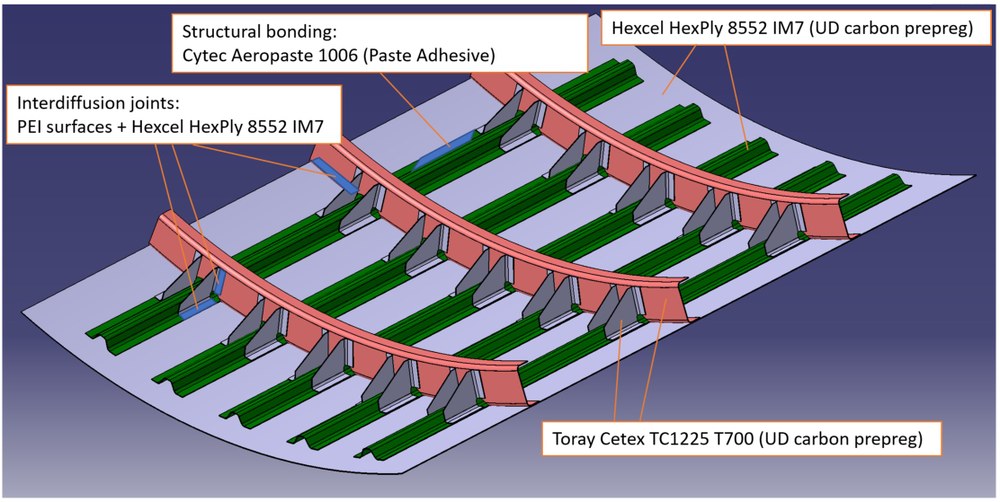
Hybrid construction of the fuselage structure of a future regional aircraft using carbon fibre reinforced plastic (CFRP)
with a thermosetting matrix for the outer skin and thermoplastic and thermosetting matrices for the stiffening elements.
Image: 1/2, Credit:
DLR
TRL-pyramid
Image: 2/2, Credit:
DLR
Duration: 2024–2027
Lightweight construction for the aviation of tomorrow: hybrid CFRP structures for low-emission regional aircraft
The EU research project HERFUSE is developing innovative fuselage and tailplane structures for the next generation of hybrid-electric regional aircraft. The focus is on the seamless integration of new energy sources and complementary systems into lightweight-optimised aircraft structures – with the aim of significantly reducing greenhouse gas emissions in regional air transport.
As part of HERFUSE, the DLR is conducting research into CFRP-CFRP hybrid construction methods: outer skins made of carbon fibre-reinforced plastic with a thermosetting matrix are combined with stiffening elements that utilise both thermoplastic and thermosetting matrix systems. To ensure scalable and efficient production, suitable component manufacturing processes and material-specific joining technologies are being developed – from material characterisation through to joining techniques suitable for series production.
Why hybrid CFRP construction methods? Lightweight construction meets climate protection
The aviation industry faces the challenge of delivering significantly lower-emission regional aircraft by 2035. Hybrid propulsion concepts – combining conventional engines with electric powertrains – promise considerable efficiency gains, but place new demands on fuselage structure, weight, volume and thermal management.
HERFUSE addresses these challenges with a holistic approach: the project simultaneously optimises the weight, volume, safety, flexibility and sustainability of the fuselage and tail structure. CFRP-CFRP hybrid construction methods allow the targeted combination of the advantages of thermosetting and thermoplastic fibre-reinforced composites – high stiffness and strength coupled with efficient processability and joining technology suited to the materials.
DLR’s contribution: From material development to pressing and joining technology
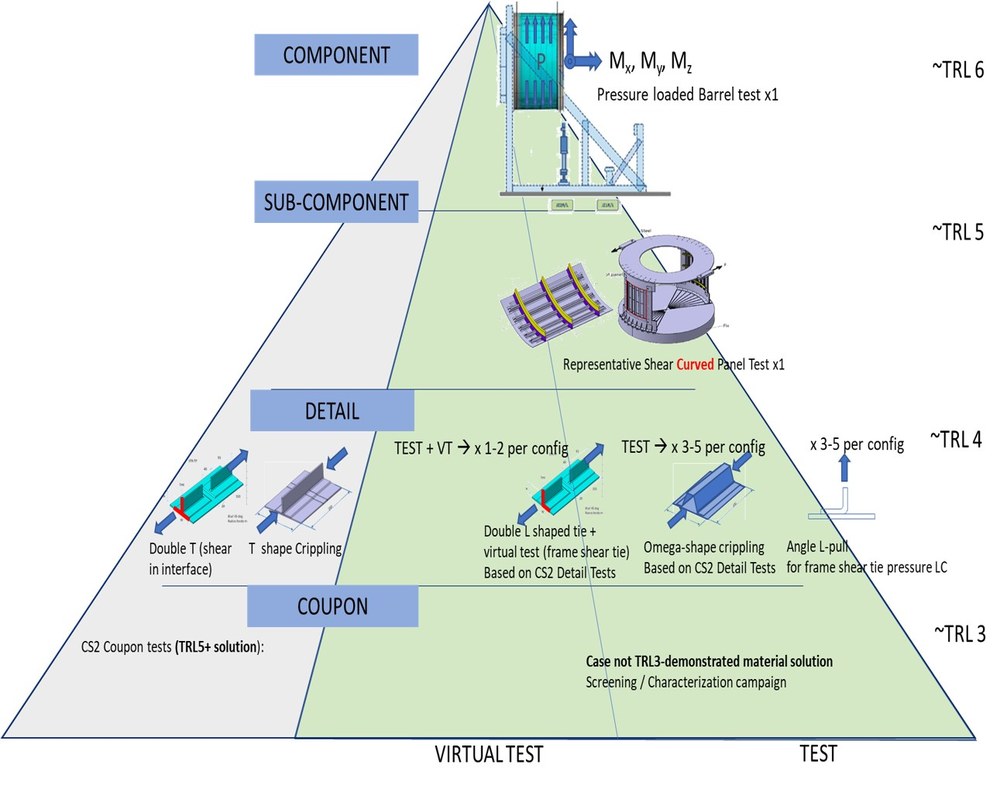
Within the HERFUSE project, DLR is developing the technological basis for CFRP-CFRP hybrid fuselage structures through implementation on a scaled-up fuselage demonstrator. The path to this begins with fundamental tests (comparable to Technology Readiness Level 3, or TRL3 for short), followed by further manufacturing and analysis steps at a detailed level (comparable to TRL4), right through to the demonstrator shown here (comparable to TRL5).
The research work is divided into three main areas:
▸ Hybrid construction methods: Development of fuselage structures in which the outer skin (thermoset CFRP matrix) and stiffening elements (thermoplastic and thermoset CFRP matrix) are optimally matched. This hybrid strategy offers weight and manufacturing advantages over conventional single-material solutions.
▸ Manufacturing processes: Design and validation of suitable manufacturing processes for hybrid CFRP composite structures – from preform production to consolidation – with a view to subsequent scalability in series production.
▸ Joining technologies: Development of material-specific joining processes for combining thermoset and thermoplastic CFRP components. These joining technologies are a key prerequisite for the structural integrity and certifiability of the complete assembly.
Project objectives and expected results
HERFUSE pursues two overarching technical objectives: the development of an innovative fuselage and tail unit design for hybrid-electric regional aircraft, and the demonstration of core technologies and associated manufacturing technologies with a high level of technological maturity (comparable to TRL5).
Integration into the European Clean Aviation Strategy
HERFUSE is closely linked to the HERA (Hybrid Electric Regional Aircraft) project and provides quantitative data and technological building blocks for system-level whole-aircraft studies. The project forms part of the European Union’s Clean Aviation Initiative and contributes to achieving the environmental targets for regional aircraft by 2035 as defined in the Strategic Research and Innovation Agenda (SRIA).
Through active collaboration with European partnerships for Clean Aviation, HERFUSE ensures that its results are seamlessly integrated into overarching sustainability initiatives within the aviation industry.
Funding
The HERFUSE project is supported by the Clean Aviation Joint Undertaking and its members, and is funded by the European Union under Grant Agreement No. 101140567. The views and opinions expressed are solely those of the authors and do not necessarily reflect the views of the European Union or the Clean Aviation Joint Undertaking.